Trivia Night Marketing Strategy for Packed Venues
Slow weeknights leave even the most vibrant venues searching for ways to fill seats and energize regulars. Trivia night events powered by interactive software offer a fresh solution, transforming your bar or restaurant into a lively gathering spot and giving customers a reason to return. From setup with Quizado to targeted promotions and multi-channel outreach, you'll discover how professional trivia tools create engaging experiences that boost attendance and build lasting loyalty.
Table of Contents
- Step 1: Set Up Trivia Events With Quizado Software
- Step 2: Develop Targeted Promotions And Incentives
- Step 3: Promote Trivia Night Across Multiple Channels
- Step 4: Engage Attendees And Gather Feedback
- Step 5: Evaluate Results And Refine Your Approach
Quick Summary
| Key Point | Explanation |
|---|---|
| 1. Simplify Event Setup | Use Quizado software to easily host trivia nights without complex setups and rely on games that run on Quizado's servers. |
| 2. Create Targeted Promotions | Design promotions based on audience preferences to increase participation and build a loyal customer base. |
| 3. Promote Across Multiple Channels | Utilize social media, email, and local advertising to reach diverse audiences for better event turnout. |
| 4. Engage Attendees Actively | Foster interaction during events to enhance the experience and encourage repeat attendance. |
| 5. Evaluate Results Continuously | Track performance metrics and feedback to refine your approach for future trivia nights, ensuring ongoing success. |
Step 1: Set Up Trivia Events with Quizado Software
Setting up your first trivia event with Quizado is straightforward, even if you've never hosted before. You'll move from installation to a fully functioning game show in minutes, not hours.
Start by downloading the Quizado app for your venue's operating system. Whether you're running macOS, Windows, Linux, Android, or iOS, the native application installs directly on your host device. No complex cloud setup required. Every game also runs on Quizado's servers, so a reload or a device switch keeps the night going, which matters in bars and restaurants where WiFi can be unreliable.
Once installed, open the app and you'll immediately see the host control interface. This is where all your magic happens. You control the game, questions, scoring, and contestant displays from this single screen.
Configure your basic settings:
- Choose your visual theme (modern or retro aesthetics)
- Upload your bar or restaurant logo for branded displays
- Select the number of teams competing
- Set team sizes based on your venue's table arrangement
Quizado handles the heavy lifting of game management, while event management software helps organize guest lists and attendee data for promotion and registration. Your focus shifts to hosting, not administration.
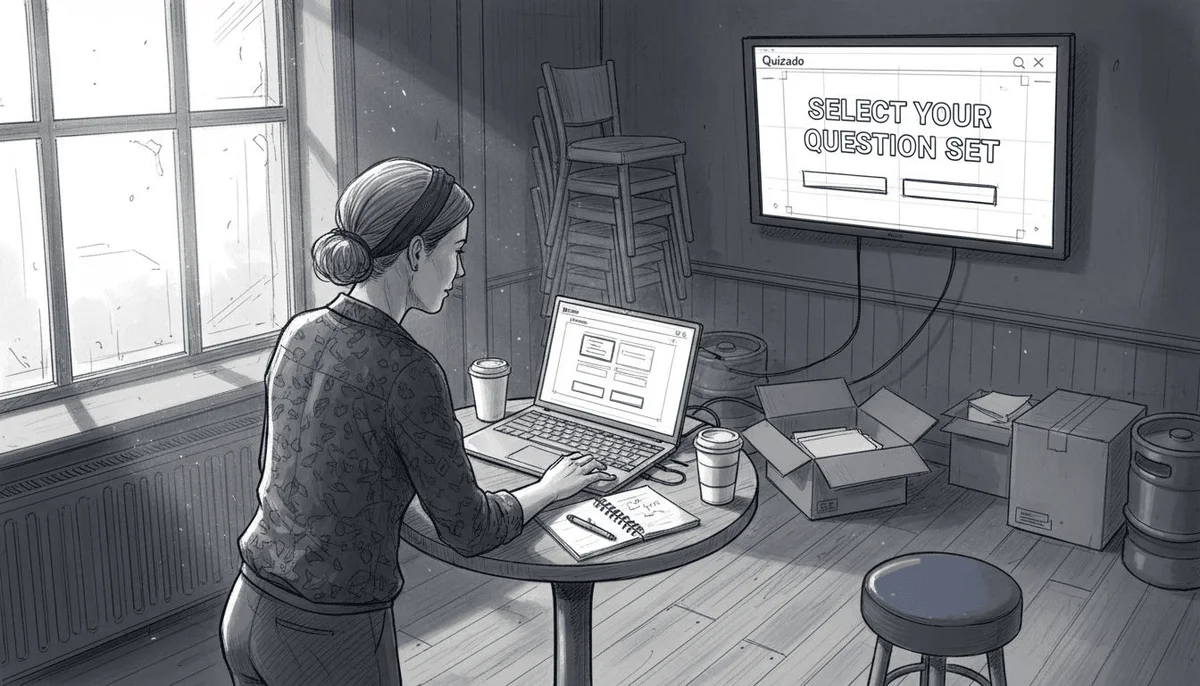
Next, select your question set. Quizado offers over 500 hours of ready-made content across countless categories and difficulty levels. Browse the library and pick a set matching your audience's interests and knowledge level. Want custom questions about your venue or local trivia? Create them directly in the app.
Your contestants will use their smartphones as wireless buzzers and remote controls. They don't download anything. Instead, display the connection code on your main screen, and teams scan it or enter a PIN using their phones. This eliminates clunky physical buzzers and the chaos that comes with them.
Test everything before your first event starts. Run through a practice round with your staff. Make sure contestant phones connect properly, the host screen displays correctly, and sound levels work for your space.
The difference between a smooth trivia night and a chaotic one often comes down to this single step: testing everything beforehand.
Pro tip: Run your first event with a smaller group or during a soft opening. This gives you experience with Quizado's interface before hosting a full crowd, and you'll catch any venue-specific issues like WiFi dead zones or display positioning problems.
Here's a summary of how Quizado software benefits trivia event hosts:
| Feature | Host Benefit | Business Impact |
|---|---|---|
| Server-run games | Survive a reload or a device switch | Scores stay safe if a device drops |
| Custom team configuration | Fits any venue size | Better player experience |
| Branded display options | Venue logo on screen | Reinforces brand identity |
| Smartphone buzzer integration | No physical buzzers needed | Reduces equipment costs |
| Pre-made & custom questions | Wide topic variety | Appeals to diverse audiences |
Step 2: Develop Targeted Promotions and Incentives
Targeted promotions turn casual bar-goers into loyal trivia night regulars. Your goal is to create offers that speak directly to your audience and motivate them to show up week after week.
Start by identifying who you want to attract. Are you targeting after-work professionals looking for weeknight entertainment? University students? Neighborhood regulars? Your promotion strategy shifts based on these groups. A happy hour discount appeals differently than a "bring three friends, get one free entry" offer.
Design promotions around your venue's needs:
- Offer discounts on food or drinks for trivia participants
- Create a "season pass" for regular attendees (discounted entry for 8 weeks)
- Give free entries to early arrivals or first-time players
- Run themed trivia nights with costume prizes
Research shows that well-designed incentive programs increase participation by aligning rewards with what your audience actually values. Don't guess. Ask yourself: what makes your customers tick? Free appetizers matter more to some groups than entry discounts do.
Prizes matter more than you might think. Offer something meaningful, not generic. Local gift cards, bottles of premium spirits, free meal vouchers, or even cash pooled from a tournament entry fee. Sales promotions and contests effectively encourage participation when the payoff feels real.
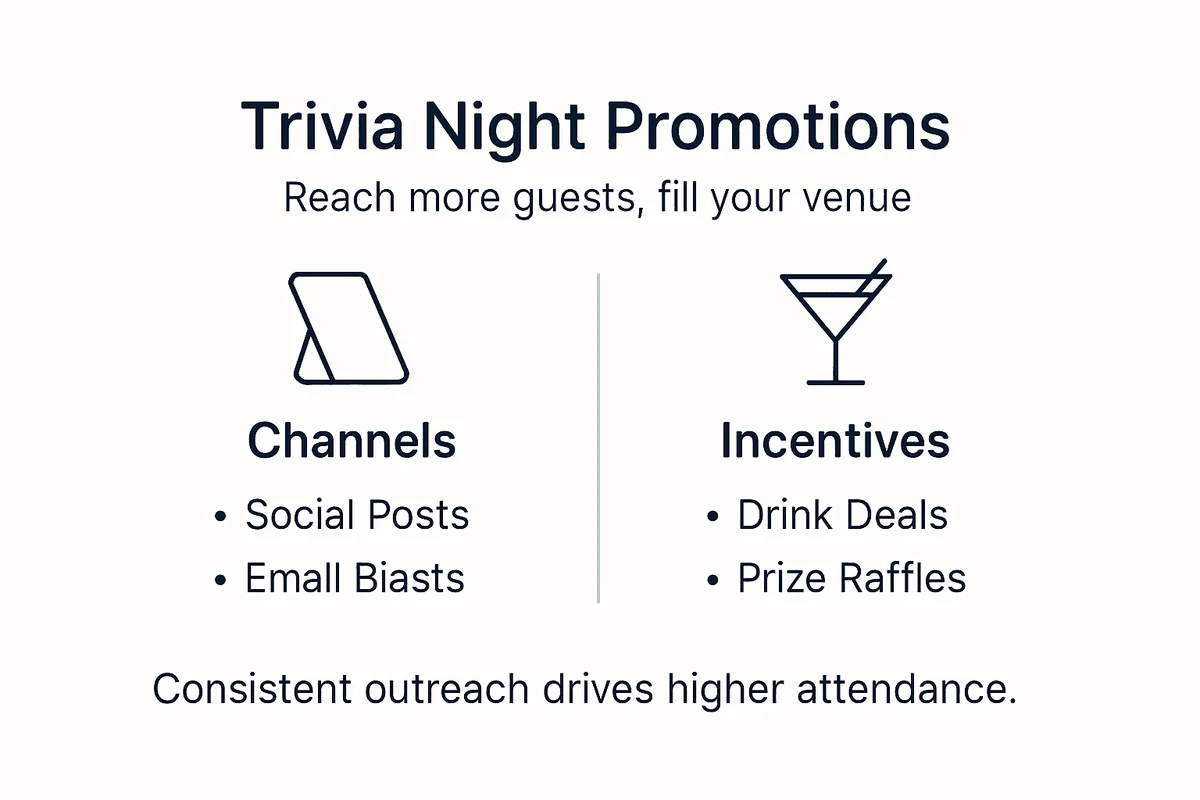
Promote strategically across channels where your audience actually spends time. Social media posts work for younger crowds. Email newsletters work for regulars. Local community boards work for neighborhood players. Timing matters too. Post promotions three weeks out for big events, one week out for regular nights.
Measure what works. Track which promotions fill seats and which fall flat. A 30 percent discount might not outperform a free appetizer offer. Let your data guide next month's strategy.
The most powerful promotion isn't always the biggest discount. It's the one that makes people feel like they're getting insider access to something special.
Pro tip: Create a simple referral incentive where existing players get a free entry for each new team they bring. Your best marketing comes from satisfied customers who become your event ambassadors.
This table compares promotional strategies and their likely effectiveness for trivia nights:
| Promotion Type | Best Audience | Typical Incentive | Expected Outcome |
|---|---|---|---|
| Social media posts | Young adults, students | Prizes, entry discounts | Wider online reach |
| Email newsletters | Repeat/local customers | Special reminders, VIP perks | Higher return attendance |
| Posters & flyers | Walk-in and local traffic | Event info, QR code access | Increased neighborhood turnout |
| Referral incentives | Existing satisfied players | Free entries for referrals | New teams from word-of-mouth |
Step 3: Promote Trivia Night Across Multiple Channels
One promotion channel rarely fills a room. You need to meet your audience wherever they are, whether that's on their phones, in their email inbox, or on physical bulletin boards around town.
Start with social media, the obvious choice for reaching younger crowds and regulars who follow your venue online. Post about your trivia night at least twice weekly on Instagram, Facebook, and TikTok. Show clips from past events, highlight prizes, announce special themes. Make it look fun and worth their time.
Don't forget email newsletters. Loyal customers who've visited before are your easiest sell. Send a reminder email three days before each event with the date, time, entry fee, and what makes this week's trivia special.
Multiple promotion channels including social media and email newsletters efficiently create awareness among diverse audiences. Blend online and offline tactics for maximum reach.
Your offline tactics matter just as much. Print colorful posters and place them in high-traffic areas: bathrooms, near the bar, at the entrance. Create a simple community board presence by posting flyers at nearby coffee shops, gyms, and workplaces. Local players discover events through physical reminders.
Use these channels strategically:
- Social media for younger, tech-savvy crowds and frequent guests
- Email for existing customers who trust your venue
- Posters for walk-in traffic and neighborhood awareness
- Local partner networks if you have relationships with nearby businesses
- Word-of-mouth by rewarding players who bring friends
Timing your promotions matters. Push hardest two weeks before launch. Then maintain weekly reminders leading up to the event. The day-of announcement should feel like a final call, not breaking news.
Track which channels drive actual attendance. Ask new players how they heard about your event. Maybe your Instagram posts convert better than email, or your posters drive more foot traffic. Let this data shape next month's promotional focus.
The best promotion channel is the one your specific audience actually uses. One bar's social media goldmine is another bar's wasted effort.
Pro tip: Create a simple QR code on your poster that links directly to your event details, ticket purchase, or reservation system. This bridges the gap between offline discovery and immediate online action, capturing interested players before they forget.
Step 4: Engage Attendees and Gather Feedback
Engagement during the event itself determines whether players return. A room full of passive spectators generates no buzz. A room where everyone feels invested and heard builds loyalty that lasts.
Start by creating interactive moments beyond just answering questions. Encourage teams to celebrate correct answers loudly. Announce team names with enthusiasm. Make fun of wrong answers in a playful way. Ask teams between rounds what they're enjoying most. These moments transform trivia from a solo activity into a shared experience.
Involving players in the action matters enormously. Effective engagement strategies include providing opportunities for interaction and active participation, which increase satisfaction and motivation. When attendees feel part of something larger, they stay longer and return sooner.
During the event, watch for energy dips. If excitement flatlines, switch up the format. Jump to a different category. Offer a surprise bonus round. Play upbeat music between questions. Small adjustments keep momentum alive.
Gather feedback while the experience is fresh. Hand out simple paper surveys at the end of the night, or use your phone to snap a quick poll. Ask these questions:
- What was your favorite moment or round?
- What should we change for next time?
- Would you bring a team back next week?
- Any specific trivia topics you want to see?
Anonymous surveys and focus groups capture diverse perspectives from your attendees. Make it easy. Keep surveys to three to five questions. Offer a small incentive for completing one, like entry into a prize drawing.
Review feedback before your next event. Look for patterns. Maybe multiple teams requested sports trivia. Maybe everyone said the music was too loud. Act on these insights visibly. When you make changes based on feedback, mention it next time: "You asked for more music rounds, so here we go."
This closes the loop. Players see their voices matter. That feeling converts one-time guests into regulars.
Feedback isn't just data to collect. It's your roadmap for turning a one-time event into a weekly tradition.
Pro tip: Keep a simple notebook with each week's feedback noted by date. Over two months, you'll spot trends impossible to see week-to-week, revealing which changes actually drive better attendance and satisfaction.
Step 5: Evaluate Results and Refine Your Approach
One successful trivia night doesn't guarantee the next one will be packed. You need to measure what worked, what didn't, and adjust accordingly. This is where your strategy becomes sustainable.
Start by tracking concrete numbers. Count actual attendance. Record revenue from entry fees and drink sales. Note how many teams showed up and how many people per team. Document whether you hit your targets or fell short.
Evaluating key performance indicators and feedback assesses event success and areas of improvement/Version-2/A5320107.pdf). Beyond attendance, measure engagement quality. Did teams stay the entire event or leave early? Were they checking phones or focused on the game? Did they laugh and celebrate? These observations matter as much as headcount.
Compare your results against your original goals. Did you want to fill 10 tables? Did you achieve it? Were you targeting a specific demographic and miss them? Did your promotion strategy actually work, or did one channel drive all the traffic?
Analyze which decisions moved the needle:
- Which promotion channel brought the most people?
- What entry price point maximized attendance?
- Which trivia categories generated the most excitement?
- Did your prize incentives drive participation?
- What time slot worked best for your audience?
Gather all feedback sources together. Review survey responses. Remember conversations with attendees. Combine this with your attendance data. Patterns emerge quickly. Maybe your 8 PM start time attracts fewer people than 7 PM. Maybe free appetizers convert better than drink discounts.
Results-based management emphasizes continuous monitoring of progress through data and stakeholder feedback. Use this intelligence to refine your next event. Change one or two elements, then measure again. This iterative cycle compounds improvement over time.
Document your findings. Create a simple spreadsheet tracking attendance, revenue, feedback themes, and what you changed each week. After three months of data, you'll see exactly which adjustments drive results.
The venue that fills seats week after week isn't lucky. It's systematic about measuring results and acting on them.
Pro tip: Create a before-and-after comparison sheet. List what you changed from week one to week four, and measure attendance growth alongside those changes. This visual proof motivates your team and guides future decisions with confidence.
Elevate Your Trivia Night Marketing with Quizado
Struggling to keep your venue packed night after night with engaging trivia events is a common challenge. This article highlights the importance of targeted promotions, multi-channel outreach, and seamless event hosting to transform casual players into loyal regulars. Quizado’s interactive software addresses these key pain points by offering professional-quality game show experiences with customizable branding and smartphone-based buzzer systems. By integrating your promotions with Quizado’s broad ready-made question libraries and server-run reliability, you can captivate diverse audiences and avoid technical issues that disrupt momentum.
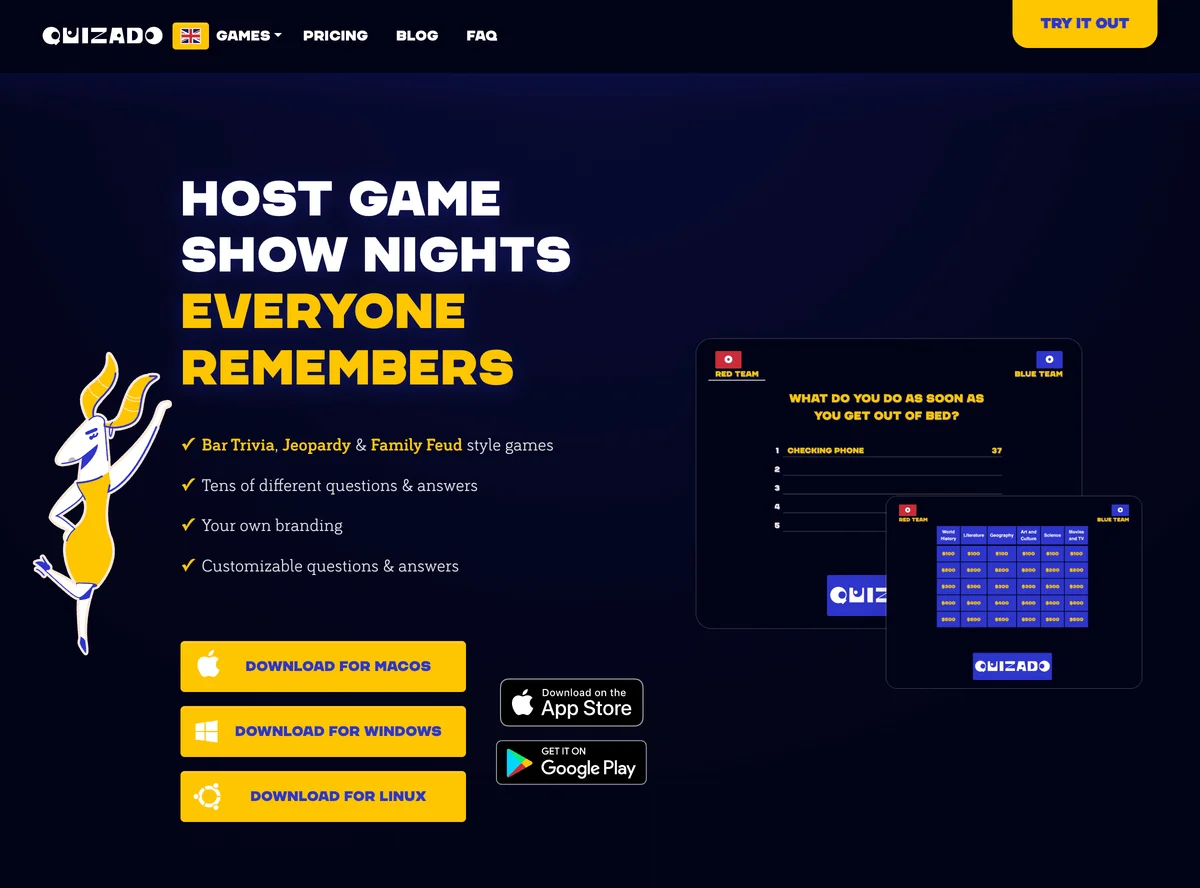
Ready to boost attendance and enhance player engagement with a cutting-edge platform? Explore how Quizado supports unique themes like Food trivia nights and makes hosting smooth regardless of your venue’s WiFi. Visit Quizado today to start on the free plan and turn your marketing strategy into packed, unforgettable trivia events.
Frequently Asked Questions
How can I promote my trivia night to attract more attendees?
Start by utilizing multiple marketing channels—social media, email newsletters, and local flyers are effective. Post engaging content regularly, such as event highlights or upcoming themes, at least twice weekly to maximize reach.
What types of promotions work best for trivia night events?
Design promotions tailored to your audience, such as discounts on food and drinks for participants, or themed trivia nights with costume prizes. Test various incentives, like offering free entries for referrals, to see what resonates most with your crowd.
How do I engage attendees during trivia nights to encourage repeat visits?
Create interactive moments by encouraging teams to celebrate answers and providing opportunities for playful banter. Keep the energy high and solicit feedback during and after the event to make players feel involved and valued.
What metrics should I track to evaluate the success of my trivia night?
Monitor attendance numbers, entry fees collected, and participant engagement levels. Document the data weekly and analyze patterns to adjust your marketing strategy effectively—aim to review these metrics after each event.
How often should I test my trivia night setup before launching?
Conduct a full test run at least a week before the event. This should include a mock trivia night with staff participation to identify any technical issues or venue-specific challenges that need addressing before the actual event.
Recommended
Run your next trivia night with Quizado
Prepare the rounds, invite players by QR code and show live scores on your venue’s screen.
Bring your group together for a game
Try a free starter game, then choose the format and plan for your group.
Trusted by 5,000+ hosts