Fun Quiz Game Strategies Explained: Team Success Tips
More than 60 percent of american workplaces now use interactive quiz games to boost team engagement. Companies everywhere are rethinking the way employees learn, collaborate, and build trust. When quiz games move beyond simple trivia, teams experience greater creativity and deeper learning. This guide breaks down the strategies and concepts that help transform any american quiz game from a basic activity into a memorable team-building powerhouse.
Table of Contents
- Defining Fun Quiz Game Strategies And Concepts
- Popular Quiz Game Types For Teams
- Effective Tactics For Team Engagement And Success
- Common Mistakes And How To Avoid Them
- Expert Recommendations For Corporate Quiz Events
Key Takeaways
| Point | Details |
|---|---|
| Importance of Game Design | Effective quiz games blend playful elements with learning to enhance participant engagement and motivation. |
| Team Dynamics Matter | Diverse teams, with balanced skills and personality types, foster creativity and improve problem-solving. |
| Avoid Common Errors | Organizers should focus on clear, appropriately challenging questions and equitable team composition to maintain engagement. |
| Strategic Planning is Key | Successful quiz events require careful preparation, alignment with organizational goals, and post-event analysis for continuous improvement. |
Defining Fun Quiz Game Strategies and Concepts
Team quiz games transform traditional learning and engagement into dynamic, interactive experiences that spark creativity and collaboration. Game design strategies have evolved dramatically, moving beyond simple question-and-answer formats into sophisticated engagement tools that leverage psychology and interactive learning principles.
At the core of successful quiz game experiences is understanding how play intersects with knowledge acquisition. Research exploring crowdscience game mechanics reveals that strategic game design can dramatically enhance participant motivation and learning outcomes. By integrating playful elements with substantive content, teams can create immersive experiences that feel less like work and more like an exciting challenge.
Effective quiz game strategies typically involve several critical components:
- Team Composition: Balancing skills and personalities
- Question Diversity: Creating multi-dimensional challenge sets
- Scoring Mechanisms: Designing fair and motivating point systems
- Interactive Elements: Incorporating multimedia and real-time engagement
Interactive game formats like cybersecurity education simulations demonstrate how thematic approaches can transform complex concepts into engaging experiences. These strategies go beyond traditional learning, creating environments where participants actively participate rather than passively receive information. By treating quiz games as dynamic learning platforms, organizations can unlock powerful team-building and educational opportunities that feel more like entertainment than training.
Popular Quiz Game Types for Teams
Quiz games for teams have evolved into diverse formats that cater to different organizational needs and engagement styles. Team quiz experiences range from traditional knowledge-based challenges to immersive, multimedia-driven interactions that transform learning and collaboration into exciting group activities.
Four primary quiz game types dominate modern team-building and learning environments:
-
Trivia Challenge Games
- Multiple-choice question formats
- Wide range of difficulty levels
- Rapid-fire or timed response structures
-
Theme-Based Quiz Experiences
- Industry or department-specific content
- Storytelling and narrative-driven gameplay
- Contextual learning through interactive scenarios
-
Problem-Solving Quiz Formats
- Complex scenario-based challenges
- Collaborative decision-making requirements
- Critical thinking and strategic planning elements
-
Competitive Team Tournament Styles
- Head-to-head team competitions
- Bracket-style elimination rounds
- Points-based ranking systems
Each quiz game type offers unique advantages for team dynamics. Trivia challenges test general knowledge and quick thinking, while theme-based experiences provide deep, contextual learning opportunities. Problem-solving formats encourage collaborative strategizing, and competitive tournaments spark healthy team rivalry and engagement. The key is selecting a format that matches your team's specific goals, skill levels, and learning objectives.
Effective Tactics for Team Engagement and Success
Successful team quiz game experiences hinge on strategic approaches that maximize participant motivation and collaborative potential. Team dynamics play a crucial role in transforming a simple game into an engaging learning and bonding opportunity that resonates with all participants.

Research exploring team composition strategies reveals that diverse teams demonstrate remarkable performance potential. By deliberately mixing participants with different skills, backgrounds, and perspectives, organizations can create quiz game environments that spark creativity and enhance problem-solving capabilities. The key is balancing individual strengths while maintaining a cohesive group dynamic that encourages mutual support.
Effective team engagement tactics include:
-
Strategic Team Formation
- Balance skill levels across teams
- Mix personality types strategically
- Ensure complementary competencies
-
Communication Protocols
- Establish clear interaction guidelines
- Encourage active listening
- Create safe spaces for idea sharing
-
Motivation Techniques
- Use transparent scoring systems
- Provide meaningful rewards
- Recognize both individual and team achievements
Drawing insights from competitive quiz bowl formats, successful teams implement structured roles and clear answering strategies. These approaches transform quiz games from simple competitions into sophisticated team-building experiences that develop communication skills, strategic thinking, and collective problem-solving abilities. By treating each quiz game as an opportunity for growth, teams can convert playful interactions into powerful learning moments that strengthen organizational culture.
Common Mistakes and How to Avoid Them
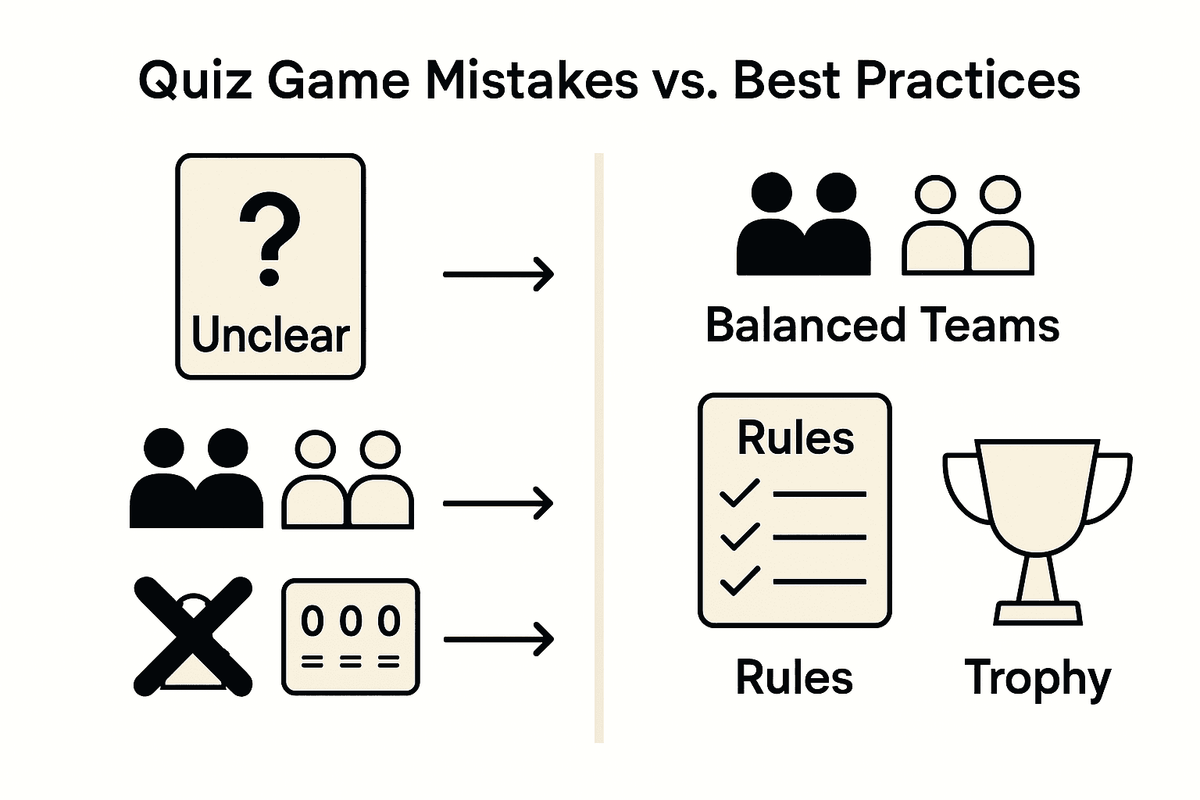
Quiz game experiences can quickly derail when organizers fail to anticipate potential pitfalls that undermine participant engagement and enjoyment. Team game dynamics require careful planning and strategic foresight to prevent common mistakes that can transform an exciting activity into a frustrating experience.
One significant challenge emerges from poorly designed game mechanics that create unnecessary complexity or confusion. Some quiz games inadvertently design questions that are so ambiguous or challenging that they discourage participation rather than stimulate learning. The key is striking a delicate balance between challenging content and achievable difficulty levels that keep participants motivated and intellectually engaged.
Common mistakes to avoid include:
-
Question Design Failures
- Overly complex or vague questions
- Lack of clear scoring criteria
- Unbalanced difficulty across question sets
-
Team Composition Errors
- Uneven skill distribution
- Ignoring personality dynamics
- Failing to rotate team roles
-
Engagement Breakdown
- Monotonous question formats
- Inadequate time management
- Neglecting participant feedback
Drawing insights from strategic game design principles, successful quiz experiences incorporate clear rules and balanced mechanics that prevent confusion and ensure fair play. Effective organizers understand that the game's structure should facilitate interaction, learning, and enjoyment. By anticipating potential disconnects and proactively designing inclusive, dynamic experiences, teams can transform quiz games from potential sources of frustration into powerful tools for collaboration and skill development.
Expert Recommendations for Corporate Quiz Events
Corporate quiz events represent sophisticated team-building opportunities that extend far beyond simple entertainment. Strategic quiz experiences require meticulous planning, nuanced understanding of organizational dynamics, and a sophisticated approach to participant engagement and learning objectives.
Successful corporate quiz events demand careful consideration of multiple interconnected factors. Organizations must design experiences that simultaneously entertain, educate, and foster meaningful team connections. This requires a holistic approach that balances challenging content, interactive gameplay, and strategic learning outcomes.
Key expert recommendations include:
-
Pre-Event Preparation
- Conduct thorough team skill assessments
- Align quiz content with organizational goals
- Create personalized question sets
- Establish clear performance metrics
-
Event Design Principles
- Incorporate diverse question categories
- Balance difficulty across question sets
- Design inclusive participation mechanisms
- Create opportunities for cross-departmental interaction
-
Post-Event Strategy
- Collect comprehensive participant feedback
- Analyze team performance data
- Identify skill gaps and learning opportunities
- Use insights for future team development initiatives
Ultimately, exceptional corporate quiz events transcend mere competition. They serve as powerful diagnostic tools that reveal team dynamics, communication patterns, and collective intelligence. By treating these experiences as strategic learning interventions rather than simple recreational activities, organizations can transform quiz games into meaningful professional development platforms that simultaneously entertain, educate, and unite team members across hierarchical and departmental boundaries.
Elevate Your Team Quiz Success with Customized Game Experiences
The challenge of designing quiz games that truly engage every team member while balancing skill diversity and clear scoring can feel overwhelming. This article highlighted how strategic team formation, varied question formats, and interactive elements create immersive, motivating quiz games that build collaboration and spark creativity. If you want to avoid common pitfalls like unbalanced difficulty and disengagement, leveraging the right tools is essential.
Discover how quizado.com helps you turn these expert strategies into reality. With customizable quizzes inspired by popular game shows like Jeopardy and Family Feud, you can tailor content to your team’s needs, control game pacing, and add branded themes that boost corporate spirit. Whether hosting remote or in-person, our flexible platform supports varied team configurations and rich multimedia to keep players engaged and motivated.
Explore a variety of team-friendly game formats in our free-time category to match your group's style. For solutions that combine entertainment with effective team-building, visit quizado.com today. Start transforming your team quiz events into memorable, rewarding experiences that develop skills and strengthen bonds. Your next successful game awaits.
Frequently Asked Questions
What are the key components of effective quiz game strategies?
Effective quiz game strategies involve team composition, question diversity, scoring mechanisms, and interactive elements. These components enhance participant engagement and learning outcomes.
How can I form balanced teams for quiz games?
To form balanced teams, consider mixing skill levels, personality types, and complementary competencies. This approach maximizes creativity and problem-solving capabilities within the group.
What common mistakes should I avoid when organizing quiz games?
Common mistakes include poorly designed questions, uneven team composition, and inadequate engagement strategies. Aim for clear questions, balanced team dynamics, and varied question formats to maintain participant interest.
What are some effective tactics to enhance team engagement during quiz games?
Effective tactics for team engagement include establishing communication protocols, employing motivation techniques like transparent scoring and rewards, and creating safe spaces for participants to share ideas.
Host a quiz with your group
Find a hosting setup for your venue, company, classroom or activity group.

Bring your group together for a game
Try a free starter game, then choose the format and plan for your group.
Trusted by 5,000+ hosts