Benefits of Downloadable Team Games: Boosting Corporate Collaboration

Over 60 percent of American companies with global teams report persistent collaboration challenges in remote settings. As digital engagement becomes vital for large multinational organizations, finding reliable and interactive tools for team building is more important than ever. Downloadable team games offer a proven, engaging solution that goes beyond traditional activities by combining entertainment with meaningful workplace skill development, helping HR managers foster stronger employee connections and support collaboration across continents.
Table of Contents
- Downloadable Team Games: Core Concepts and Myths
- Types of Downloadable Games for Teams
- Key Features and Customization Advantages
- Enhancing Collaboration and Employee Engagement
- Cost, Security, and Offline Play Considerations
Key Takeaways
| Point | Details |
|---|---|
| Downloadable Team Games Enhance Collaboration | These games facilitate improved communication and problem-solving among team members, leading to better performance outcomes. |
| Customization is Critical for Effectiveness | Tailoring team games to specific organizational contexts and team dynamics significantly boosts their impact. |
| Analytics and Feedback Drive Learning | Advanced platforms that provide performance metrics help organizations track progress and refine training strategies effectively. |
| Cost and Security Considerations are Essential | Organizations must evaluate total costs and ensure robust security measures when selecting downloadable team games to protect sensitive information. |
Downloadable Team Games: Core Concepts and Myths
Downloadable team games are strategic interactive experiences designed to enhance workplace collaboration and communication through digital platforms. These digital tools go beyond traditional team building by offering flexible, engaging methods for employees to interact, learn, and problem solve together. Unlike conventional training approaches, downloadable team games leverage interactive technology to create immersive learning environments.
At their core, these games represent a sophisticated approach to organizational development. Academic game research principles demonstrate that well-designed interactive experiences can effectively address collaboration challenges while maintaining participant engagement. The key is creating structured experiences that balance entertainment with meaningful skill development.
Several persistent myths surround downloadable team games that require careful examination. Many organizations mistakenly believe these games are merely frivolous distractions, when in fact they represent sophisticated tools for skills transfer and team cohesion. Another common misconception is that these games work identically across all team structures - in reality, effective team games must be carefully customized to specific organizational contexts and team dynamics.
Here's how major myths about downloadable team games compare to their realities:
| Myth | Reality | Business Impact |
|---|---|---|
| Games are just distractions | They build skills and cohesion | Improved team performance |
| One game fits all teams | Customization is essential | Better alignment with team needs |
| Digital games lack engagement | Interactive design ensures participation | Higher employee motivation |
Successful implementation requires understanding both technological capabilities and human interaction dynamics. Corporate teams benefit most when games are strategically designed to target specific collaborative skills, such as communication, problem solving, and cross-functional understanding. By selecting games that align with precise organizational objectives, companies can transform seemingly simple digital interactions into powerful learning experiences.
Pro tip: When selecting downloadable team games, prioritize platforms that offer customization options and track measurable engagement metrics to ensure meaningful team development.
Types of Downloadable Games for Teams
Downloadable team games represent a diverse ecosystem of interactive digital experiences designed to enhance workplace collaboration and skills development. These games range from strategic simulations to interactive problem-solving challenges, each targeting specific organizational learning objectives. Modern corporate teams can leverage research support game formats that systematically address communication, leadership, and interpersonal skill enhancement.
The primary categories of downloadable team games include communication-focused exercises, strategic problem-solving simulations, role-playing scenarios, and competitive knowledge-based challenges. Communication games often involve complex scenario navigation where team members must collaborate to achieve shared objectives. Strategic simulations might replicate business decision-making environments, allowing teams to experiment with leadership approaches and resource management without real-world consequences.
Compare the main categories of downloadable team games and their organizational benefits:
| Game Type | Key Focus | Typical Scenario | Team Benefit |
|---|---|---|---|
| Communication Exercise | Negotiation and dialogue | Simulated client meeting | Enhanced communication skills |
| Strategic Simulation | Decision making | Resource management challenge | Better problem-solving ability |
| Role-Playing Scenario | Leadership and empathy | Handling difficult coworker | Improved leadership insights |
| Competitive Quiz | Knowledge and recall | Industry trivia contest | Increased knowledge retention |
Digital team games increasingly incorporate sophisticated mechanics that mirror actual workplace dynamics. Some advanced platforms offer serious game experiences that integrate role-playing elements, allowing participants to explore complex interpersonal interactions and organizational challenges. These games typically feature multilayered scenarios that require critical thinking, negotiation skills, and adaptive problem-solving strategies.
Innovative downloadable team games now integrate data analytics and performance tracking, enabling organizations to measure learning outcomes and team dynamics precisely. By providing immediate feedback and comprehensive performance metrics, these games transform traditional training approaches into interactive, engaging skill development experiences that resonate with modern workforce expectations.
Pro tip: Select team games that offer customizable scenarios and robust analytics to maximize learning potential and track tangible skill improvements.
Key Features and Customization Advantages
Customizable team games represent a transformative approach to corporate learning and development, offering unprecedented flexibility in addressing organizational training needs. Computer-based learning game features now enable organizations to design precisely targeted experiences that promote self-reflection, collaborative problem-solving, and individual skill enhancement.
The most advanced downloadable team games offer multiple customization layers that allow organizations to tailor experiences to their unique cultural and operational contexts. Key customization advantages include branded visual interfaces, role-specific scenario development, adaptive difficulty levels, and comprehensive performance tracking mechanisms. These features enable HR managers to create immersive learning environments that directly align with specific team development objectives and organizational strategic goals.
Advanced customization goes beyond superficial changes, providing deep configurability in game mechanics, participant roles, and learning outcomes. Teams can now modify game scenarios to reflect real-world challenges, integrate company-specific terminology, and simulate complex interpersonal dynamics. This approach transforms traditional training from a generic, one-size-fits-all model to a highly personalized, engaging learning experience that resonates with individual team members.
Technological innovations have significantly expanded the potential of downloadable team games, integrating sophisticated analytics that provide granular insights into team performance, communication patterns, and skill development. By offering real-time feedback and comprehensive performance metrics, these customizable platforms enable organizations to continuously refine their team-building strategies and measure tangible improvements in collaboration and interpersonal effectiveness.

Pro tip: Prioritize team game platforms that offer multiple customization layers and robust analytics to maximize learning potential and track precise skill development.
Enhancing Collaboration and Employee Engagement
Downloadable team games have emerged as powerful tools for transforming workplace dynamics, offering sophisticated mechanisms to boost employee engagement and collaborative potential. Digital game-based interventions demonstrate remarkable effectiveness in enhancing team adaptation, social perception, and mutual understanding through strategically designed interactive experiences.
These innovative platforms create immersive environments that go beyond traditional training methods by incorporating nuanced collaboration mechanics. By assigning specific team roles and creating scenarios that require collective problem-solving, these games naturally encourage employees to develop deeper communication skills, build interpersonal trust, and align towards shared organizational objectives. The multiplayer cooperative design ensures that participants must actively engage with one another, breaking down communication barriers and fostering a more integrated team dynamic.
Advanced team games strategically balance collaboration and competition, creating engagement frameworks that motivate employees while promoting collective achievement. Research indicates that carefully calibrated interdependence levels can significantly enhance team motivation, with game mechanics designed to reward both individual contributions and collective success. This approach transforms traditional team-building exercises from passive learning experiences into dynamic, interactive challenges that resonate with modern workforce expectations.
The most effective downloadable team games now integrate sophisticated performance tracking and real-time feedback mechanisms, allowing organizations to quantify engagement improvements and identify specific areas of team development. By providing detailed analytics on communication patterns, problem-solving approaches, and collaborative effectiveness, these platforms offer HR managers unprecedented insights into team dynamics and individual employee potential.
Pro tip: Select team games that provide comprehensive performance analytics and create scenarios requiring genuine interdependent collaboration to maximize engagement and skill development.
Cost, Security, and Offline Play Considerations
Downloadable team games require careful evaluation of financial investment, technological infrastructure, and operational flexibility. Digital game distribution challenges highlight the complex landscape of acquiring and managing interactive team development platforms, particularly for organizations with diverse technological requirements and budget constraints.
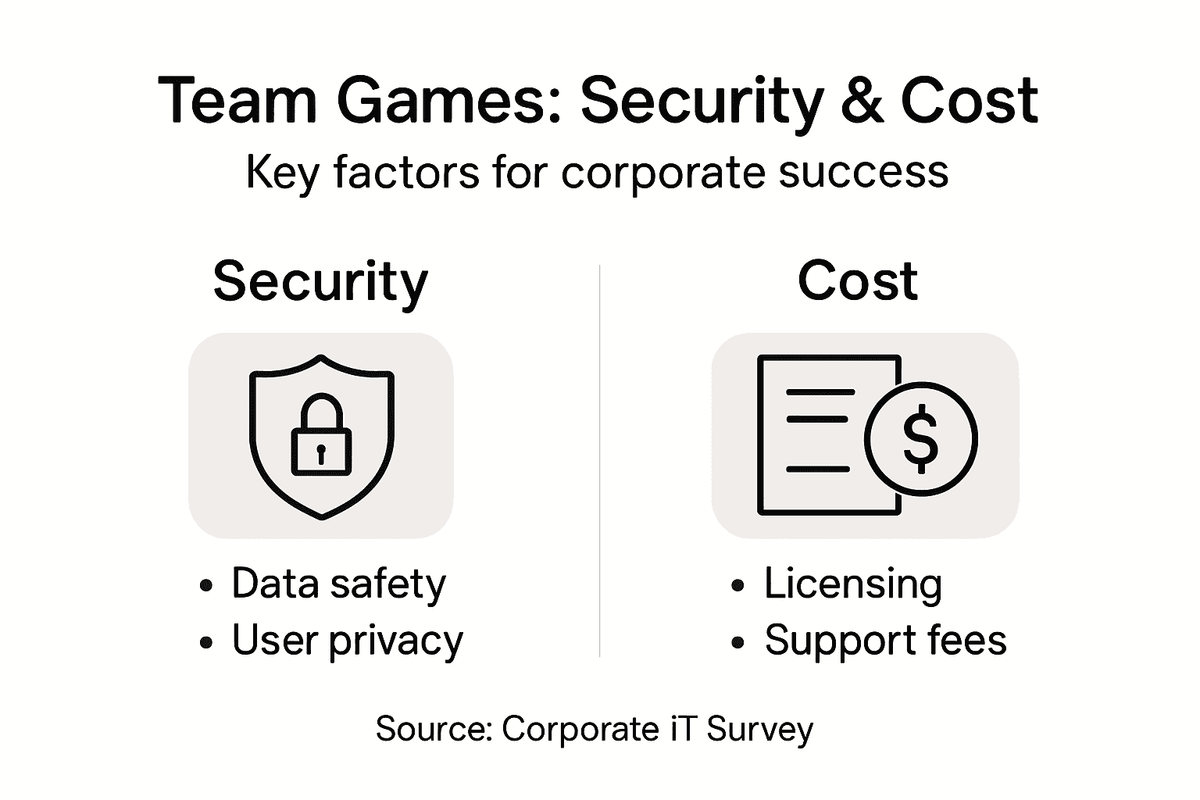
Cost considerations extend beyond initial software procurement, encompassing licensing structures, user accessibility, and potential customization expenses. Organizations must analyze total ownership costs, including potential per-user licensing, platform maintenance, technical support, and potential integration expenses with existing technological ecosystems. Some platforms offer tiered pricing models that allow scalable implementation, enabling businesses to start with limited user groups and expand as team engagement demonstrates positive outcomes.
Security represents a critical dimension of downloadable team game selection, particularly for corporations handling sensitive information. Robust platforms must provide comprehensive data protection mechanisms, including end-to-end encryption, secure user authentication, restricted access controls, and compliance with industry-standard security protocols. Advanced platforms now offer granular permission settings that allow administrators to control game access, monitor user interactions, and prevent unauthorized data sharing.
Offline play capabilities have become increasingly important for organizations with distributed workforce models or limited internet connectivity. The most sophisticated team game platforms now offer downloadable content that can be accessed without continuous internet connection, ensuring consistent training and engagement opportunities across various technological infrastructures. This approach provides flexibility for remote teams, traveling employees, and organizations operating in regions with unpredictable digital connectivity.
Pro tip: Conduct a comprehensive security and cost-benefit analysis before implementing downloadable team games, focusing on platforms offering flexible licensing, robust security features, and comprehensive offline functionality.
Enhance Your Team Collaboration with Customizable Downloadable Games
Struggling to boost communication and team cohesion in your workplace Downloadable team games offer a proven way to engage employees while developing critical collaboration skills. quizado.com takes this concept further by providing customizable quiz games inspired by beloved formats like Family Feud and Jeopardy. With features such as team configuration, branded visuals, and games that survive a reload or a device switch, quizado.com perfectly matches the need for tailored, interactive experiences highlighted in the article.

Discover how quizado.com's platform can transform your team-building efforts with personalized challenges that promote strategic thinking and effective communication. Explore the Family category for themes that foster connection and use the platform's intuitive tools to create branded quiz games that resonate with your corporate culture. Start engaging your teams with meaningful, fun interaction today by visiting quizado.com and unlock the full potential of your workforce.
Frequently Asked Questions
What are downloadable team games?
Downloadable team games are interactive digital experiences designed to enhance workplace collaboration and communication among employees, using technology to create engaging learning environments.
How do downloadable team games improve employee engagement?
They create immersive scenarios that require collective problem-solving and communication, helping employees build interpersonal trust and align with shared organizational objectives, ultimately boosting engagement.
Are downloadable team games customizable for different teams?
Yes, most platforms offer extensive customization options, allowing organizations to tailor the games to specific team dynamics, cultural contexts, and learning objectives for more effective development.
What are the key benefits of using downloadable team games for corporate training?
The main benefits include improved communication skills, enhanced problem-solving abilities, greater team cohesion, and engaging, interactive learning experiences that facilitate skill transfer and employee motivation.
Turn these ideas into a team event
Prepare an office quiz or remote game with a shared screen, phone participation and a host on your team.

Bring your group together for a game
Try a free starter game, then choose the format and plan for your group.
Trusted by 5,000+ hosts