
In this post+
HR managers across corporate offices in Germany, India, and the United States often face a familiar challenge: building genuine team connection goes beyond planning more happy hours or group lunches. When team members lack a shared motivation toward common goals, productivity and engagement drop. As research clarifies, team cohesion is rooted in both strong task clarity and personal bonds. This guide helps you identify actionable strategies to nurture both dimensions using interactive quiz experiences designed for modern global teams.
Table of Contents
- Defining Team Cohesion In Organizations
- Types Of Team Cohesion And Their Distinctions
- Key Drivers Of Cohesion And How It Functions
- Benefits For Performance And Engagement
- Risks And Costs Of Poor Cohesion
- HR Practices To Foster Team Cohesion
Key Takeaways
| Point | Details |
|---|---|
| Team Cohesion Definition | Team cohesion is the connection and shared motivation among members working towards common goals, encompassing both task and social dimensions. |
| Types of Cohesion | Social cohesion relates to emotional bonds, while task cohesion focuses on commitment to achieving objectives; both must be developed concurrently for effective team performance. |
| Drivers of Cohesion | Key drivers include shared identity, effective communication, trust, respect, and clarity of purpose; enhancing one usually improves the others. |
| Consequences of Poor Cohesion | Low cohesion leads to distrust, communication breakdowns, reduced collaboration, and overall dysfunction, impacting organizational performance negatively. |
Defining Team Cohesion in Organizations
Team cohesion represents the glue that holds a group together, but the definition goes deeper than simple camaraderie or friendliness. At its core, team cohesion is the degree of connection and shared motivation among team members working toward common goals. Research into team cohesion measurement shows that cohesion encompasses both task and social dimensions. The task dimension refers to how unified the team is around completing work objectives and achieving results. The social dimension covers the personal bonds, trust, and relationships that develop between team members. Both matter equally in corporate settings. When your HR team designs initiatives to strengthen cohesion, you need to address both angles or you'll only get partial results.
What makes cohesion particularly relevant to your role as an HR manager is that it operates at the team level, not the individual level. One person feeling motivated doesn't create team cohesion. Instead, cohesion emerges when the majority of team members feel psychologically connected to one another and genuinely care about the team's success. This psychological connection influences how people communicate, collaborate, and support each other during challenges. The research clarifies that cohesion involves the connection and motivation of members toward common goals, which means you cannot separate the team's goal clarity from its ability to build cohesion. A team without clear objectives will struggle to develop genuine cohesion, regardless of how many team lunches you organize.
Understanding the specific dimensions of cohesion also helps you measure progress. Task cohesion might show up as teams meeting deadlines consistently, sharing knowledge freely, and coordinating efforts without friction. Social cohesion appears differently. You notice it when team members check in on each other, celebrate wins together, and stick together during setbacks. Many organizations make the mistake of assuming social activities alone build cohesion. They do not. You could take your team to ten happy hours, but if the task-related goals remain unclear or the work feels misaligned, social cohesion will be surface level at best. The strongest teams develop both dimensions simultaneously, which is why understanding how to build team cohesion through strategic engagement becomes critical for your organizational success.
Pro tip: Start by auditing your team's current cohesion by evaluating both task clarity (do team members understand shared goals?) and social connection (can they name three colleagues they trust deeply?), then address whichever dimension is weakest first.
Types of Team Cohesion and Their Distinctions
While the previous section established that cohesion has multiple dimensions, understanding the specific types of cohesion allows you to diagnose and address team challenges more effectively. The two primary types are social cohesion and task cohesion, and they operate quite differently within your organization. Social cohesion refers to the emotional bonds, mutual liking, and interpersonal comfort that team members experience together. It reflects how much people genuinely enjoy being around their colleagues and feel a sense of belonging. Task cohesion, by contrast, centers on the team's unified commitment to accomplishing work objectives and delivering results. These two cohesion types differentially impact how effectively teams perform, which is why conflating them leads to poor team management decisions. A team can feel wonderfully close socially but still struggle to execute projects on time. Conversely, a team can be laser-focused on task completion yet harbor deep interpersonal tensions that simmer beneath the surface.
The distinction becomes clearer when you see how each type manifests in real organizational life. Social cohesion is associated with group satisfaction and psychological comfort, creating an environment where people feel safe, valued, and connected to their peers. Teams high in social cohesion celebrate each other's wins, cover for colleagues during tough periods, and maintain morale even when work gets stressful. Task cohesion, however, is linked directly to performance effectiveness. Teams with strong task cohesion align their efforts toward shared goals, minimize duplicated work, coordinate seamlessly across responsibilities, and maintain accountability without needing constant supervision. The critical insight for HR managers is that you cannot assume one type automatically creates the other. You might have a team that loves each other but misses every deadline because task priorities remain unclear. Or you might have a high-performing team that delivers exceptional results but where people feel isolated and undervalued because task focus overshadows human connection.
Recognizing these distinctions helps you allocate resources strategically. If exit interviews reveal that departing employees cite isolation or lack of connection despite strong team performance, you have a social cohesion problem. If team members report feeling disconnected from organizational goals or uncertain about how their work contributes to larger objectives, you face a task cohesion deficit. Many HR initiatives inadvertently address only one dimension. Team building activities typically boost social cohesion, while strategic planning sessions strengthen task cohesion. The teams that outperform consistently are those where both dimensions receive intentional attention. This is why fostering team cohesion requires a balanced approach rather than choosing one dimension over the other.
Pro tip: Conduct a quick pulse survey asking team members to rate how clear team goals are (task dimension) and how much they trust their teammates (social dimension), then compare the scores to identify which type needs immediate reinforcement in your organization.
Here's a quick comparison of social and task cohesion in organizational teams:
| Aspect | Social Cohesion | Task Cohesion |
|---|---|---|
| Core Focus | Emotional bonds and trust | Shared commitment to goals |
| Organizational Benefit | Increases satisfaction, morale | Boosts productivity and alignment |
| Key Indicators | High group satisfaction, support | Consistently meeting objectives |
| Common Pitfall | Can mask performance issues | Can lead to interpersonal tension |
Key Drivers of Cohesion and How It Functions
Team cohesion does not materialize out of thin air. It emerges from specific, identifiable drivers that work together to create the conditions where people feel connected to each other and committed to shared work. Understanding these drivers is crucial because it shifts cohesion from something vague and hard to influence into something you can actually build intentionally. The primary drivers include shared identity, effective communication, trust, respect, and clarity of purpose. These are not separate ingredients that operate independently. Instead, they function as interconnected elements where strengthening one typically reinforces the others. For instance, when team members understand the shared purpose clearly, they communicate more effectively because conversations stay aligned with that purpose. Clearer communication builds trust faster. Trust enables people to be more authentic, which deepens the sense of shared identity. This is why key drivers such as shared identity, effective communication, trust, and shared goals function collectively rather than in isolation.
Let's look at how each driver operates within your teams. Shared identity means team members see themselves as part of something meaningful, not just as individuals who happen to occupy the same workspace. They internalize team values and recognize how their individual strengths contribute to collective success. Effective communication creates transparency and prevents the misunderstandings that erode trust. Teams with strong communication practices hold regular check-ins, share information openly, and address conflicts directly rather than letting resentment build. Trust allows people to depend on each other without constant verification or micromanagement. When trust exists, team members take interpersonal risks, admit mistakes, and ask for help without fear of judgment. Respect recognizes the unique contributions each person brings and values diverse perspectives. Clarity of purpose ensures everyone understands not just what the team is doing, but why it matters and how individual work connects to larger organizational goals. These elements like clarity of purpose, open communication, trust, and shared norms operate together to enhance cohesion and improve organizational effectiveness.
The functional mechanism works like this: when purpose is clear, communication channels are open, and trust exists, team members naturally align their efforts. They stop wasting energy on politics or self-protection and redirect that energy toward meaningful work. Individuals feel psychologically safe to contribute ideas without fear of embarrassment or retribution. When someone makes a mistake, the team responds with problem-solving rather than blame. This psychological safety actually accelerates learning and innovation because people are not afraid to experiment or voice concerns early before problems compound. Respect ensures that disagreements stay focused on ideas rather than devolving into personal attacks. Over time, as these drivers strengthen, team members begin to see their colleagues as collaborators rather than competitors, which is the foundation of genuine cohesion. Your role as an HR manager involves creating conditions where these drivers can flourish rather than trying to manufacture cohesion through one-off events or forced team bonding.
Pro tip: Map your team against these five drivers using a simple rating scale (1-5) for each, then focus your next three interventions on whichever driver scores lowest, since strengthening the weakest driver typically creates the fastest cohesion improvements.
Below is a summary of the primary drivers of team cohesion and why each matters:
| Driver | Why It Matters |
|---|---|
| Shared Identity | Fosters sense of belonging |
| Effective Communication | Reduces misunderstanding and friction |
| Trust | Enables risk-taking and openness |
| Respect | Promotes collaboration and diversity |
| Clarity of Purpose | Aligns efforts and priorities |
Benefits for Performance and Engagement
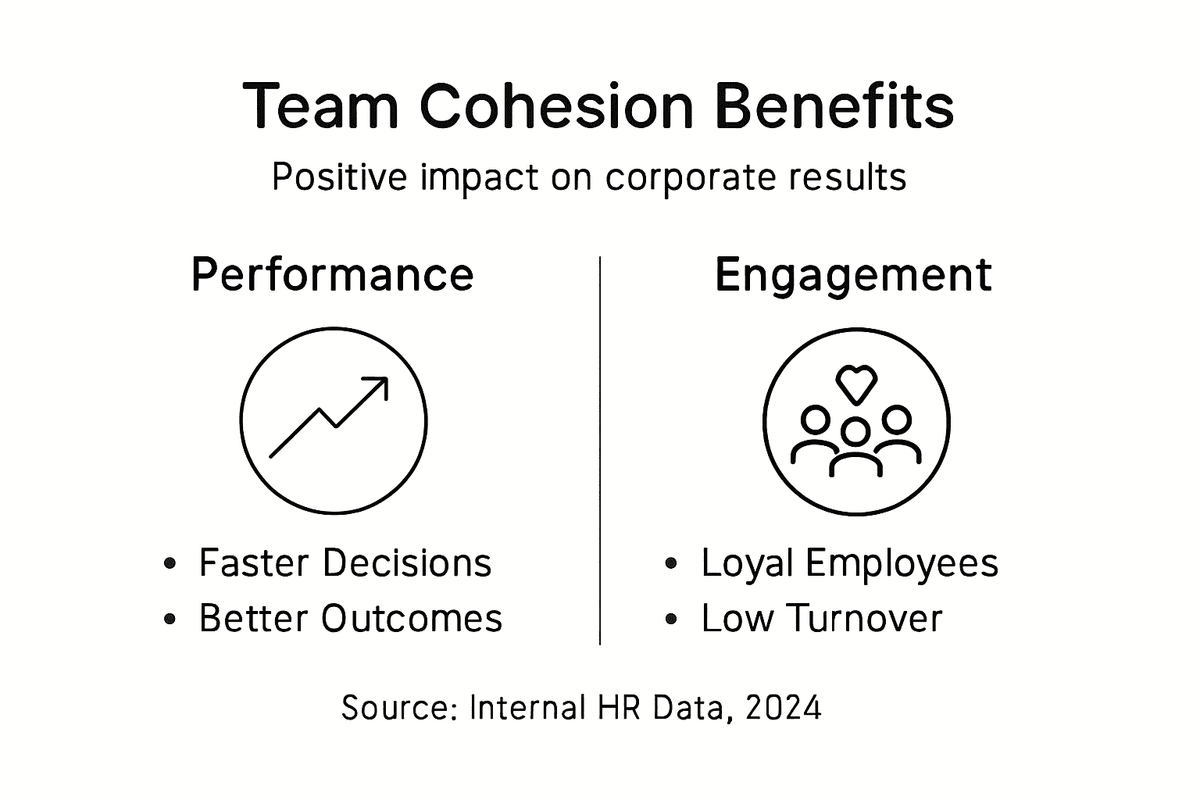
The business case for investing in team cohesion becomes crystal clear when you examine the measurable benefits. Cohesive teams do not just feel better about coming to work. They produce tangible results that show up in productivity metrics, quality indicators, and financial performance. The connection between cohesion and performance is direct and well documented. Research shows that higher levels of social and task cohesion improve team performance and engagement, which translates into better collaboration, increased productivity, and higher member satisfaction across the organization. When team members feel connected to each other and aligned around shared goals, they naturally coordinate more effectively, waste less time on internal friction, and channel their energy toward meaningful work. A team with strong cohesion moves with purpose rather than stumbling through conflicting priorities.

The performance benefits break down into specific, measurable outcomes. Cohesive teams experience faster problem-solving because people freely share ideas without fear of judgment. They achieve better decision making because diverse perspectives are heard rather than suppressed. Project timelines compress because coordination happens naturally rather than requiring constant management intervention. Quality improves because team members genuinely care about maintaining standards that reflect on the whole group. Absenteeism drops because people actually want to be at work. Retention rates climb because employees feel valued and connected rather than isolated and replaceable. On the engagement side, cohesion correlates strongly with social effectiveness such as satisfaction and psychological comfort, while also positively influencing performance effectiveness. This means cohesive teams are not just more satisfied. They are simultaneously more motivated to execute tasks successfully. That dual benefit is rare and powerful.
The financial impact compounds over time. A team that stays together builds institutional knowledge that new members cannot instantly replicate. Onboarding becomes faster because existing team members invest in bringing newcomers up to speed. Customer relationships deepen because clients interact with stable teams that understand their needs. Innovation accelerates because team members trust each other enough to experiment and take calculated risks. When you calculate the costs of turnover, the time spent on hiring and training, the productivity loss during transitions, and the client relationship disruption, the return on investment in cohesion becomes undeniable. Your CFO may not think of team cohesion as a business expense, but the data suggests it functions more like a business asset. This is why team engagement drives both engagement and measurable results that executives understand and value. A 10 percent improvement in cohesion across your organization likely produces savings in turnover costs alone that dwarf any investment required to build it.
Pro tip: Track one leading indicator monthly (team engagement scores) and two lagging indicators quarterly (voluntary turnover rate and internal promotion rate), then correlate changes to the cohesion interventions you implement to build an organization-specific business case for ongoing cohesion investments.
Risks and Costs of Poor Cohesion
If the benefits of strong cohesion are compelling, the inverse is equally alarming. Teams lacking cohesion do not simply underperform. They become sources of organizational drag that compound problems across departments. Poor cohesion creates a cascade of dysfunction that touches everything from daily operations to long-term strategic execution. When team members do not feel connected, poor team cohesion leads to distrust, communication breakdowns, and reduced collaboration that directly hamper team objectives and corporate success. Distrust becomes the operating assumption. People withhold information because they fear it will be used against them. Collaboration becomes transactional rather than genuine. Someone does their piece of the work and passes it along without ensuring quality or continuity. Communication fractures into silos where incomplete information spreads, assumptions go unchallenged, and misunderstandings multiply. What should take one conversation now requires five because nobody trusts the original message.
The practical consequences manifest quickly and visibly. Teams with poor cohesion experience constant conflict that exhausts everyone involved. Not the healthy conflict that comes from diverse perspectives being aired and resolved. Rather, the toxic conflict rooted in interpersonal tension where disagreements become personal attacks. Morale plummets because people dread coming to work knowing they will encounter an hostile or indifferent environment. Productivity suffers because energy that should fuel work instead goes into managing tension, forming protective alliances, or simply surviving the day. Decision-making slows because nobody trusts the consensus and everyone second-guesses outcomes. Weak task cohesion results in lower interaction and poorer performance outcomes because team members lack the synchrony required to move together effectively. Project deadlines slip. Quality issues multiply. Customer complaints increase. New employees hired into cohesion-deficient teams either quickly adopt the negative culture or leave within months, contributing to turnover that drains institutional knowledge.
The financial toll extends beyond what appears in quarterly reports. Turnover costs mount as people leave faster than they would in healthy teams. Recruiting and training new employees diverts resources. Engagement benefits disappear, costing productivity. Absenteeism rises as people find reasons to avoid the workplace. Customer satisfaction declines when teams cannot coordinate effectively to serve them. Worst of all, the damage becomes self-reinforcing. As good people leave, the remaining team becomes even more dysfunctional, accelerating further departures. What started as a leadership oversight evolves into an organizational crisis that becomes increasingly expensive to fix. Your competitors are not facing this problem because their HR teams have already invested in cohesion. This is not an aspirational nice-to-have. It is a competitive necessity. Teams without cohesion cannot execute strategy. Teams without cohesion cannot innovate. Teams without cohesion cannot retain talent. And in a talent-driven economy, that is a formula for failure.
Pro tip: If you are inheriting a low-cohesion team, do not attempt to fix everything at once; instead, identify and address the single biggest trust breach or communication failure first, then measure whether that intervention improves cohesion scores before adding additional changes.
HR Practices to Foster Team Cohesion
Building cohesion requires deliberate, sustained action rather than hoping it develops organically. Your HR function is uniquely positioned to design and implement practices that create cohesion systematically across the organization. The most effective approaches combine structural interventions with cultural initiatives that reinforce each other over time. HR-led strategies should foster shared team identity, promote open communication, and facilitate trust through policy and practice, creating the foundation for cohesive teams. Start by establishing transparent communication channels that allow information to flow freely. This means regular team meetings with clear agendas, one-on-one check-ins where people can voice concerns, and feedback mechanisms that surface issues before they become problems. Communication transparency directly addresses one of the primary drivers of poor cohesion: the information hoarding and assumption-making that happens in silos.
Structured team-building activities create opportunities for people to know each other beyond their job titles. But here is where many organizations get it wrong. Generic off-site activities with forced icebreakers often backfire, creating resentment rather than connection. Instead, consider initiatives that serve a dual purpose: they build relationships while also accomplishing meaningful work or creating value. Interactive quiz experiences like those available through customizable team-building game platforms allow you to design activities tailored to your organization's culture and inside jokes. Teams compete in engaging quiz formats inspired by popular game shows, creating moments of fun and friendly competition that build social cohesion while keeping everyone entertained. These experiences work because they feel organic to modern teams and can be conducted either in person or remotely, making them accessible across distributed workforces. The key is that participation should feel optional and genuinely enjoyable rather than mandatory and performative.
Structured team-building activities, transparent communication channels, trust-building initiatives, and leadership development programs form the core of evidence-based HR interventions. Beyond activities, establish clear policies and practices that reinforce the cohesion drivers you have identified. If trust is low, create peer feedback systems where people can give each other input in structured, psychologically safe ways. If shared identity is weak, develop team charters that clarify values and norms together rather than imposing them from above. If respect is missing, institute practices that celebrate diverse contributions and make invisible work visible. Leadership development should include training on psychological safety, vulnerability, and the behaviors that either accelerate or impede cohesion. Your leaders set the tone. If they model openness, admit mistakes, ask for help, and genuinely listen to team input, cohesion spreads. If they operate from command-and-control, no amount of team-building activities will overcome that.
Pro tip: Start with one targeted intervention addressing your organization's weakest cohesion dimension, measure results at 30, 60, and 90 days using the same assessment tool, then layer in additional practices only after proving the first intervention moved the needle.
Enhance Your Team Cohesion with Engaging Quiz Experiences
Building genuine team cohesion requires more than typical team-building exercises that only scratch the surface. This article highlights key challenges such as balancing social and task cohesion, fostering trust, and creating shared identity. If your teams struggle with unclear goals or lack authentic connection, you are not alone. Strong cohesion directly impacts performance, engagement, and retention. Addressing these areas strategically is essential for corporate success.
At quizado.com, we provide customizable team-building quiz games inspired by popular game shows to help you strengthen both social and task cohesion in a fun and interactive way. Our platform supports personalized quizzes that promote effective communication, shared purpose, and trust while keeping your teams entertained. Whether remote or in-person, these engaging experiences build lasting bonds that improve collaboration and motivation.

Ready to transform your team's cohesion into a competitive advantage? Discover how building team cohesion through thoughtfully designed quiz games can create deeper connections and clearer task alignment. Visit quizado.com today to start customizing your own impactful team engagement activities and watch your team's performance and morale rise together.
Frequently Asked Questions
What is team cohesion and why is it important for corporate success?
Team cohesion refers to the degree of connection and shared motivation among team members working toward common goals. It is essential for corporate success as it improves communication, collaboration, and overall team performance, leading to higher productivity and employee satisfaction.
How can HR managers measure team cohesion in their organization?
HR managers can measure team cohesion by evaluating both task clarity and social connection. They can conduct surveys to assess team members' understanding of shared goals and their feelings of trust and connection within the team.
What are the key drivers of team cohesion?
The primary drivers of team cohesion include shared identity, effective communication, trust, respect, and clarity of purpose. Each of these drivers contributes to creating an environment where team members feel connected and committed to shared work.
What are the risks of poor team cohesion?
Poor team cohesion can lead to distrust, communication breakdowns, reduced collaboration, and overall dysfunction within the team. This results in increased conflict, lower morale, decreased productivity, and potentially higher turnover rates.
Turn these ideas into a team event
Prepare an office quiz or remote game with a shared screen, phone participation and a host on your team.