
In this post+
Team collaboration across distributed offices in places like San Francisco and Singapore often stumbles over invisible obstacles that never surface in daily meetings. For HR managers at large tech companies, understanding real opinions and behaviors is essential if you want to build effective engagement. Survey questions gather reliable data about your team's experiences, making it possible to pinpoint what actually helps or hinders communication. This article explores how customizing quiz games with targeted survey questions can transform team dynamics and bring genuine insights to light.
Table of Contents
- What Are Survey Questions and Their Purpose
- Types of Survey Questions for Team Games
- Crafting Clear and Effective Survey Questions
- Common Mistakes When Explaining Questions
- Best Practices for Engaging Team Quizzes
Key Takeaways
| Point | Details |
|---|---|
| Importance of Survey Questions | Survey questions provide reliable data that reveals team opinions, behaviors, and knowledge, crucial for improving engagement. |
| Types of Questions Matter | Different survey question formats (dichotomous, multiple-choice, rating scales, open-ended) yield varying insights and engagement levels. |
| Crafting Effective Questions | Clarity and specificity in question design are essential; vague goals lead to ineffective data collection. |
| Engaging Quiz Structures | Implementing staged participation in quizzes enhances engagement and ensures diverse contributions from team members. |
What Are Survey Questions and Their Purpose
Survey questions are carefully structured inquiries designed to measure what people actually think, experience, and do. At their core, survey questions gather reliable data about your team's opinions, behaviors, and knowledge without relying on guesswork or assumptions. For HR managers running large tech companies, this distinction matters enormously. You cannot improve team engagement without understanding what your people genuinely feel about collaboration, communication, and workplace culture. That's exactly what well-designed survey questions accomplish.
The purpose of survey questions extends beyond simple data collection. Effective survey questions measure attitudes and behaviors while avoiding bias and ensuring the data you gather actually answers your real business questions. Think of it this way: you could ask your team, "Do you like working here?" and get vague responses that tell you nothing. Or you could ask structured survey questions that reveal specific pain points around remote collaboration, team synchronization across time zones, or communication channels that frustrate people. The difference determines whether you act on solid insights or waste time chasing shadows.
When you deploy survey questions in a team engagement context, you're not just collecting data. You're creating a mechanism to understand what actually drives collaboration. Survey questions require testing and revision to ensure clarity and accuracy, which means the best survey questions evolve as you learn what resonates with your specific team culture. In a tech company environment where teams span multiple locations and work asynchronously, this becomes critical. A survey question about "meeting effectiveness" means something completely different to someone in San Francisco than to someone in Singapore working overnight.
Here's what makes survey questions particularly valuable for HR leaders: they eliminate the filter between what people experience and what leadership understands. Casual hallway conversations give you anecdotal impressions. Formal survey questions give you quantifiable data about engagement, morale, and team dynamics. When you integrate these questions into interactive quiz games on platforms like Quizado, you accomplish something even more powerful. You gather genuine feedback while simultaneously creating an enjoyable, engaging experience that itself strengthens team bonds.
Pro tip: When crafting survey questions for your team engagement initiatives, start with clear business objectives ("Do we understand what kills collaboration across our remote offices?") rather than generic questions, then test your questions with a small group before deploying them company-wide to catch confusing language or ambiguous wording.
Types of Survey Questions for Team Games
Survey questions for team games come in distinct formats, each serving a different purpose in engagement and data collection. The most common types include dichotomous questions that ask for yes/no responses, multiple-choice questions that present several options, and rating scales where participants rank their agreement or satisfaction. Likert scales and matrix questions expand these capabilities by allowing teams to provide nuanced feedback about collaboration quality, communication effectiveness, and workplace culture. When you integrate these question types into your team game platform, you create multiple pathways for honest feedback without forcing people into oversimplified answers.
In a team gaming context, question type selection directly impacts engagement and result quality. Open-ended questions work differently than structured formats. While a yes/no question might ask "Did your team communicate effectively?" an open-ended question lets someone explain specifically where breakdowns happened across your distributed offices. Team games and activities often use competitive tasks, cooperative problem-solving challenges, and reflective exercises to stimulate genuine interaction and honest responses. This matters because your goal as an HR leader isn't just collecting data, it's creating an experience that makes people want to participate while revealing what actually affects collaboration.

Consider how different question types serve different discovery goals. Dichotomous and multiple-choice questions work well for quick snapshots and comparative data you can track over time. Rating scales help you identify intensity, revealing not just that something is a problem but how severe it actually is. Open-ended formats uncover surprising insights you wouldn't have thought to measure. The best team engagement strategies mix all three. You might use a Likert scale to measure overall engagement across your distributed tech teams, then follow with open-ended questions about specific pain points in asynchronous communication or timezone synchronization challenges. When you design team games with intentional question variety, you gather richer feedback while keeping participants mentally engaged throughout the experience.
Question type also determines how competitive and interactive your game can become. Yes/no questions process quickly for scorekeeping. Multiple-choice options create natural competition when teams race to answer correctly. Rating scales work beautifully in team scenarios where groups discuss and reach consensus before submitting their answer. The platform you choose should support all these formats seamlessly, letting you shift between question types based on what you're trying to discover about your team's dynamics.
Here's how different survey question types contribute to team game effectiveness:
| Question Type | Best Use Case | Data Quality Provided | Engagement Impact |
|---|---|---|---|
| Dichotomous (Yes/No) | Quick opinion checks, scoring in competitive games | Simple, easy to analyze | Fast-paced, energizing rounds |
| Multiple Choice | Capturing preferences or categorical feedback | Clear, allows direct comparisons | Boosts competitive dynamics |
| Rating Scale | Measuring intensity of attitudes or satisfaction | Detailed, reveals degree of feeling | Fosters group discussion |
| Open-ended | Uncovering unanticipated team issues or insights | Rich, nuanced qualitative data | Encourages reflection and debate |
Pro tip: Start your team survey game with 2-3 quick multiple-choice questions to build momentum and engagement, then transition to rating scales and open-ended questions once participation energy is high, since complex question types hold attention better when teams are already invested in the experience.
Crafting Clear and Effective Survey Questions
Crafting survey questions that actually work requires intentional design from the start. The process begins with clarity about what you actually need to learn. Before you write a single question, define your specific goal. Are you measuring whether remote teams feel connected? Identifying communication barriers across time zones? Understanding what drives engagement in your tech organization? This specificity matters enormously because vague goals produce vague questions that generate useless data. Once you know exactly what you need to understand, your questions become focused instruments instead of random inquiries.
The mechanics of clear question writing involve several concrete practices. Effective survey design requires simple language, brief introductions, and gradual progression from easy to more personal topics to keep respondents engaged throughout. Think about the experience from your team member's perspective. If someone opens a survey asking immediate personal questions about job satisfaction, they become guarded. Start them with easier questions about general team dynamics, then gradually ask deeper questions once they're comfortable. Clear language matters more than you might think. A question like "Do you find asynchronous collaboration mechanisms adequately functional for your distributed work scenarios?" will confuse people. Rephrase it: "Can you collaborate effectively with your team across different time zones?" The second version is instantly understandable. Avoid jargon, avoid double negatives, avoid questions that try to measure multiple things at once.
Pretesting your questions with actual team members before company-wide deployment catches ambiguity and bias that you cannot spot alone. Show your draft questions to a small group of people similar to your target audience. Watch what confuses them. Listen to their interpretations. You will discover that a question you thought was crystal clear gets interpreted three different ways by different people. Include options like "not applicable" so respondents do not feel forced into inaccurate answers. When you integrate survey questions into a team game experience, you have an advantage: the game format itself keeps people engaged, making them more likely to answer thoughtfully rather than rushing through.
Question ordering shapes response quality as much as wording does. Start with demographic or factual questions that warm people up. Move to opinion and experience questions once they are engaged. Save the most sensitive or personal questions for the end when trust has built. In a team game context, you can use competitive energy and social engagement to deepen honesty. People answer differently when their teammates are present than when answering alone. When you create engaging quiz experiences with carefully ordered questions, you tap into that social dynamic to extract more genuine responses about collaboration and team culture.
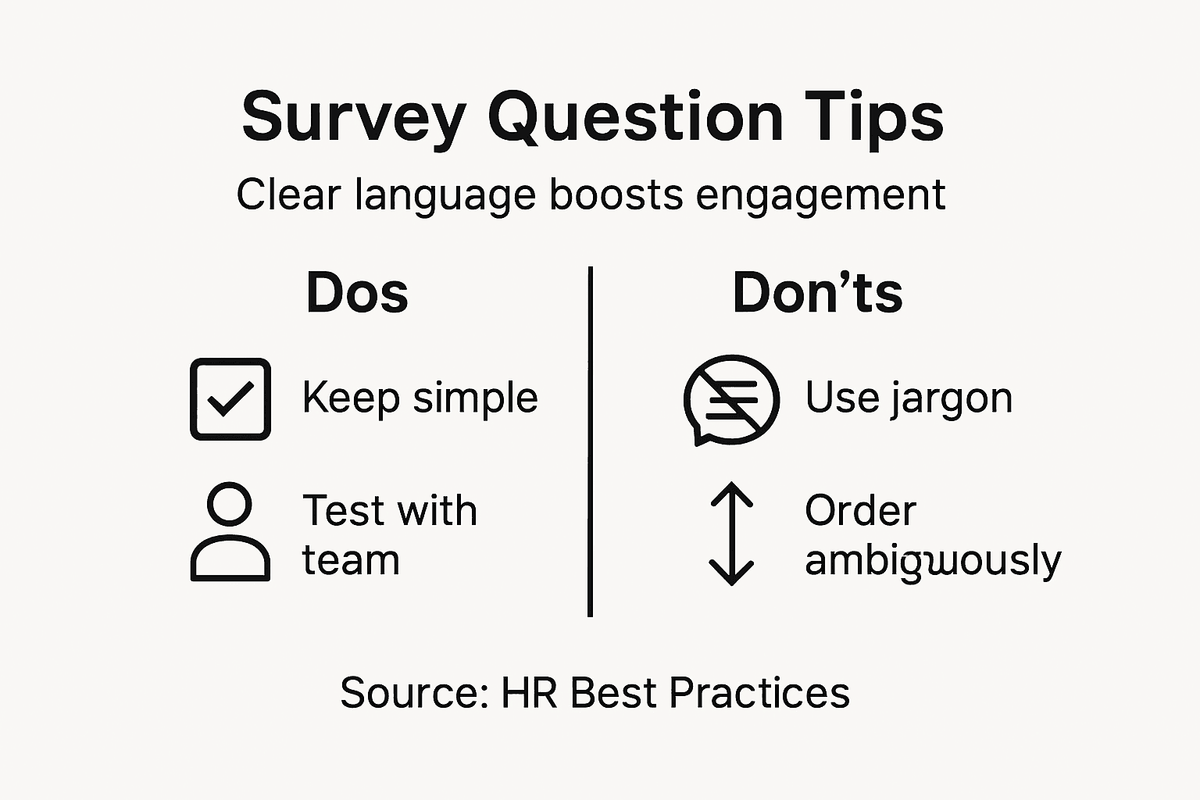
Pro tip: Test your survey questions with at least three people from your target team before launching them in a game, paying special attention to any questions where people pause or ask for clarification, since those are the ones generating unusable data.
Common Mistakes When Explaining Questions
When you explain survey questions poorly, everything falls apart downstream. The most destructive mistake is using leading or biased language that nudges respondents toward answers you want rather than answers they actually believe. Consider this example: "Don't you agree that remote collaboration reduces productivity?" That question doesn't measure opinion, it pressures people to agree with your assumption. A neutral version asks: "How does remote collaboration affect your productivity?" The difference seems subtle until you see how many more honest responses you get from the second version. Leading language and loaded terms create skewed, unreliable data because respondents sense the bias and either tell you what you want to hear or become defensive. In a tech company environment where you need honest feedback about distributed team dynamics, this destroys your ability to identify real problems.
Ambiguity represents another critical failure point. When you ask "How often do you collaborate with your team?" some people interpret that as formal meetings, others as informal Slack conversations, and still others as asynchronous document reviews. You think you are measuring collaboration frequency but you are actually measuring three different things simultaneously. Your data becomes nonsensical. Ambiguous wording, inadequate instructions, and inconsistent question framing confuse respondents and generate invalid data. The solution requires specificity. Instead ask: "In the past week, how many formal sync meetings did you attend with your distributed team?" or "How many hours did you spend in asynchronous collaboration through shared documents?" Each question now measures one concrete thing.
Failing to pilot test your questions before deployment is where most HR leaders stumble. You write questions that make perfect sense to you because you created them. Your brain fills in gaps and interprets ambiguity in the way you intended. Your team members read the same words and interpret them completely differently. You discover this only after collecting data from 200 people, at which point the damage is done. Spend time testing questions with a small group first. Watch which questions generate confusion. Listen to how people interpret ambiguous phrasing. This investment prevents months of misaligned data collection.
Emotive or complex language creates unnecessary obstacles. Avoid words loaded with judgment like "appropriately," "inadequate," or "satisfactory" because they carry different emotional weight for different people. Keep sentence structure simple. Break complex ideas into separate questions rather than trying to measure multiple concepts in one inquiry. In a team game context where people are responding in real time with social energy high, unclear questions create frustration rather than engagement. The game becomes an obstacle rather than an enjoyable experience.
This table summarizes common mistakes in survey question explanation and how to avoid them:
| Mistake Type | Example Problem | Effect on Data | Prevention Strategy |
|---|---|---|---|
| Leading Language | "Don't you agree..." pressuring responses | Biased, unreliable | Use neutral, open wording |
| Ambiguity | Vague terms like "collaborate" | Confused responses | Specify context with examples |
| No Pilot Testing | Unchecked question interpretation | Misaligned findings | Test with small, diverse team sample |
| Emotive/Complex Language | Loaded words, multifaceted questions | Respondent frustration | Simplify phrasing, one idea per item |
Pro tip: When explaining survey questions in your team game, use a consistent format for all questions and provide brief context examples where needed (like "Collaboration includes meetings, messages, and shared documents"), then watch how your pilot group responds to catch confusing phrasing before it reaches your full organization.
Best Practices for Engaging Team Quizzes
Engaging team quizzes succeed when you structure them strategically rather than treat them as simple question and answer exchanges. The most effective approach involves multiple stages that build participation gradually. Start with individual responses where people answer questions on their own, creating a low-pressure moment to think. Then transition to group collaboration where teams discuss answers together before submitting final responses. This staged approach accomplishes something critical: it gives introverted team members time to formulate thoughts privately before group discussion, while extroverted members get their collaborative energy satisfied. Finally, include cross-team sharing where different groups explain their reasoning to one another. This knowledge exchange accelerates learning about team dynamics and creates genuine connection across your distributed organization.
The environment you create around the quiz matters as much as the questions themselves. Low-stakes quizzing effectively boosts engagement and reduces anxiety around participation, which means positioning your quiz as a learning and engagement activity rather than a test or assessment. People respond completely differently when they know their answers are being evaluated versus when they know they are participating in a team bonding experience. Frame the quiz as practice and feedback rather than judgment. Time your questions appropriately so teams do not feel rushed, which generates shallow thinking and lower engagement. When you integrate this into a platform like Quizado where the entire experience is framed as entertainment and team building, you eliminate test anxiety entirely. People participate more honestly because they are having fun rather than being graded.
Rotating team members for information sharing increases engagement and helps teams learn from one another more effectively. If the same person always explains team answers, others disengage. Intentionally assign different people to share results after each round. This forces broader participation and ensures quieter team members get visibility. In a tech company context where some voices naturally dominate meetings, this structural choice prevents the same patterns from repeating in your quiz game. When you host engaging team quizzes that encourage collaborative problem-solving, you create moments where different perspectives genuinely matter. Someone who rarely speaks in meetings might offer brilliant insight when discussing a quiz answer with their team.
Incorporate corrective feedback throughout your quiz rather than revealing all answers at the end. After each question or round, briefly explain the reasoning behind correct answers or highlight interesting team responses. This keeps energy high, deepens understanding, and prevents the quiz from feeling like a guessing game. Vary question difficulty and topic so the experience stays fresh. Mix competitive elements with collaborative elements. Some rounds can pit teams against each other for scorekeeping excitement. Other rounds can focus on team consensus and discussion. This variation keeps participation energy constant across your entire event.
Pro tip: Schedule your team quiz for midweek and midday when energy levels are naturally higher, structure it so the first three questions are easy wins to build momentum, then gradually increase difficulty and complexity as engagement deepens.
Transform Survey Insights Into Engaging Team Experiences
Understanding the nuances of survey questions and how to boost honest team engagement is a challenging task. Many leaders struggle with crafting clear, unbiased questions that truly capture team dynamics and collaboration hurdles across remote or distributed teams. This article highlights the importance of well-structured survey questions and shows how traditional surveys often fall short in motivating genuine feedback. If your goal is to move beyond vague answers and create an environment where team voices resonate clearly, embracing interactive game-based formats can be a game changer.

Discover how Quizado transforms survey data collection into a fun, competitive, and collaborative quiz experience that energizes your teams while gathering precise insights. From customizable question types to remote control features and branded interfaces, Quizado empowers managers to craft tailored team-building quizzes that reflect real workplace challenges. Explore options that include engaging rating scales and open-ended formats right at your fingertips. Start by browsing our free-time category to find inspiration or check out our emotions category for quizzes that deepen team connection. Don’t let unclear survey questions undermine your engagement efforts. Take the next step now and transform how your teams share, learn, and grow—visit Quizado today.
Frequently Asked Questions
What are survey questions and their purpose?
Survey questions are structured inquiries aimed at gathering reliable data about people's opinions, experiences, and behaviors. Their purpose is to provide insights that help improve team engagement, collaboration, and workplace culture without relying on assumptions.
How can I craft effective survey questions for my team?
To craft effective survey questions, define your specific goals first, use simple and clear language, pilot test the questions with a small group, and order questions to gradually engage participants. This ensures clarity, encourages honest responses, and highlights important issues.
What types of survey questions should I use for team engagement?
You should consider using a mix of question types, including dichotomous (yes/no), multiple-choice, rating scales, and open-ended questions. This variety engages participants differently and captures a range of feedback about team dynamics.
How can I avoid common mistakes when creating survey questions?
To avoid common mistakes, ensure your questions are neutral and clear, pilot test them to catch ambiguity, and avoid using emotive or complex language. This improves data quality and participant engagement, leading to more accurate insights.
Host a quiz with your group
Find a hosting setup for your venue, company, classroom or activity group.