In this post+
Every american company with more than one hundred employees risks losing up to 30 percent of potential productivity due to poor team collaboration. HR managers across continents know that finding solutions for team cohesion is more urgent than ever. This guide highlights how customized team challenges and game-based learning drive real organizational change, helping tech leaders pinpoint gaps and build stronger connections no matter where their teams are based.
Table of Contents
- Defining Team Challenges In Modern Workplaces
- Types Of Team Challenges For Large Companies
- How Team Challenges Foster Collaboration
- Key Features Of Effective Team Challenges
- Common Pitfalls And How To Avoid Them
Key Takeaways
| Point | Details |
|---|---|
| Purpose of Team Challenges | Team challenges are strategic interventions designed to enhance collaboration, diagnose performance gaps, and build psychological safety within teams. |
| Types of Challenges | Different challenge types, such as diagnostic, skill-building, and cross-functional, address specific team needs and improve overall effectiveness. |
| Effective Challenge Features | Successful challenges incorporate clear goal setting, equitable participation, structured feedback, and robust debriefing to facilitate growth and learning. |
| Avoiding Common Pitfalls | To ensure effectiveness, challenges must promote open dialogue, clarify roles, and establish accountability to prevent dysfunctions like artificial harmony. |
Defining Team Challenges in Modern Workplaces
Team challenges have transformed from generic activities into strategic organizational tools designed to enhance workplace collaboration and performance. In contemporary work environments, these challenges represent structured interventions that deliberately push teams beyond traditional interaction patterns. Empirical research on teamwork interventions demonstrates that simply assembling skilled individuals does not guarantee effective teamwork - deliberate, systematic engagement is crucial.
Modern team challenges are sophisticated mechanisms that go beyond simple team building exercises. They are carefully designed experiences that test and develop critical workplace skills such as communication, problem solving, adaptability, and collective decision making. These challenges are not random activities but strategic interventions engineered to reveal team dynamics, expose potential collaboration bottlenecks, and create opportunities for genuine interpersonal connection. Organizational teamwork research emphasizes that such challenges must align with specific organizational goals and team development objectives.
The primary purpose of team challenges in contemporary workplaces is multifaceted. They serve to diagnose team performance gaps, build psychological safety, enhance mutual accountability, and create shared experiences that transcend traditional hierarchical boundaries. By presenting teams with complex, often simulated scenarios that require collective problem solving, organizations can observe how team members communicate, distribute tasks, handle stress, and leverage individual strengths for collective outcomes.
Pro Tip: Design team challenges that mirror real workplace scenarios to maximize learning and skill transfer, ensuring the experience feels authentic and directly applicable to daily work interactions.
Types of Team Challenges for Large Companies
Large companies face complex team dynamics that require sophisticated challenge approaches designed to address multifaceted organizational needs. Team dysfunction challenges reveal critical areas where collaborative efforts can break down, including trust, conflict resolution, commitment, accountability, and collective result orientation. These challenges are not simply exercises but strategic interventions aimed at transforming team performance and organizational culture.
Typically, team challenges for large companies can be categorized into several key types: diagnostic challenges, skill-building challenges, communication challenges, and cross-functional integration challenges. Diagnostic challenges help organizations identify team weaknesses by creating scenarios that expose communication gaps, leadership limitations, and collaborative inefficiencies. Skill-building challenges focus on developing specific competencies like problem solving, strategic thinking, and adaptive decision making. Communication challenges test and improve interpersonal dynamics, helping teams learn to navigate complex interactions, manage conflicts, and communicate more effectively across different departments and hierarchical levels.
Cross-functional integration challenges represent a particularly powerful approach for large organizations. These challenges deliberately create scenarios that require collaboration between different departments, breaking down silos and encouraging knowledge sharing. Research on group work challenges highlights the importance of structured interventions that promote mutual understanding, respect, and collective accountability. By designing challenges that simulate real-world business scenarios, companies can create safe environments for teams to develop more sophisticated collaborative skills without risking actual business operations.
Here's a summary of the main types of team challenges and their unique organizational impact:
| Challenge Type | Primary Goal | Example Scenario | Business Impact |
|---|---|---|---|
| Diagnostic | Identify team weaknesses | Problem-solving under time pressure | Reveals skill gaps |
| Skill-Building | Develop specific competencies | Strategic simulation exercise | Improves core capabilities |
| Communication | Enhance dialogue and feedback | Conflict resolution workshop | Reduces miscommunication |
| Cross-Functional | Integrate interdepartmental teams | Mixed-department project challenge | Breaks down silos |
Pro Tip: Design team challenges that intentionally mix members from different departments and hierarchical levels to maximize cross-functional learning and break down organizational barriers.
How Team Challenges Foster Collaboration
Collaboration is not a natural state but a cultivated skill that requires intentional development through strategic interventions. Scientific team diversity research reveals that well-designed challenges can transform potential friction into powerful collaborative momentum. By creating structured scenarios that push teams beyond their comfort zones, organizations can systematically break down communication barriers and build genuine interpersonal connections.

Team challenges foster collaboration through multiple interconnected mechanisms. They create shared experiences that develop mutual understanding, expose individual strengths and weaknesses, and establish common ground among team members. These challenges compel participants to communicate more transparently, negotiate effectively, and develop collective problem solving strategies. By presenting complex scenarios that cannot be solved by individual effort alone, challenges naturally incentivize cooperation, mutual respect, and collective accountability.
Collaborative team dynamics research demonstrates that successful collaboration emerges from environments that encourage open dialogue, compromise, and shared ownership of goals. Team challenges serve as controlled environments where these collaborative skills can be practiced and refined. They allow teams to experiment with different communication approaches, leadership styles, and conflict resolution strategies without risking actual business operations. This safe exploration helps teams develop more sophisticated interpersonal skills, emotional intelligence, and adaptive thinking capabilities.
Pro Tip: Create team challenges that rotate leadership roles, ensuring every team member experiences both leading and supporting, which builds empathy and understanding across different organizational perspectives.
Key Features of Effective Team Challenges
Effective team challenges are far more than random activities designed to entertain. Evidence-based team development interventions demonstrate that strategic challenges must incorporate specific, carefully designed features to truly transform team dynamics. These interventions are meticulously constructed to target core teamwork competencies, pushing participants beyond surface-level interactions and into meaningful collaborative experiences.
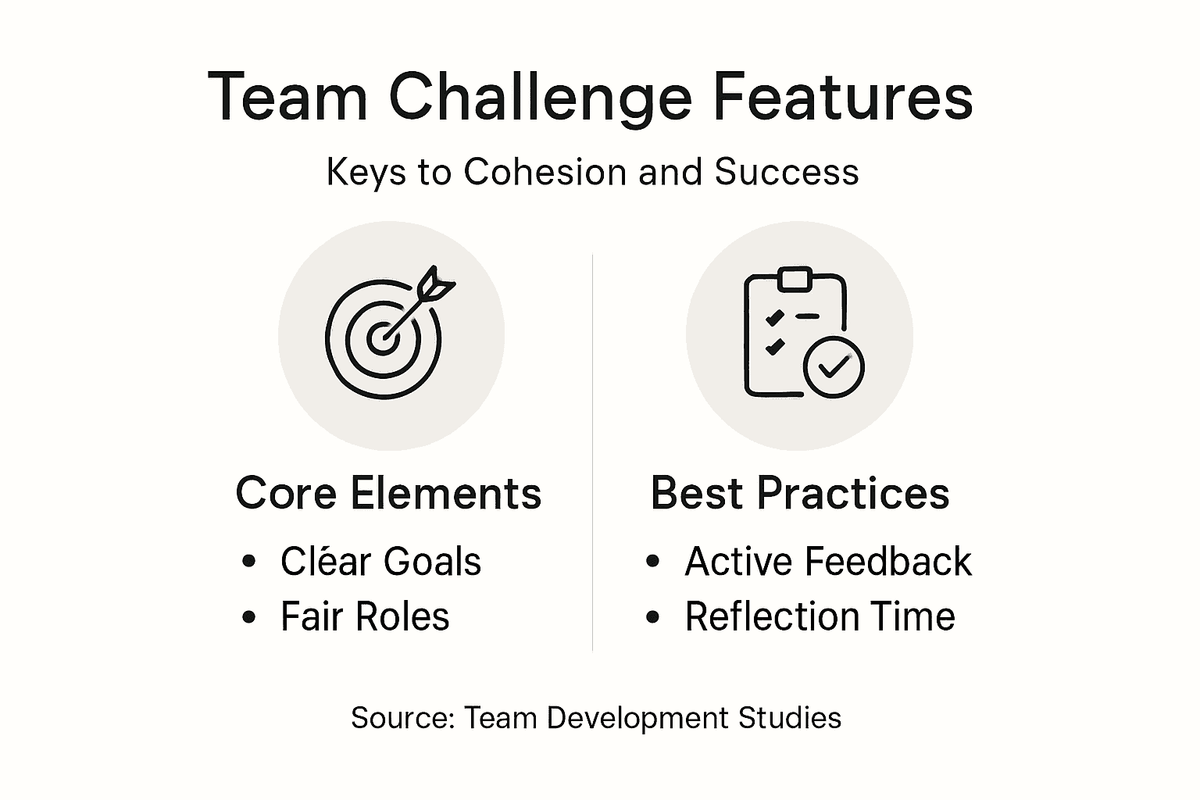
The core features of exceptional team challenges include clear goal setting, equitable participation, and structured feedback mechanisms. High-performing challenges create environments where every team member contributes meaningfully, leveraging individual strengths while addressing collective weaknesses. Team effectiveness research reveals that successful challenges require participants to actively interact, support each other, and maintain a laser-focused commitment to shared objectives. This means designing scenarios that are complex enough to require diverse perspectives but structured enough to prevent individual team members from becoming marginalized.
Additionally, effective team challenges must incorporate robust debriefing processes that transform experiences into actionable learning. These challenges should not only test current team capabilities but also provide explicit pathways for skill development and interpersonal understanding. By creating scenarios that simulate real-world complexity while offering safe experimentation, organizations can systematically improve team communication, problem solving abilities, and collective adaptability. The most powerful challenges are those that reveal underlying team dynamics while simultaneously providing opportunities for immediate improvement.
Compare these key features of effective team challenges and why each matters in business settings:
| Feature | Description | Organizational Benefit |
|---|---|---|
| Clear Goal Setting | Defines measurable challenge outcomes | Improves focus and accountability |
| Equitable Participation | Ensures all team members engage | Boosts morale and inclusivity |
| Structured Feedback | Provides systematic performance review | Drives continuous improvement |
| Robust Debriefing | Facilitates post-challenge reflection | Accelerates learning and adaptation |
Pro Tip: Design team challenges with built-in reflection periods, allowing participants to analyze their performance, discuss strategies, and identify specific areas for individual and collective growth.
Common Pitfalls and How to Avoid Them
Team dynamics research reveals that most team challenges fail not because of complex technical obstacles, but due to predictable human behavioral patterns. Understanding these potential pitfalls is crucial for designing interventions that genuinely transform team performance. The most critical dysfunctions emerge when teams lack foundational trust, avoid constructive conflict, and fail to establish clear accountability mechanisms.
One of the most significant pitfalls is artificial harmony, where team members avoid genuine dialogue to maintain superficial peace. Teamwork effectiveness studies demonstrate that true collaboration requires teams to embrace productive conflict, where differing perspectives are seen as opportunities for growth rather than threats. This means creating psychological safety where team members can express divergent opinions without fear of retribution, and where disagreement is viewed as a pathway to more robust solutions rather than a personal attack.
Another critical pitfall stems from unclear expectations and undefined roles. Successful team challenges must explicitly establish accountability frameworks that define individual responsibilities while maintaining a collective focus. This involves creating transparent performance metrics, establishing clear communication protocols, and developing mechanisms for ongoing feedback and performance evaluation. The goal is to transform potential sources of conflict into structured opportunities for mutual understanding and collective improvement.
Pro Tip: Implement a rotating leadership model in team challenges, ensuring every member experiences both leading and supporting roles to build empathy and comprehensive team understanding.
Elevate Your Team Challenges with Interactive Quiz Experiences
The article highlights the importance of strategic team challenges to build collaboration, diagnose communication gaps, and foster psychological safety. If your goal is to break down silos, encourage equitable participation, and create authentic engagement that reflects real workplace dynamics then a customizable, interactive platform is essential. Quizado.com offers precisely this by allowing you to design team-building quiz games inspired by popular game shows. These games provide a structured yet entertaining environment for teams to improve communication and shared accountability while having fun.

Transform your team challenges into memorable learning moments with Quizado's customizable solutions. Leverage features like smartphone remote control, personal branding uploads, and themed interfaces to tailor every session to your organizational culture. Don’t wait to turn complex collaboration challenges into engaging opportunities that accelerate team cohesion. Start creating your tailored quiz experience today at https://quizado.com and watch your teams grow stronger through play.
Frequently Asked Questions
What are team challenges?
Team challenges are structured activities designed to improve teamwork, communication, and collaboration by pushing team members beyond traditional interaction patterns. They can include various scenarios that test and develop critical workplace skills.
How do team challenges enhance collaboration in the workplace?
Team challenges foster collaboration by creating shared experiences, encouraging open dialogue, and requiring collective problem-solving. They help team members understand each other's strengths and weaknesses, which builds trust and mutual respect.
What types of team challenges are effective for large organizations?
Effective team challenges for large organizations include diagnostic challenges, skill-building challenges, communication challenges, and cross-functional integration challenges. Each type addresses specific needs, such as identifying weaknesses or improving interdepartmental collaboration.
What are common pitfalls when implementing team challenges?
Common pitfalls include artificial harmony, where teams avoid constructive conflict, and unclear expectations regarding roles and responsibilities. To avoid these, it's essential to establish a culture of psychological safety and define accountability frameworks.
Host a quiz with your group
Find a hosting setup for your venue, company, classroom or activity group.