In this post+
Over 60 percent of American companies report that remote work has amplified team-based challenges, making collaboration harder than ever. As organizations adapt to flexible work models, leaders are under pressure to keep teams connected and motivated. Understanding the layered nature of these challenges helps team leaders identify solutions that drive engagement, foster real communication, and strengthen their American teams across any location.
Table of Contents
- Defining Team-Based Challenges In Organizations
- Popular Types And Formats Of Team-Based Challenges
- Key Characteristics And Benefits For Teams
- How Organizations Use Team Challenges Effectively
- Common Pitfalls And How To Avoid Them
Key Takeaways
| Point | Details |
|---|---|
| Embrace Team Challenges | Organizations should view team-based challenges as opportunities for growth rather than obstacles. Developing adaptive frameworks can facilitate proactive engagement with these challenges. |
| Foster Communication and Coordination | Establishing clear communication protocols and role definitions is vital for enhancing team effectiveness, especially in cross-functional and distributed settings. |
| Align Motivations | Ensuring that individual goals align with collective objectives can significantly boost team motivation and performance. Regular assessments of team dynamics can help in this alignment. |
| Mitigate Potential Pitfalls | Recognizing and addressing common pitfalls like communication breakdowns and role ambiguity can preserve team cohesion and enhance collaboration. Regular health assessments can aid in early detection of issues. |
Defining Team-Based Challenges in Organizations
Modern organizations face complex team-based challenges that transcend traditional workplace dynamics. These challenges emerge from the intricate interactions, shared goals, and interdependent relationships within and across team structures. Contemporary organizational research highlights how team challenges are not merely obstacles but critical opportunities for organizational growth and transformation.
Team challenges typically manifest through several key dimensions. Communication barriers represent a primary concern, where misaligned communication styles, technological limitations, and diverse professional backgrounds create friction. Coordination complexity emerges as teams become more distributed and cross-functional, requiring sophisticated strategies for synchronization. Motivational alignment becomes crucial, as individual team members must synchronize personal objectives with collective organizational goals. Peer-reviewed studies on team dynamics suggest that these challenges are not uniform but contextually dependent on organizational culture, team composition, and strategic objectives.
Understanding team-based challenges requires recognizing their multifaceted nature. They encompass psychological, structural, and operational dimensions that interact dynamically. Cultural differences, skill disparities, technological constraints, and individual personality types all contribute to the complexity of team interactions. Successful organizations develop adaptive frameworks that anticipate, diagnose, and proactively address these challenges through targeted interventions, continuous learning, and flexible management approaches.
Pro tip: Conduct quarterly team diagnostics to identify emerging challenges before they become systemic performance bottlenecks.
Here's a summary of common team-based challenge dimensions and practical intervention approaches:
| Challenge Dimension | Common Causes | Practical Intervention |
|---|---|---|
| Communication | Misaligned styles, tech issues | Set clear protocols, encourage feedback |
| Coordination | Cross-functional work, time zones | Use agile methods, clarify roles |
| Motivation | Differing goals, unclear incentives | Align rewards, foster ownership |
| Emotional | Trust issues, cultural gaps | Promote psychological safety, team-building |
| Behavioral | Inconsistent execution, weak accountability | Define expectations, regular check-ins |
Popular Types and Formats of Team-Based Challenges
Team-based challenges represent diverse organizational experiences that span multiple operational frameworks. Academic research systematically classifies these challenges into critical categories including cognitive, motivational, emotional, and behavioral dimensions. These challenge types reflect the complex interactions that emerge within contemporary workplace environments, transcending traditional performance measurement approaches.
Organizations typically encounter several prominent challenge formats. Project teams often face time-sensitive collaborative challenges requiring rapid problem solving and cross-functional coordination. Work teams experience challenges related to role clarity, communication synchronization, and collective goal achievement. Parallel teams represent specialized units designed to address specific organizational objectives, encountering unique coordination and integration challenges. Comprehensive organizational research suggests these team formats require tailored intervention strategies that recognize their distinct operational characteristics.

The complexity of team-based challenges emerges from their multidimensional nature. Cognitive challenges involve problem solving and information processing capabilities. Motivational challenges center on aligning individual and collective objectives. Emotional challenges address interpersonal dynamics, trust building, and psychological safety. Behavioral challenges focus on performance consistency, accountability, and collaborative execution. Successful organizations develop adaptive frameworks that can diagnose, anticipate, and proactively address these intricate challenge landscapes.
Pro tip: Design team challenge assessments that evaluate multiple dimensions simultaneously to gain comprehensive insights into team dynamics and potential improvement areas.
Below is a comparison of team challenge formats and their unique organizational impact:
| Team Format | Key Challenge | Organizational Impact |
|---|---|---|
| Project Team | Fast collaboration required | Drives innovation, meets deadlines |
| Work Team | Role clarity needed | Boosts efficiency, reduces friction |
| Parallel Team | Integration across units | Solves unique issues, adds expertise |
Key Characteristics and Benefits for Teams
Team effectiveness represents a complex interplay of multiple organizational dynamics that extend far beyond simple performance metrics. Contemporary research exploring team performance models reveals intricate connections between leadership qualities, emotional intelligence, and collaborative potential. These insights demonstrate that successful teams are not accidentally assembled but strategically constructed through deliberate design and continuous development.
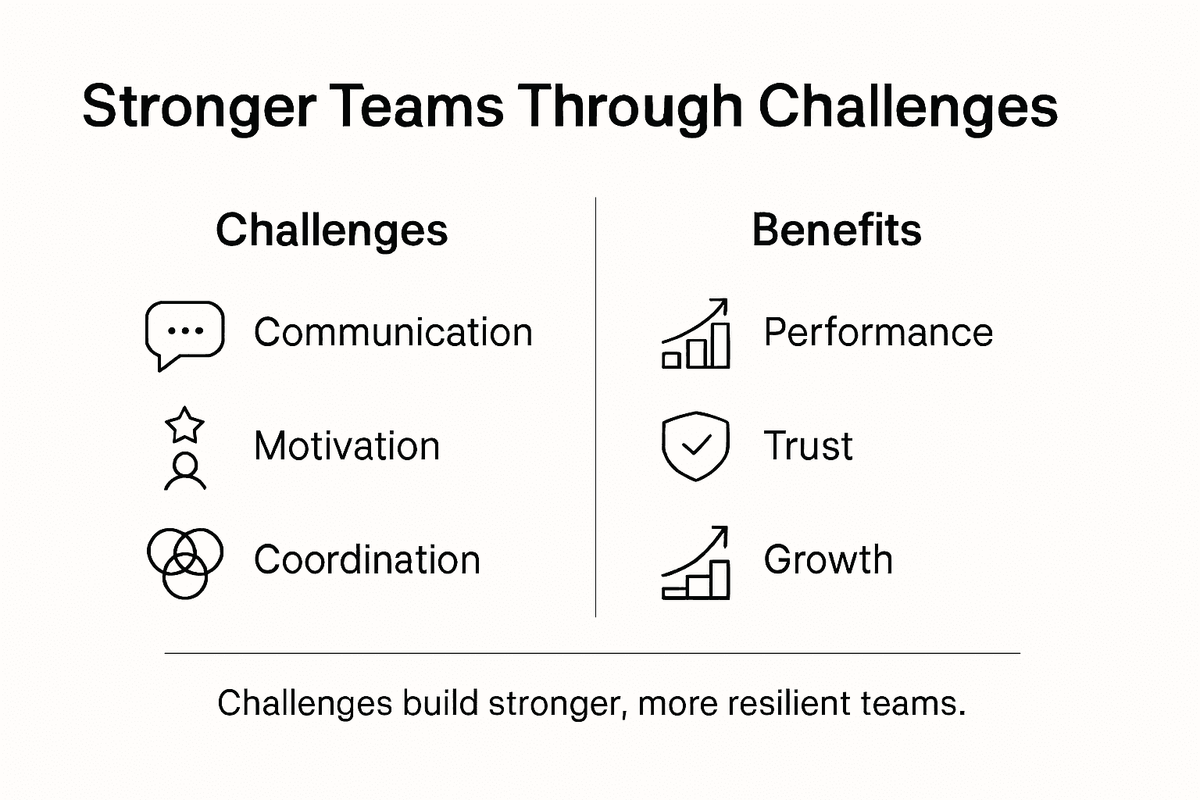
The key characteristics of high-performing teams encompass several critical dimensions. Emotional intelligence emerges as a fundamental attribute, enabling team members to navigate interpersonal complexities with empathy and understanding. Communication transparency, mutual trust, shared accountability, and adaptability form the foundational pillars of team success. Strong teams demonstrate remarkable resilience, with members capable of balancing individual strengths while maintaining collective objectives. These teams consistently exhibit proactive problem solving, open dialogue, and a commitment to continuous learning and improvement.
The benefits of developing robust team characteristics extend across multiple organizational domains. Performance improvements become measurable through enhanced collaboration, reduced conflict, accelerated decision making, and increased innovation potential. Teams that cultivate psychological safety create environments where members feel empowered to share ideas, take calculated risks, and contribute meaningfully. By investing in team development, organizations unlock potential that transcends traditional hierarchical limitations, creating adaptive, responsive, and intellectually dynamic work environments that can effectively navigate complex contemporary business challenges.
Pro tip: Conduct periodic team emotional intelligence assessments to systematically identify and develop collaborative skills across your organization.
How Organizations Use Team Challenges Effectively
Modern organizations strategically leverage team challenges as powerful developmental tools that transcend traditional training approaches. Comprehensive research on teamwork interventions reveals systematic approaches for diagnosing and addressing organizational team dynamics through carefully designed challenge experiences. These interventions are not random exercises but meticulously crafted strategies aimed at uncovering team potential, identifying collaboration barriers, and fostering adaptive organizational capabilities.
Effective team challenge implementation follows a structured methodology with multiple critical components. Diagnostic assessment represents the initial phase, where organizations map existing team capabilities and potential friction points. Leaders must design challenges that target specific skill development areas, such as communication, problem solving, decision making, and cross-functional collaboration. Practical organizational strategies emphasize creating environments that balance psychological safety with strategic performance expectations. This approach enables teams to explore complex scenarios, test collaborative boundaries, and develop resilience through controlled, purposeful challenge experiences.
Successful organizations recognize that team challenges are not punitive measures but transformative learning opportunities. They construct challenge frameworks that encourage experimentation, normalize failure as a learning mechanism, and provide structured reflection opportunities. By integrating challenges across in-person, hybrid, and remote work environments, organizations create flexible developmental pathways that adapt to evolving workforce dynamics. The most sophisticated approaches incorporate continuous feedback mechanisms, allowing real-time insights into team performance and immediate opportunities for skill refinement and personal growth.
Pro tip: Design team challenges with clear learning objectives and intentional debriefing processes to maximize developmental impact.
Common Pitfalls and How to Avoid Them
Team dynamics frequently encounter complex challenges that can derail collaborative efforts. Research identifying fundamental teamwork pitfalls reveals nine critical obstacles organizations must proactively address. Understanding these potential roadblocks enables leaders to design strategic interventions that prevent performance degradation and maintain team cohesion.
The most significant team challenge pitfalls emerge from communication breakdowns, role ambiguity, and motivational misalignment. Authoritative academic research highlights that teams struggle most with excessive coordination costs, inconsistent individual motivation, and ineffective conflict resolution mechanisms. Common red flags include persistent communication silos, undefined team member responsibilities, unequal workload distribution, lack of psychological safety, and absence of clear performance metrics. These challenges can create toxic team environments where collaboration becomes difficult and individual frustration escalates.
Successful organizations develop sophisticated mitigation strategies to preemptively address potential team challenge pitfalls. Proactive approaches include implementing transparent role definitions, establishing explicit communication protocols, creating regular feedback mechanisms, and designing performance evaluation systems that reward collaborative behaviors. Leaders must cultivate environments that normalize constructive disagreement, provide structured conflict resolution pathways, and maintain a continuous learning orientation. By recognizing these challenges as opportunities for growth rather than insurmountable obstacles, teams can transform potential weaknesses into strengths, building resilience and adaptability.
Pro tip: Conduct periodic anonymous team health assessments to identify emerging challenges before they become entrenched systemic issues.
Strengthen Your Teams by Turning Challenges into Opportunities
The article highlights key team-based challenges such as communication barriers, motivational misalignment, and coordination complexity that can often block your team’s progress. At quizado.com, we understand these pain points and offer a customizable, interactive quiz platform designed specifically to enhance collaboration, build trust, and improve team dynamics through engaging, game-inspired formats. Our solution supports meaningful team-building by fostering emotional intelligence, open communication, and shared accountability in a fun and memorable way.

Discover how you can transform team obstacles into growth opportunities with quizado.com. Start creating personalized team-building experiences that align with your organizational goals and boost motivation today. Visit quizado.com to explore our flexible platform and learn how easy it is to implement effective team challenges that improve coordination and performance!
Frequently Asked Questions
What are common team-based challenges in organizations?
Common team-based challenges include communication barriers, coordination complexity, motivational alignment, emotional dynamics, and behavioral inconsistencies. These challenges arise from mismatched communication styles, distributed team structures, and differences in individual and collective goals.
How can organizations effectively address team challenges?
Organizations can address team challenges by conducting regular diagnostics to identify emerging issues, implementing clear communication protocols, fostering psychological safety, and creating structured feedback mechanisms that promote continuous learning and improvement.
What role does emotional intelligence play in team dynamics?
Emotional intelligence is crucial for team dynamics as it enables members to navigate interpersonal relationships with empathy, build trust, and maintain open communication. Teams with high emotional intelligence tend to be more resilient and collaborative.
What are some practical interventions to enhance team performance?
Practical interventions include setting clear performance expectations, conducting periodic emotional intelligence assessments, designing team challenges with specific learning objectives, and establishing regular check-ins to reinforce accountability and collaboration.
Recommended
Host a quiz with your group
Find a hosting setup for your venue, company, classroom or activity group.