In this post+
Most american managers find that true teamwork now stretches across multiple countries, cultures, and time zones. The shift from rigid hierarchies to networked global squads means old-school approaches often fall short. With over 75 percent of international companies using digital tools to spark collaboration, understanding what defines organizational teamwork today helps HR leaders harness the full power of customized quiz experiences that genuinely engage and unify modern teams.
Table of Contents
- What Defines Organizational Teamwork Today
- Core Types of Teams in Organizations
- Key Benefits for Global Companies
- Modern Challenges and Trends Shaping Teamwork
- Best Practices for Building Team Cohesion
Key Takeaways
| Point | Details |
|---|---|
| Organizational Teamwork Evolution | Modern teamwork emphasizes flexibility and cross-functional collaboration, breaking down traditional silos within organizations. |
| Team Types and Their Strengths | Various team structures, such as project teams and self-managed teams, serve specific purposes and enhance problem-solving capabilities. |
| Global Team Benefits | Effective global teamwork fosters cost efficiency, diverse insights, and enhanced organizational agility, driving greater innovation. |
| Building Cohesion | Intentional leadership and structured practices are essential for cultivating team cohesion and psychological safety among members. |
What Defines Organizational Teamwork Today
Organizational teamwork has transformed dramatically in recent years, evolving from traditional hierarchical structures to dynamic, interconnected networks of professionals. Modern teams are increasingly characterized by their ability to collaborate across geographical, cultural, and technological boundaries, representing a fundamental shift in how organizations approach collective work.
Today's organizational teamwork is distinguished by several critical elements. Flexibility has become paramount, with teams now requiring rapid adaptation to changing business environments. Cross-functional collaboration means professionals from diverse departments and skill sets work together, breaking down traditional organizational silos. Technological infrastructure plays a crucial role, enabling real-time communication and project management across global teams. Virtual collaboration tools have fundamentally reshaped how team members interact and coordinate their efforts.
Successful teams now prioritize psychological safety, creating environments where members feel comfortable sharing ideas, taking calculated risks, and providing transparent feedback. This approach requires leaders to foster trust, encourage open communication, and recognize that team effectiveness depends more on collective dynamics than individual brilliance. Cultural intelligence has become essential, with team members needing to navigate complex interpersonal and cross-cultural interactions effectively.
Pro tip: Invest in regular team-building activities that develop trust, communication skills, and mutual understanding across your organization's diverse workforce.
Core Types of Teams in Organizations
Organizational teams have evolved into sophisticated structures that address complex business challenges through varied configurations. Modern organizations utilize multiple team types strategically, each designed to accomplish specific objectives and solve unique workplace problems, reflecting the nuanced approach required in contemporary business environments.
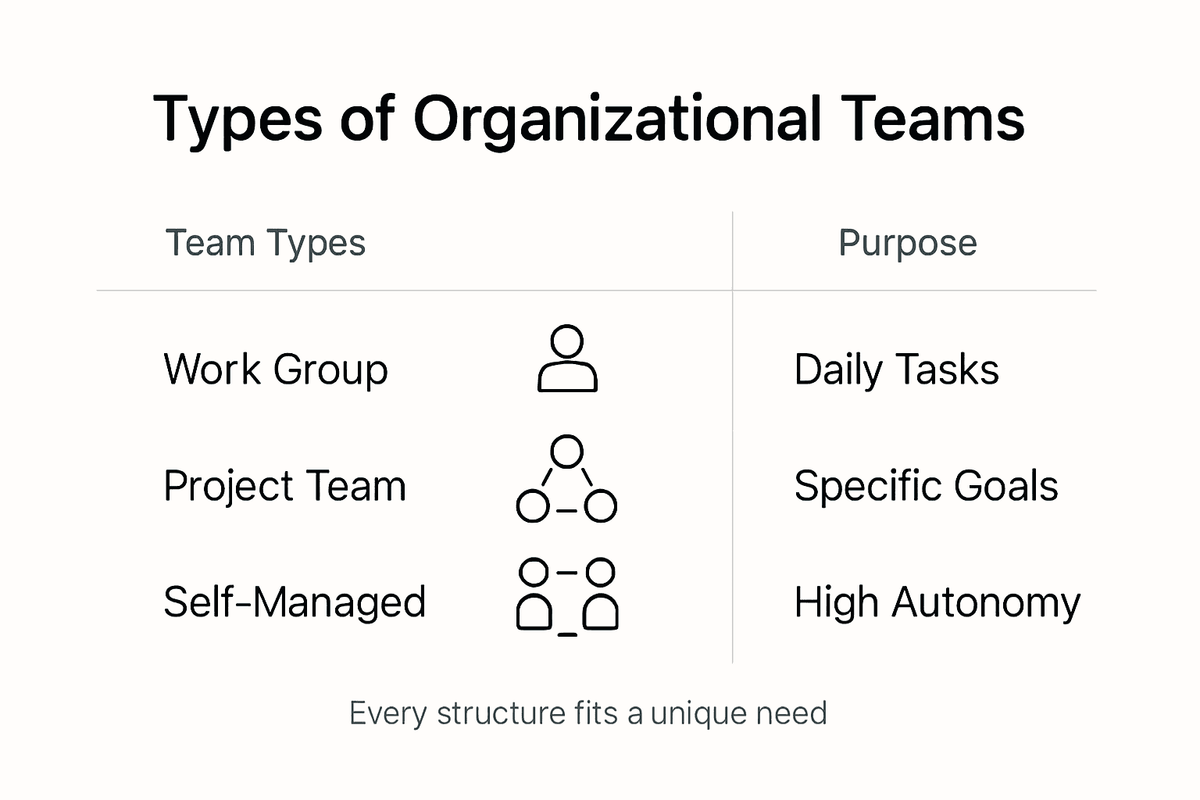
Work groups represent the most fundamental team structure, typically organized around natural departmental divisions like marketing, finance, or human resources. These teams focus on ongoing operational responsibilities and maintain consistent performance standards. In contrast, project teams are temporary assemblies created to address specific initiatives with defined timelines and deliverables. Process improvement teams emerge as another critical organizational team type, specifically focused on analyzing and enhancing existing organizational workflows and efficiency mechanisms.
Self-managed teams represent a more advanced organizational model, characterized by high autonomy and minimal direct supervision. These teams are empowered to make independent decisions, manage their own performance, and take collective responsibility for outcomes. Action teams, often found in emergency services, healthcare, and aerospace, represent another specialized category requiring rapid coordination and precise execution under dynamic conditions. Advisory teams, typically composed of subject matter experts, provide strategic guidance and specialized insights to organizational leadership.
Pro tip: Carefully match team structure to your specific organizational goals, recognizing that different team types offer unique advantages in problem-solving and performance delivery.
Here is a comparison of core organizational team types and their distinct strengths:
| Team Type | Typical Purpose | Key Strength |
|---|---|---|
| Work Group | Departmental operations | Consistent output |
| Project Team | Defined projects or initiatives | Goal focus |
| Process Improvement | Workflow optimization | Efficiency gains |
| Self-Managed | Autonomous performance | High ownership |
| Action Team | Urgent response or execution | Rapid adaptability |
| Advisory Team | Specialized recommendations | Expert guidance |
Key Benefits for Global Companies
Global companies increasingly recognize that strategic teamwork delivers far more than incremental improvements. Organizational performance dramatically transforms when teams are empowered to collaborate across traditional boundaries, creating unprecedented opportunities for innovation and competitive advantage.
The primary benefits of effective global teamwork extend beyond simple productivity. Cost efficiency emerges as a critical advantage, with distributed teams reducing overhead expenses associated with physical infrastructure. Cross-cultural teams bring unique perspectives that drive creative problem-solving, enabling organizations to develop more sophisticated, nuanced strategies for complex global challenges. Technological integration allows seamless communication, breaking down geographical barriers and enabling real-time collaboration across multiple time zones and cultural contexts.

Companies investing in robust team structures experience significant strategic advantages. Enhanced organizational agility allows faster response to market changes, while diverse team compositions generate more comprehensive insights. Knowledge transfer becomes accelerated, with team members learning from each other's unique backgrounds and expertise. Talent retention improves as employees experience more meaningful, collaborative work environments that value individual contributions within collective frameworks.
Pro tip: Systematically measure team performance through both quantitative metrics and qualitative feedback to continuously optimize your global collaboration strategies.
Modern Challenges and Trends Shaping Teamwork
Contemporary organizational teams are navigating unprecedented complexity and transformation, with emerging challenges fundamentally reshaping how professionals collaborate and deliver results. Remote and hybrid work models have dramatically altered traditional team dynamics, requiring new approaches to communication, trust-building, and performance management across distributed environments.
Technological integration stands at the forefront of these transformative trends. Artificial intelligence and advanced collaboration platforms are rapidly changing team interactions, enabling more sophisticated coordination while simultaneously introducing complex adaptation requirements. Organizations must now balance technological efficiency with human-centric approaches that maintain meaningful connections. Global teams are experiencing significant pressure to streamline communication, overcome information silos, and develop more agile, responsive collaboration strategies.
The most successful teams are developing new competencies centered on adaptability, cross-cultural communication, and continuous learning. Psychological safety has become a critical metric, with organizations recognizing that innovative problem-solving emerges from environments where team members feel empowered to share diverse perspectives. Generational shifts are also driving changes, with younger professionals demanding more flexible, purpose-driven team structures that prioritize meaningful engagement over traditional hierarchical models.
Pro tip: Regularly audit your team's communication practices and technological tools to ensure they genuinely support, rather than complicate, collaborative effectiveness.
This table summarizes challenges and responsive trends shaping modern teamwork:
| Challenge | Emerging Team Trend | Outcome Sought |
|---|---|---|
| Remote workforce | Advanced digital platforms | Connected collaboration |
| Cross-cultural barriers | Cultural intelligence training | Effective communication |
| Tech change pace | Continuous learning | Increased adaptability |
| Siloed information | Agile knowledge sharing | Faster decision-making |
| Generational diversity | Flexible team structures | Higher engagement |
Best Practices for Building Team Cohesion
Successful team cohesion requires strategic and intentional approaches that go beyond traditional management techniques. Organizations must recognize that cohesion is not an automatic outcome but a deliberate process requiring consistent investment in relationship-building, communication, and shared understanding.
Shared identity emerges as a fundamental element of strong team dynamics. Research-backed interventions emphasize creating clear team goals, establishing trust mechanisms, and developing structured team practices that promote collective ownership. This involves developing communication protocols that encourage open dialogue, creating opportunities for team members to understand each other's strengths, and designing collaborative experiences that highlight interdependence and mutual support.
Leadership plays a critical role in nurturing team cohesion. Effective leaders create psychological safety by modeling vulnerability, encouraging diverse perspectives, and demonstrating genuine commitment to team growth. They must balance individual recognition with collective achievement, developing reward systems that incentivize collaborative behaviors. Virtual teams require even more intentional approaches, with leaders using technology not just as a communication tool but as a platform for building meaningful connections and shared experiences.
Pro tip: Implement quarterly team reflection sessions where members can openly discuss team dynamics, celebrate collective achievements, and collaboratively develop improvement strategies.
Elevate Your Organizational Teamwork with Interactive Team-Building Experiences
The challenges of fostering psychological safety, building cohesion, and driving cross-cultural collaboration are at the heart of effective organizational teamwork today. When teams struggle to create trust or adapt rapidly to new business environments, engagement suffers and performance stalls. Our platform directly addresses these key pain points by offering customizable, interactive quiz games designed to unify your workforce through fun and meaningful collaboration.
Interactive team-building games create environments where trust develops naturally, encouraging open communication and shared ownership—concepts highlighted in the latest research on team cohesion and organizational dynamics. Whether your teams are remote, hybrid, or in-person, Quizado's flexible design lets you personalize quizzes with your company branding and setup games to break down silos, celebrate diversity, and spark fresh perspectives with real-time playful competition.
Challenge your teams to strengthen their collaboration and agility now with tools proven to enhance cohesion and engagement. Discover how easy it is to bring dynamic quiz experiences to your workplace at Quizado. Empower your managers and teams with games that transform learning into collective achievement and help your organization drive results globally.
Frequently Asked Questions
What are the key elements of modern organizational teamwork?
Modern organizational teamwork is characterized by flexibility, cross-functional collaboration, technological infrastructure, psychological safety, and cultural intelligence. These elements enable teams to adapt and perform effectively in dynamic business environments.
How do different types of teams function within organizations?
Different team types serve specific purposes: work groups handle ongoing operations, project teams focus on temporary initiatives, process improvement teams work on enhancing workflows, self-managed teams operate with high autonomy, action teams respond to urgent situations, and advisory teams provide expert guidance to leadership.
What benefits do global companies gain from effective teamwork?
Global companies that leverage effective teamwork experience enhanced productivity, cost efficiency, improved organizational agility, accelerated knowledge transfer, and higher talent retention. These factors contribute to a competitive advantage and foster innovation across different markets.
What are some best practices for building team cohesion?
To build team cohesion, organizations should focus on establishing a shared identity, creating trust mechanisms, enhancing communication protocols, and nurturing leadership that supports psychological safety. Regular reflection sessions can also help teams celebrate achievements and develop improvement strategies.
Recommended
Host a quiz with your group
Find a hosting setup for your venue, company, classroom or activity group.