
In this post+
Nearly half of American employees feel disconnected from their remote teams, making meaningful engagement a growing challenge for HR leaders worldwide. As multinational organizations expand across the globe, building genuine cohesion requires more than routine check-ins. Innovative, interactive gaming experiences now give corporate managers the creative tools to connect diverse teams, strengthen collaboration, and transform virtual teamwork into something memorable and productive.
Table of Contents
- Defining Team Engagement In Corporate Settings
- Types Of Team Engagement Strategies For Work
- How Engagement Impacts Remote Team Performance
- Key Drivers Of Engagement For Global Teams
- Risks Of Low Engagement In The Workplace
- Leveraging Interactive Games For Team Cohesion
Key Takeaways
| Point | Details |
|---|---|
| Engagement is Critical | Team engagement goes beyond participation; it's essential for creativity and problem solving in organizations. |
| Diverse Strategies Needed | Successful engagement requires tailored strategies that foster connection and inclusivity across diverse teams. |
| Technology's Role | Modern tools enable real-time collaboration and must be integrated into engagement practices to meet workforce expectations. |
| Addressing Low Engagement Risks | Organizations must proactively assess engagement levels to mitigate risks such as decreased morale and increased turnover. |
Defining Team Engagement in Corporate Settings
Team engagement represents a complex organizational dynamic where employees actively invest their cognitive, emotional, and behavioral resources toward achieving collective goals. Understanding team engagement requires recognizing it as more than simple participation - it's a profound psychological commitment to collaborative success. Positive interdependence emerges as a critical framework illustrating how team members perceive their interconnected potential.
In corporate environments, team engagement transcends traditional performance metrics. It involves creating an ecosystem where individuals feel genuinely connected to their colleagues, organizational mission, and shared strategic objectives. Successful engagement strategies transform workplace interactions from transactional exchanges to meaningful collaborations that drive innovation and productivity. HR managers recognize that engaged teams demonstrate significantly higher creativity, problem solving capabilities, and resilience compared to disconnected work groups.
Modern global teams face unique engagement challenges requiring intentional, strategic approaches. Cultural diversity, remote work technologies, and distributed workforce models demand nuanced engagement techniques that bridge geographical and cultural differences. Team motivation strategies must now incorporate digital communication tools, virtual team building experiences, and inclusive practices that respect individual perspectives while maintaining cohesive team dynamics.
Pro Tip - Engagement Assessment: Conduct quarterly anonymous surveys measuring team members' emotional connection, perceived organizational support, and collaborative satisfaction to proactively identify and address potential engagement barriers before they impact performance.
Types of Team Engagement Strategies for Work
Engagement strategies in modern corporate environments require a multifaceted approach that addresses diverse workforce needs and motivational dynamics. Organizations are increasingly recognizing that effective team engagement techniques must go beyond traditional performance management to create meaningful workplace experiences that inspire genuine commitment.
Successful team engagement strategies typically fall into several key categories. Social interaction strategies include hosting team lunches, organizing company sporting events, and creating collaborative spaces that encourage informal interactions. Professional development strategies focus on continuous learning, providing growth opportunities, and training programs that support individual career progression. Cultural alignment strategies emphasize building shared values, establishing daily rituals that reinforce organizational identity, and creating communication platforms that connect distributed team members.
Technology plays a critical role in modern engagement approaches, especially for global teams. Digital platforms now enable real time collaboration, virtual team building experiences, and communication tools that bridge geographical distances. Companies are developing sophisticated engagement models that combine digital interaction, personalized recognition programs, and flexible work arrangements to meet the complex needs of contemporary workforce expectations. Team participation strategies must now integrate technological solutions with human centered design principles.
Pro Tip - Engagement Mapping: Develop a comprehensive engagement matrix that tracks individual and team engagement metrics across multiple dimensions, allowing for targeted interventions and personalized motivation strategies.
Here is a summary of major team engagement strategy categories and their typical benefits:
| Strategy Category | Key Features | Typical Benefits |
|---|---|---|
| Social Interaction | Team lunches, informal events | Boosts camaraderie, morale |
| Professional Development | Learning, skill growth, advancement | Supports retention, motivation |
| Cultural Alignment | Shared values, identity rituals | Enhances belonging, trust |
| Technology-Driven | Digital tools for collaboration | Enables flexible teamwork |
How Engagement Impacts Remote Team Performance
Remote team performance is fundamentally shaped by the depth and quality of team engagement, with digital interactions replacing traditional workplace connection points. Strategies to boost team engagement online have become critical for maintaining productivity and team cohesion in distributed work environments where physical proximity no longer dictates collaborative effectiveness.
The impact of engagement on remote team performance manifests through multiple interconnected dimensions. Psychological safety emerges as a primary indicator, where team members feel comfortable sharing ideas, taking calculated risks, and providing transparent feedback without fear of negative consequences. Highly engaged remote teams demonstrate measurably higher problem solving capabilities, faster decision making processes, and more innovative thinking compared to disconnected virtual workgroups. Team engagement activities play a crucial role in creating these collaborative ecosystems that transcend geographical boundaries.
Technological platforms now serve as critical infrastructure for maintaining team engagement, enabling real time communication, collaborative project management, and virtual interaction spaces that simulate organic workplace interactions. Performance metrics increasingly reflect not just individual output, but the quality of team interconnectedness, with engagement directly correlating to reduced turnover rates, increased discretionary effort, and more resilient organizational cultures. Remote teams that prioritize continuous communication, public recognition, and meaningful interpersonal connections consistently outperform traditional work models.
Pro Tip - Remote Engagement Calibration: Implement quarterly virtual team pulse surveys that measure engagement across multiple dimensions, using anonymous feedback to continuously refine communication strategies and team building approaches.
Key Drivers of Engagement for Global Teams
Global team engagement is a complex ecosystem driven by multifaceted psychological, cultural, and organizational factors that transcend traditional workplace dynamics. Employee recognition strategies represent a foundational element in creating meaningful connections across geographically dispersed teams, transforming workplace interactions from transactional exchanges to genuine collaborative experiences.
The key drivers of engagement for global teams encompass several critical dimensions. Communication transparency emerges as a primary catalyst, where organizations establish robust platforms that enable real time, contextually rich interactions regardless of time zones or cultural backgrounds. Team collaboration workflows must intentionally create spaces for meaningful dialogue, ensuring that every team member feels heard, valued, and integral to collective success. Professional development opportunities, personalized recognition programs, and mechanisms that promote work life balance become instrumental in sustaining motivation across diverse workforce segments.

Technological infrastructure plays a pivotal role in enabling engagement for global teams. Advanced communication platforms, collaborative project management tools, and interactive digital environments now serve as the connective tissue that bridges geographical and cultural gaps. Performance management systems increasingly emphasize holistic metrics that capture not just individual output, but the quality of team interconnectedness, interpersonal dynamics, and collective problem solving capabilities. Organizations that successfully integrate human centered design principles with technological solutions create engagement models that feel intuitive, responsive, and genuinely supportive of individual and team potential.
Pro Tip - Global Engagement Calibration: Develop a standardized yet flexible engagement assessment framework that can be customized across different cultural contexts, allowing for nuanced understanding of team dynamics while maintaining consistent measurement principles.
Risks of Low Engagement in the Workplace
Low employee engagement represents a critical organizational vulnerability that can systematically erode workplace performance and cultural integrity. Employee engagement strategies reveal that disengaged teams create cascading negative consequences that extend far beyond individual productivity, potentially compromising entire organizational ecosystems.
The quantifiable risks of low engagement manifest through multiple interconnected dimensions. Decreased productivity emerges as the most immediate and measurable impact, with disengaged employees demonstrating significantly reduced discretionary effort and innovative thinking. Turnover rates escalate dramatically in low engagement environments, as talented professionals seek workplace cultures that provide meaningful connection, recognition, and professional growth opportunities. Team engagement tactics become essential in mitigating these potential organizational risks, creating proactive frameworks that address underlying motivational challenges.
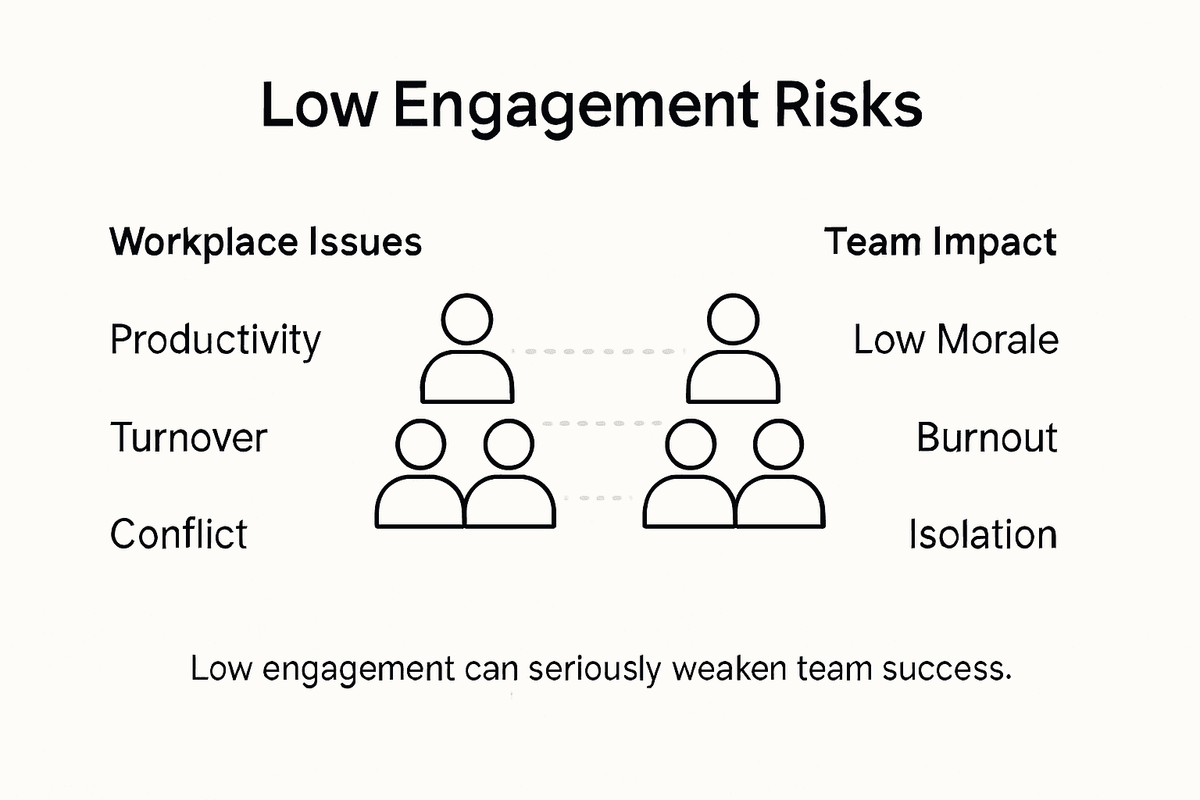
Psychological and cultural consequences of low engagement can be even more profound than measurable performance metrics. Reduced team morale creates toxic workplace dynamics where collaboration diminishes, communication becomes transactional, and collective problem solving capabilities deteriorate. Organizations experiencing chronic low engagement often face compounding challenges, including decreased customer satisfaction, reputation damage, and increased operational friction. The financial implications are substantial, with studies indicating that disengaged workforces can cost companies up to 34% of their annual salary expenditures through reduced productivity and increased turnover.
Compare the main risks of low engagement for organizations:
| Risk Area | Impact on Organization | Example Consequences |
|---|---|---|
| Productivity | Declines across teams | Missed deadlines, lower output |
| Turnover | Higher employee attrition | Costly recruitment, instability |
| Team Morale | Decreased collaboration | Siloed teams, toxic culture |
| Financial Performance | Increased operational costs | Lost revenue, reduced profit |
Pro Tip - Engagement Risk Assessment: Implement quarterly anonymous engagement pulse surveys that capture nuanced psychological indicators of workplace sentiment, allowing leadership to identify and address potential disengagement triggers before they become systemic organizational challenges.
Leveraging Interactive Games for Team Cohesion
Interactive games have emerged as a powerful mechanism for building team cohesion, transforming traditional team building approaches into dynamic, engaging experiences that transcend geographical and cultural boundaries. Team building activities represent more than simple entertainment, serving as strategic tools for developing trust, communication, and collaborative problem solving skills in modern workplace environments.
The psychological mechanisms underlying interactive games are particularly potent for global teams. Carefully designed game experiences create shared challenges that require collective intelligence, encouraging team members to communicate across cultural differences, develop mutual understanding, and build psychological safety. Interactive team game strategies can systematically break down communication barriers, enabling participants to experience collaborative success in low stakes, enjoyable environments that naturally foster interpersonal connections.
Technology has revolutionized the landscape of interactive team engagement, enabling sophisticated virtual experiences that simulate complex collaborative scenarios. Digital platforms now offer immersive game environments that can be customized to reflect specific organizational challenges, learning objectives, and cultural contexts. These interactive experiences go beyond traditional team building by providing measurable insights into team dynamics, individual communication styles, and collective problem solving capabilities. Advanced game design principles integrate elements of competition, cooperation, and skill development to create holistic engagement experiences that are simultaneously entertaining and strategically meaningful.
Pro Tip - Game Experience Design: Develop game experiences with clear learning objectives, ensuring that every interactive element connects directly to desired team development outcomes while maintaining an atmosphere of genuine enjoyment and voluntary participation.
Strengthen Your Global Team Engagement with Interactive Quiz Games
Global teams face unique challenges in building meaningful connections across distances and cultures as highlighted in the article on the Importance of Team Engagement for Global Teams. When communication barriers and time zone differences hinder collaboration it becomes critical to adopt strategies that boost psychological safety transparency and shared motivation. The pain points of remote collaboration and cultural alignment call for innovative engagement tools that turn virtual meetings from transactional to transformational.
That is exactly where quizado.com can help your organization thrive. Our platform offers customizable team-building quiz games inspired by popular shows such as Jeopardy and Family Feud. Designed for both online and in-person settings our software enables teams worldwide to connect through fun interactive experiences that build trust foster communication and nurture collective problem solving. With features like team configurations branding options and remote smartphone control you can create engaging activities that truly reflect your company culture and promote inclusivity.
Discover how interactive team building games transform engagement into a measurable advantage for your global workforce.

Enhance your team cohesion today by exploring our flexible quiz game platform at quizado.com. Don’t wait let your global teams experience the power of entertainment-driven engagement to improve collaboration and drive success now.
Frequently Asked Questions
What is team engagement and why is it important for global teams?
Team engagement refers to the level of commitment and involvement that employees have towards their team's goals and the organization. For global teams, it is crucial as it fosters collaboration, enhances communication, and drives performance across diverse cultural backgrounds.
How can organizations assess team engagement in global teams?
Organizations can assess team engagement through quarterly anonymous surveys that measure emotional connection, perceived organizational support, and collaborative satisfaction among team members. This helps identify areas needing improvement.
What strategies can be implemented to improve engagement in remote teams?
To improve engagement in remote teams, organizations can utilize technology-driven solutions like digital communication tools, virtual team-building experiences, and professional development opportunities to create an inclusive and connected work environment.
What are the risks associated with low engagement in global teams?
Low engagement in global teams can lead to decreased productivity, higher turnover rates, and diminished team morale. This can result in negative consequences such as reduced collaboration, missed deadlines, and increased operational costs.
Recommended
Host a quiz with your group
Find a hosting setup for your venue, company, classroom or activity group.