Leadership in Teamwork: Driving Collaboration and Results

Most American organizations report that over 75% of workplace challenges stem from unclear leadership roles within teams. In today’s diverse business climate, corporate team leaders and HR managers must rethink their approach to building trust, communication, and shared accountability. This guide uncovers how understanding dynamic leadership methods can help large companies worldwide transform team productivity and strengthen core collaboration skills through proven, interactive team-building activities.
Table of Contents
- Defining Leadership In Teamwork Dynamics
- Types Of Leadership Approaches In Teams
- Key Traits And Skills For Team Leaders
- Roles, Responsibilities, And Accountability
- Common Pitfalls And Misconceptions
Key Takeaways
| Point | Details |
|---|---|
| Leadership is Collaborative | Modern leadership emphasizes shared decision-making and collaboration among team members rather than hierarchical control. |
| Cultivate Psychological Safety | Leaders should foster an environment where team members feel safe to express ideas and take risks. |
| Embrace Adaptive Leadership | Successful leaders integrate various styles and approaches to respond flexibly to team needs and challenges. |
| Recognize Individual Strengths | Effective leadership involves understanding and leveraging the unique talents of each team member for overall success. |
Defining Leadership in Teamwork Dynamics
Leadership in teamwork represents a dynamic and complex process that transcends traditional hierarchical models. Modern organizational research increasingly views leadership as a collaborative, reciprocal phenomenon where influence flows multidirectionally among team members. Emerging leadership dynamics challenge conventional top-down management approaches, emphasizing shared responsibility and collective decision making.
At its core, teamwork leadership involves creating an environment where individual contributions seamlessly integrate into collective achievements. This approach requires leaders to develop sophisticated interpersonal skills that facilitate communication, trust, and mutual understanding. Unlike traditional leadership models that position one individual as the sole decision maker, contemporary perspectives recognize leadership as a fluid process where team members collectively navigate challenges, share insights, and adapt to changing circumstances.
Successful leadership in teamwork hinges on several key principles. First, leaders must cultivate psychological safety, enabling team members to express ideas without fear of ridicule or retribution. Second, they need to establish clear communication channels that promote transparency and open dialogue. Third, effective leaders recognize and leverage the unique strengths of individual team members, creating synergistic environments where collective intelligence emerges. Cross-disciplinary team leadership demonstrates that adaptability and continuous learning are crucial for navigating complex organizational landscapes.
Pro tip: Encourage rotating leadership roles within your team to develop multiple perspectives and enhance collective problem solving capabilities.
Types of Leadership Approaches in Teams
Organizational leadership is not a one-size-fits-all concept, but a nuanced spectrum of approaches tailored to different team dynamics and objectives. Vertical and horizontal leadership models represent two fundamental paradigms that organizations leverage to drive team performance and collaboration.
Traditional vertical leadership emphasizes hierarchical structures where authority flows from designated managers downward. In this model, leaders hold primary decision-making power and team members primarily execute directives. Conversely, horizontal or shared leadership distributes influence across team members, enabling collective decision-making and promoting a more collaborative environment. This approach recognizes that expertise and leadership potential exist at multiple levels within an organization, not just among formal management roles.
Modern team leadership increasingly embraces adaptive approaches that blend multiple styles. Virtual team leadership strategies demonstrate the need for flexible leadership that can respond to changing technological and interpersonal dynamics. Transformational leadership, for instance, focuses on inspiring and motivating team members, while transactional leadership centers on clear expectations, rewards, and structured performance management. Effective leaders often integrate elements from different approaches, creating a dynamic leadership model that responds to specific team needs and organizational contexts.
The following table compares key leadership approaches used in teams to clarify their core features and ideal applications:
| Leadership Approach | Core Attribute | Ideal Use Case |
|---|---|---|
| Vertical | Clear hierarchy, top-down direction | Large or highly regulated teams |
| Horizontal (Shared) | Distributed decision making | Creative or cross-functional groups |
| Transformational | Inspires and motivates change | Teams undergoing growth or change |
| Transactional | Structured, reward-based management | Task-driven or deadline-focused teams |
Pro tip: Regularly assess your team's current challenges and adjust your leadership approach accordingly, recognizing that no single style works universally.
Key Traits and Skills for Team Leaders
Leadership skills represent a complex blend of personal attributes and learned competencies that enable effective team guidance. Global leadership capabilities encompass a sophisticated range of interpersonal and strategic skills that go beyond traditional management techniques, focusing on inspiring and developing team members.
The most successful team leaders demonstrate a remarkable combination of emotional intelligence and strategic thinking. Empathy stands out as a critical trait, allowing leaders to understand and connect with team members on a deeper level. Strategic decision making requires the ability to analyze complex situations, anticipate potential challenges, and create actionable plans that align individual talents with organizational objectives. Adaptive leadership traits highlight the importance of flexibility, innovation, and long-term vision in navigating increasingly complex work environments.

Core leadership skills extend beyond technical expertise to include communication, emotional resilience, and the capacity to foster psychological safety within teams. Effective leaders create environments where team members feel empowered to share ideas, take calculated risks, and contribute fully to collective goals. This involves developing trust, providing constructive feedback, and maintaining a balance between supporting individual growth and driving overall team performance. The most impactful leaders consistently demonstrate authenticity, transparently sharing their own challenges and learning experiences to build genuine connections with their team.
This table summarizes essential traits for effective team leaders and how each trait benefits the organization:
| Leadership Trait | Description | Organizational Benefit |
|---|---|---|
| Empathy | Understanding team perspectives | Higher employee engagement |
| Strategic Thinking | Clear goal-setting and planning | Better business outcomes |
| Adaptability | Responding to change effectively | Increased innovation and resilience |
| Emotional Intelligence | Managing emotions constructively | Stronger collaboration and trust |
Pro tip: Conduct regular self-reflection and seek feedback from your team to continuously improve your leadership approach and emotional intelligence.
Roles, Responsibilities, and Accountability
Successful team performance hinges on clearly defined roles and responsibilities that create a structured yet flexible framework for collaboration. Leadership roles in team environments extend far beyond traditional management hierarchies, encompassing operational, strategic, and boundary-spanning tasks that integrate diverse perspectives and skills.
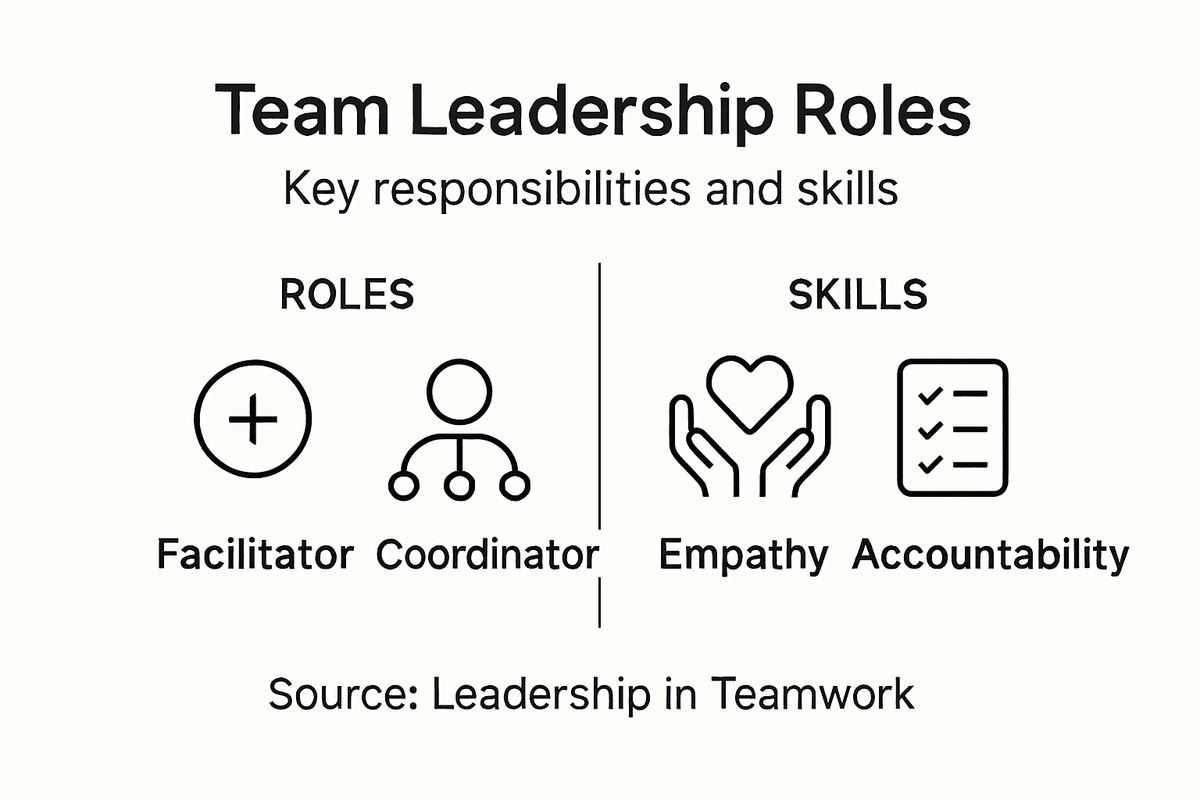
Accountability in team settings requires a multifaceted approach that balances individual performance with collective outcomes. Each team member must understand their specific responsibilities while simultaneously recognizing their contribution to broader team objectives. Engaging leadership strategies emphasize creating environments of trust where team members feel empowered to take ownership of their work, share challenges transparently, and collaborate proactively to resolve complex problems.
Effective role definition involves more than simply assigning tasks. It requires ongoing communication, periodic role reassessment, and a dynamic approach to team member capabilities. Leaders must create clear performance expectations, provide necessary resources, and establish transparent mechanisms for tracking progress and addressing potential performance gaps. This approach ensures that individual strengths are leveraged, potential weaknesses are addressed collaboratively, and team members remain motivated and aligned with overarching organizational goals.
Pro tip: Implement quarterly role review sessions to ensure individual responsibilities remain aligned with evolving team and organizational objectives.
Common Pitfalls and Misconceptions
Leadership misconceptions can significantly undermine team performance and organizational effectiveness. Workplace leadership challenges often stem from outdated perspectives that view leadership as a one-dimensional, top-down directive process, neglecting the complex relational dynamics essential for modern team success.
One prominent misconception is the belief that strong leadership requires constant control and micromanagement. In reality, effective leadership involves creating environments of trust, empowerment, and collaborative decision making. Hybrid team leadership dynamics reveal that rigid leadership approaches frequently fail to address the nuanced needs of diverse teams, particularly in increasingly complex and remote work environments. Leaders who cling to traditional hierarchical models often struggle to foster innovation, adaptability, and genuine team engagement.
Another critical pitfall is the tendency to treat all team members identically, ignoring individual strengths, learning styles, and motivational triggers. Successful leaders recognize that effective team management requires a personalized approach that balances individual development with collective goals. This means moving beyond generic performance metrics and creating tailored support strategies that acknowledge each team member's unique potential. Misconceptions about uniformity can lead to decreased motivation, reduced creativity, and ultimately, diminished team performance.
Pro tip: Regularly conduct anonymous team feedback sessions to identify and address hidden leadership blind spots and team dynamics challenges.
Elevate Your Team Leadership Through Interactive Collaboration
Effective leadership in teamwork demands fostering psychological safety, enhancing communication, and leveraging individual strengths to create collective success. If you want to overcome common challenges like rigid hierarchical control or lack of team engagement, consider embracing dynamic team-building techniques that inspire trust and camaraderie. Quizado.com offers a customizable platform designed to help leaders build these crucial connections by creating interactive quiz games that promote open dialogue and shared problem solving.

Unlock the power of collaborative leadership with Quizado. Whether you are managing remote teams or in-person groups, our versatile quiz experiences support flexible team configuration and personalized branding to make your sessions memorable and meaningful. Take action now to transform your leadership approach with engaging team-building activities that align with the principles of adaptive and shared leadership described in the article. Start building stronger, more resilient teams today at Quizado.
Frequently Asked Questions
What is the role of leadership in effective teamwork?
Leadership in effective teamwork involves creating an environment where individual contributions combine to achieve collective goals, facilitating communication, trust, and mutual understanding among team members.
How can leaders foster psychological safety within teams?
Leaders can foster psychological safety by encouraging open dialogue, allowing team members to express ideas without fear of ridicule or retribution, and by building a culture of trust and support.
What are the key traits of successful team leaders?
Successful team leaders exhibit emotional intelligence, strategic thinking, adaptability, and effective communication skills, which help in connecting with team members and driving collaboration towards common goals.
How do different leadership approaches affect team dynamics?
Different leadership approaches, such as vertical and horizontal models, impact team dynamics by influencing decision-making processes and collaboration, where vertical leadership often entails top-down direction and shared leadership emphasizes collective involvement.
Recommended
Host a quiz with your group
Find a hosting setup for your venue, company, classroom or activity group.

Bring your group together for a game
Try a free starter game, then choose the format and plan for your group.
Trusted by 5,000+ hosts