In this post+
Remote workforces in American companies are seeing over 60 percent higher demand for collaborative team activities. For team leaders managing diverse groups across continents, finding creative ways to maintain unity and engagement is more urgent than ever. This practical guide reveals actionable steps to design custom digital quizzes that inspire healthy competition, drive knowledge sharing, and deepen cross-border connections in even the most fast-paced corporate environments.
Table of Contents
- Step 1: Select the Ideal Quiz Format for Your Team
- Step 2: Configure Teams and Upload Branding Elements
- Step 3: Customize Questions and Themes for Engagement
- Step 4: Launch the Challenge Using Remote Controls
- Step 5: Review Results and Strengthen Team Cohesion
Quick Summary
| Key Insight | Explanation |
|---|---|
| 1. Select Suitable Quiz Formats | Match quiz styles to your team's dynamics for optimal engagement and collaboration. Consider competition versus cooperation based on your team's preferences. |
| 2. Customize Team Structure and Branding | Organize participants into balanced groups and upload visual elements like logos to strengthen team identity and engagement during the quiz. |
| 3. Design Engaging Questions and Themes | Tailor questions and themes to reflect team interests and professional knowledge, incorporating a mix of formats to maintain engagement. |
| 4. Utilize Remote Controls for Interaction | Implement remote controls to enhance interactivity, ensuring all team members can participate seamlessly from any location. |
| 5. Review Results to Foster Cohesion | Analyze quiz results collaboratively to promote understanding, celebrate strengths, and identify areas for team development. |
Step 1: Select the Ideal Quiz Format for Your Team
Selecting the right quiz format will transform your team collaboration from mundane to magnificent. Your goal is to match the quiz style with your team's unique dynamics, learning preferences, and engagement levels.
Start by analyzing your team's composition and communication patterns. Some teams thrive on competitive formats like head-to-head challenges, while others prefer cooperative quiz experiences that emphasize collective problem solving. Customized quizzes can significantly drive team engagement by tailoring content to your specific group's interests and skill sets. Consider factors like team size, remote vs. in-person interaction, and professional backgrounds when designing your quiz approach.
Different quiz formats serve different collaborative objectives. Multiple choice quizzes work well for knowledge testing, while open ended response formats encourage deeper thinking and discussion. Interactive team trivia can break down communication barriers, while scenario based quizzes simulate real world problem solving. Your selection should align with the specific team building or learning outcome you want to achieve.
Here's a comparison of popular quiz formats and their best use cases for team collaboration:
| Quiz Format | Ideal For | Engagement Level |
|---|---|---|
| Multiple Choice | Testing knowledge quickly | Moderate, fast-paced |
| Open Ended | Encouraging discussion | High, promotes deep thinking |
| Team Trivia | Connecting team members | High, breaks barriers |
| Scenario Based | Real world problem solving | High, fosters collaboration |
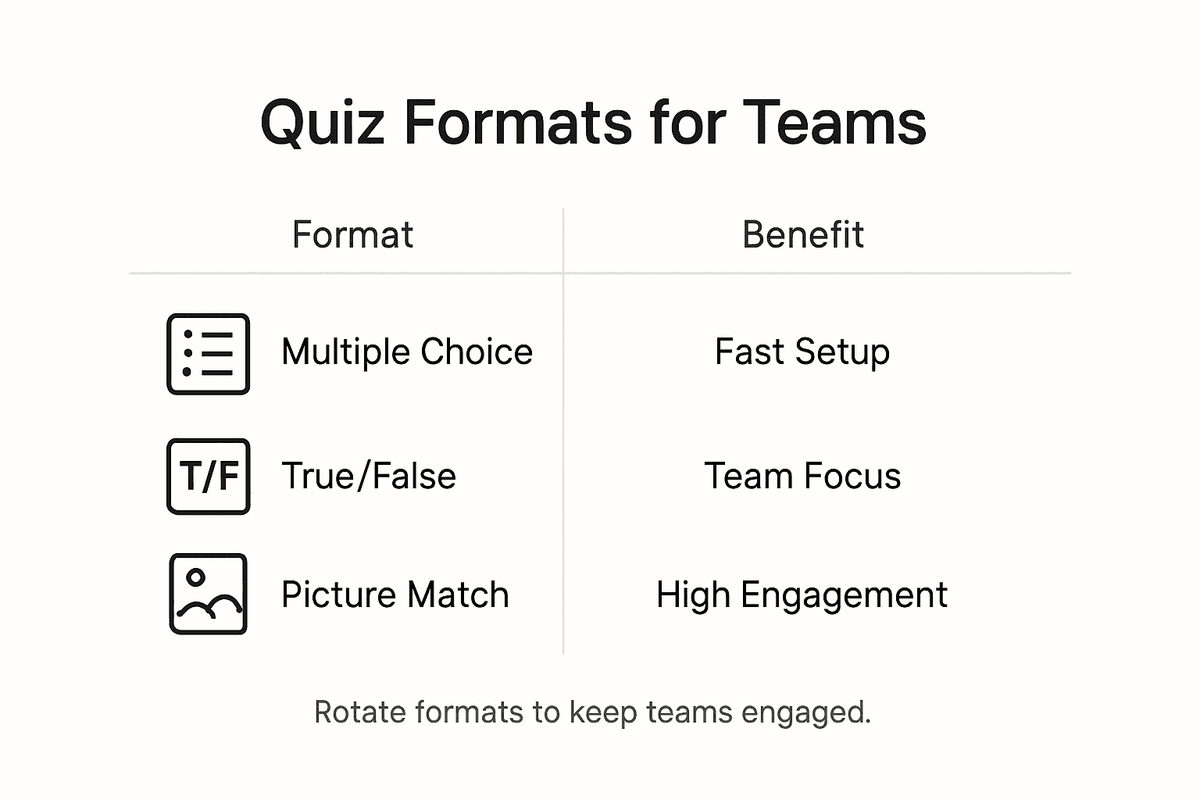
Pro Tip: Rotate quiz formats periodically to maintain team interest and prevent format fatigue by introducing variety in your collaborative game experiences.
Step 2: Configure Teams and Upload Branding Elements
Configuring your team structure and uploading personalized branding elements will transform your quiz experience from generic to extraordinary. This critical step ensures your team feels connected and professionally represented throughout the collaborative challenge.
Start by defining clear team configurations that match your organizational structure. Consider dividing participants into balanced groups that reflect different skill sets and departments. Understanding the role of visual branding in team building helps create a sense of unity and shared purpose. When uploading branding elements, focus on high quality logos, color schemes, and visual assets that represent your team or company identity. Ensure your uploaded graphics are crisp, professionally designed, and sized correctly for optimal display.

Pay attention to team member roles and permissions during configuration. Assign team leaders, determine participation levels, and set up access controls that align with your collaborative objectives. Thoughtful team configuration goes beyond simple grouping it creates a psychological framework that enhances engagement and promotes mutual accountability.
Below is a quick reference on branding element choices and their impact during team quizzes:
| Branding Element | Purpose | Team Impact |
|---|---|---|
| Logos | Team identity | Boosts recognition |
| Colors | Brand consistency | Enhances unity |
| Custom Graphics | Unique look | Increases engagement |
Pro Tip: Test your branding and team configurations before the actual event to identify and resolve any potential technical issues or visual inconsistencies.
Step 3: Customize Questions and Themes for Engagement
Customizing quiz questions and themes is the secret sauce that transforms a standard team activity into an electrifying collaborative experience. Your goal is to craft an immersive challenge that speaks directly to your team's unique personality and professional landscape.

Customizing team games for enhanced collaboration requires strategic thinking about question design and thematic elements. Start by analyzing your team's interests, professional knowledge, and learning objectives. Mix question types to maintain engagement multiple choice for quick knowledge checks, open ended queries for deeper reflection, and scenario based challenges that mirror real world workplace situations. Consider themes that resonate with your team culture whether it is industry specific trivia, company history challenges, or problem solving scenarios that reflect your organizational goals.
Prioritize variety and intellectual stimulation when developing your quiz content. Incorporate multimedia elements like images, short video clips, or interactive challenges that break up traditional text based questions. Balance difficulty levels to ensure all team members feel challenged but not overwhelmed. Include questions that highlight different team members strengths and encourage cross departmental learning and appreciation.
Pro Tip: Pilot test your quiz questions with a small group to validate engagement levels and refine content before rolling out to the entire team.
Step 4: Launch the Challenge Using Remote Controls
Launching your team challenge through remote controls transforms a traditional quiz into an interactive digital experience that keeps every participant engaged and connected regardless of physical location. This step turns your carefully crafted game into a dynamic collaborative adventure.
Prepare your remote control settings by ensuring all team members have access and understand the basic interaction protocols. Verify smartphone compatibility and test connection speeds to prevent technical disruptions during the event. Some remote control features allow real time scoring, instant feedback, and competitive tracking that can dramatically enhance participant motivation. Check that each team member can easily navigate question interfaces, submit answers quickly, and interact with the platform without confusion.
Consider the user experience when configuring remote controls. Create intuitive interfaces that work seamlessly across different devices and operating systems. Provide clear instructions before launching the challenge and consider running a brief tutorial or practice round to help participants feel comfortable with the technology. Pay attention to accessibility features that ensure all team members can participate effectively regardless of their technical expertise.
Pro Tip: Conduct a brief technical rehearsal with team leaders to identify and resolve potential remote control connectivity issues before the actual event.
Step 5: Review Results and Strengthen Team Cohesion
Reviewing quiz results provides a powerful opportunity to transform raw data into meaningful team growth and connection. This final step turns competitive moments into collaborative insights that can reshape your team's communication and understanding.
Understanding the process of building team cohesion requires more than just analyzing scores. Conduct a comprehensive debrief that goes beyond numerical performance. Highlight individual and team strengths discovered during the challenge. Create space for open dialogue where participants can share insights about their collaborative experiences discuss unexpected learning moments and reflect on how different team members contributed to solving complex questions.
Structure your results review to maximize learning and connection. Break down performance metrics in ways that celebrate collective achievement rather than individual competition. Identify skills gaps that emerged during the quiz and discuss potential training or development opportunities. Encourage team members to share personal reflections about their experience recognize innovative thinking and collaborative strategies they observed during the challenge.
Pro Tip: Schedule a follow up meeting within one week to discuss actionable insights gained from the team challenge and develop specific improvement strategies.
Unlock Powerful Team Collaboration with Customized Quiz Challenges
The article "Step by Step Team Challenges to Boost Collaboration Effectively" highlights a common problem many organizations face: creating engaging, meaningful team-building experiences that truly enhance collaboration and break down communication barriers. Key points include selecting the ideal quiz format, uploading personalized branding, designing custom questions, and using remote controls to connect teams both in-person and remotely. These steps aim to overcome challenges like maintaining team interest, fostering mutual accountability, and strengthening cohesion through interactive, thoughtful approaches.
At quizado.com, we understand these exact pain points and provide a flexible platform tailored for managers and teams seeking professional yet playful team-building solutions. Our software supports multiple quiz formats from multiple choice to scenario-based challenges, perfect for varied engagement levels and collaborative goals. With full branding options and smartphone remote controls, we bring your team’s unique identity and connection to the forefront. Explore how to customize team games for enhanced collaboration and leverage the role of visual branding in team building to create truly unforgettable experiences.
Boost your team’s spirit and productivity today by transforming ordinary meetings into dynamic challenges that everyone looks forward to. Visit quizado.com now to start customizing your next team event and see why interactive quizzes are becoming the go-to solution for effective corporate team building. Don’t wait to take your team collaboration to the next level.
Frequently Asked Questions
How do I select the ideal quiz format for my team?
Selecting the right quiz format involves analyzing your team's dynamics and preferences. Consider whether your team thrives on competition or prefers collaboration, and then match the quiz style accordingly. For example, use multiple-choice quizzes for quick knowledge checks or open-ended formats for deeper discussion.
What steps should I take to configure teams and upload branding for my quiz challenges?
Start by defining clear team configurations that balance skill sets and departments. Then, upload high-quality branding elements like logos and color schemes to foster unity. Ensure all graphics are sized correctly for optimal display to enhance team identity during the challenge.
How can I customize questions and themes to keep my team engaged?
To keep your team engaged, tailor quiz questions and themes to reflect their interests and professional knowledge. Use a mix of question types, such as multiple-choice for quick checks and scenario-based challenges for practical application. Additionally, integrate multimedia elements like images or videos to break the monotony of text-based questions.
What should I do to effectively launch the quiz challenge using remote controls?
Prepare by ensuring all team members have access to the quiz and understand the interaction protocols. Test the remote control settings and device compatibility ahead of time. Consider running a brief tutorial or practice round to make participants comfortable with the technology before the actual event.
How can reviewing quiz results strengthen team cohesion?
Reviewing quiz results can help identify individual and team strengths, creating insight into areas for improvement. Conduct a debrief that focuses on celebrating collective achievements and encourage open dialogue about the quiz experience. Schedule a follow-up meeting within one week to discuss actionable insights gained from the challenge and to develop improvement strategies.
Recommended
Host a quiz with your group
Find a hosting setup for your venue, company, classroom or activity group.