In this post+
More than 60 percent of American tech teams struggle to maintain engagement and trust when working remotely. HR managers worldwide know that building strong collaboration across global offices is never simple. Customizable quiz experiences now offer a practical way to help remote teams connect, reveal hidden talents, and strengthen communication. Discover team-building concepts that transform scattered coworkers into a unified, high-performing group.
Table of Contents
- Core Concepts of Team Challenge Planning
- Popular Team Challenge Types for Tech Teams
- Configuring and Customizing Team Challenges
- Using Online Platforms for Team Engagement
- Common Pitfalls and Success Factors
Key Takeaways
| Point | Details |
|---|---|
| Effective Team Dynamics | Successful team challenge planning hinges on intentional design that enhances collaboration among remote groups. |
| Diverse Challenge Types | Incorporate various challenges, such as hackathons and escape rooms, to foster innovation and teamwork. |
| Strategic Customization | Tailor challenges to reflect unique team dynamics and skills, ensuring integrated thinking and adaptive strategies. |
| Utilizing Online Tools | Choose digital collaboration platforms that facilitate seamless communication and enhance team engagement across distances. |
Core Concepts of Team Challenge Planning
Team challenge planning requires understanding complex interaction dynamics that transform remote groups into cohesive collaborative units. Team dynamics research reveals successful teams depend on strategic alignment around shared objectives and communication frameworks.
The fundamental pillars of team challenge planning include intentional team composition, clear goal setting, and structured interaction models. Managers must carefully design experiences that reveal individual strengths while simultaneously building collective capabilities. This means creating challenges that demand diverse skills, encourage mutual support, and generate meaningful shared experiences that transcend physical distance.
Effective team challenge planning operates on several critical dimensions. First, challenges must balance individual contribution with collective achievement. Second, they need transparent rules and objectives that all participants understand. Third, the challenges should provide opportunities for leadership rotation, skills demonstration, and collaborative problem solving. Remote teams particularly benefit from structured interactions that build trust and psychological safety through carefully designed collaborative experiences.
Pro tip: Select team challenges that require multiple team members to solve complex problems collaboratively, ensuring each participant has a unique and essential role in achieving the group's objective.
Popular Team Challenge Types for Tech Teams
Tech teams require diverse challenge types that align with their innovative and dynamic work culture. Team-building challenges encompass multiple strategic approaches designed to enhance collaboration, communication, and collective problem solving across virtual and in-person environments.
Some of the most effective challenge types include hackathons, where team members collaborate intensively to develop innovative solutions within a compressed timeframe. Creative problem-solving competitions push technical professionals to think beyond conventional boundaries, encouraging cross-functional thinking and demonstrating adaptability. Virtual escape rooms and interactive strategy games provide engaging platforms for remote teams to build trust and communication skills while solving complex scenarios that mirror real-world technological challenges.
Tech-specific team challenges often integrate technical skill assessment with interpersonal development. These might involve cross-functional project simulations, code review competitions, architecture design challenges, or collaborative debugging sessions. Such activities not only test technical prowess but also reveal team dynamics, leadership potential, and individual communication strengths. By designing challenges that require collective intelligence and diverse skill sets, organizations can transform routine team interactions into powerful learning and bonding experiences.
Here's a comparison of popular team challenge types used in tech environments:
| Challenge Type | Primary Focus | Example Outcome |
|---|---|---|
| Hackathons | Innovation under pressure | Working demo or prototype |
| Creative Problem Solving Contests | Unconventional thinking | Novel technical solution |
| Virtual Escape Rooms | Communication and trust | Collaborative puzzle solved |
| Code Review Competitions | Code quality and feedback | Improved coding standards |
Pro tip: Rotate challenge leadership roles among team members to ensure everyone experiences both collaborative participation and strategic coordination opportunities.
Configuring and Customizing Team Challenges
Customizing team challenges requires a strategic approach that goes beyond simple game design. Team configuration strategies emphasize the critical importance of understanding each team's unique dynamics, skill sets, and collaborative potential.
Successful challenge configuration involves multiple layers of strategic planning. This includes assessing individual team member strengths, identifying communication patterns, and designing challenges that expose and develop collaborative skills. Managers should create multi-dimensional experiences that test technical competence while simultaneously building interpersonal connections. Key elements include varied difficulty levels, roles that rotate leadership responsibilities, and scenarios that require cross-functional problem solving and mutual dependency.

Technological teams particularly benefit from challenges that mirror real-world complexity. This means developing scenarios that simulate actual workplace challenges, requiring integrated thinking, adaptive strategies, and collective intelligence. Challenges might involve mock project sprints, interdepartmental collaboration simulations, or problem-solving exercises that demand creative thinking and rapid strategic adjustments. The goal is to create an environment where team members learn to trust each other's capabilities, communicate effectively, and leverage diverse perspectives to achieve complex objectives.
Pro tip: Design team challenges with intentional skill diversity, ensuring each participant contributes a unique perspective while working toward a shared goal.
Using Online Platforms for Team Engagement
Online collaborative platforms have revolutionized how remote teams interact and work together. Digital collaboration tools provide sophisticated environments that transcend traditional communication barriers, enabling teams to connect, communicate, and collaborate seamlessly across geographic boundaries.
Effective online engagement requires selecting platforms that support multiple interaction modes. This means choosing tools that facilitate synchronous video meetings, asynchronous messaging, real-time document collaboration, and interactive project management. Key features to consider include integrated communication channels, robust file sharing capabilities, transparent task tracking, and intuitive user interfaces that accommodate different technological skill levels. Successful platforms should enable team members to contribute equally, regardless of their physical location or time zone.
Modern online engagement platforms go beyond simple communication. They create virtual spaces that simulate in-person team dynamics, incorporating features like digital whiteboards, interactive brainstorming tools, gamification elements, and customizable workspaces. These advanced capabilities help combat remote work isolation by creating opportunities for spontaneous interaction, informal communication, and collective problem solving. The most effective platforms transform digital interactions from transactional exchanges into meaningful collaborative experiences that build trust, enhance team cohesion, and drive collective performance.
The table below summarizes key features to consider when selecting online collaboration platforms for remote teams:
| Platform Feature | Why It Matters | Business Impact |
|---|---|---|
| Synchronous Communication | Enables real-time discussions | Faster decision making |
| Asynchronous Collaboration | Supports flexible participation | Increases inclusiveness |
| Integrated Task Tracking | Centralizes progress monitoring | Reduces missed deadlines |
| User-friendly Interface | Lowers adoption barrier | Smooth onboarding for all members |
Pro tip: Select online platforms that offer flexible communication modes and integrate seamlessly with your team's existing technological ecosystem.
Common Pitfalls and Success Factors
Team challenge implementation requires a nuanced understanding of potential obstacles and strategic approaches. Project management pitfalls often emerge from inadequate planning, communication breakdowns, and misaligned team expectations.
Critical pitfalls in team challenge design include oversimplifying complex interactions, failing to account for individual learning styles, and creating challenges that do not authentically reflect real-world workplace dynamics. Managers frequently make mistakes by developing one-size-fits-all experiences that do not recognize team diversity, technological variations, or individual participant motivations. Successful challenge design demands a sophisticated approach that balances structured guidance with creative flexibility, allowing team members to demonstrate their unique problem-solving capabilities while maintaining a collaborative framework.
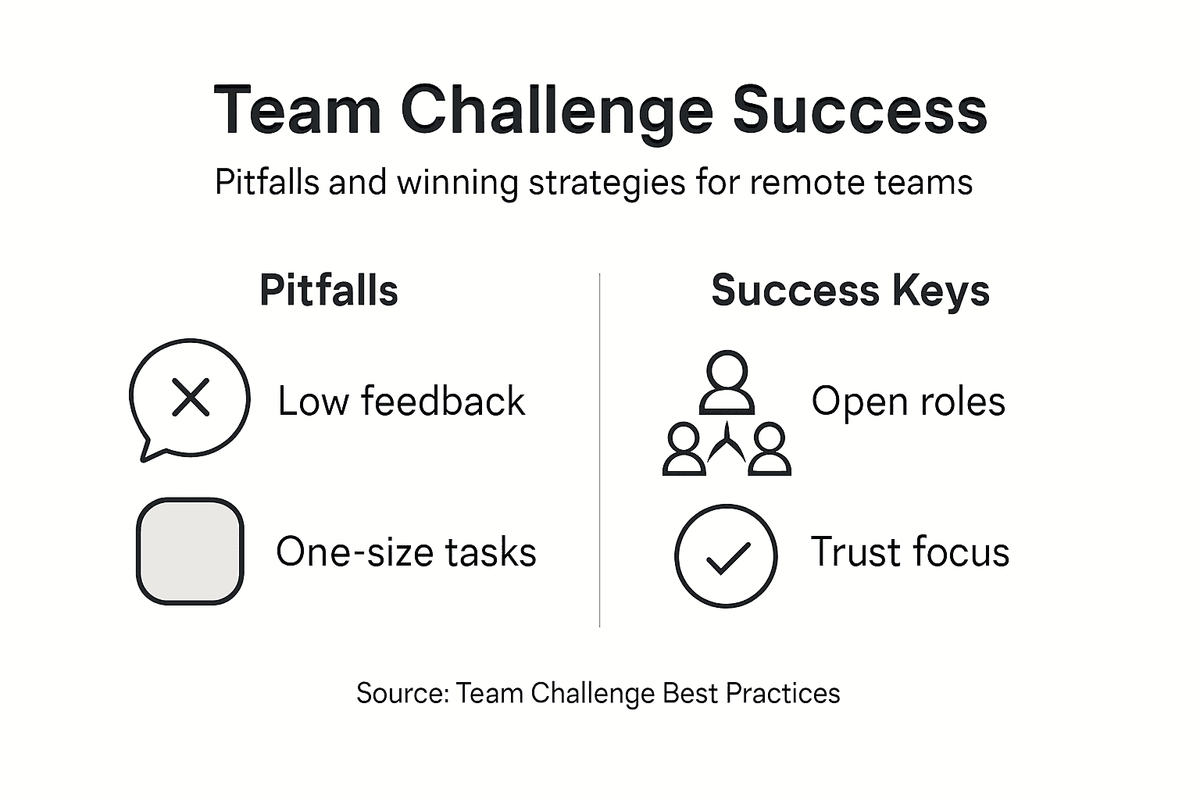
Key success factors transcend technical implementation and focus on human dynamics. These include creating psychologically safe environments where team members feel comfortable taking risks, designing challenges with transparent evaluation criteria, and ensuring that every participant has meaningful opportunities for contribution. Effective team challenges should reveal and develop individual strengths, promote cross-functional understanding, and generate shared experiences that build long-term team resilience. The most successful approaches integrate reflection, skill development, and collective achievement into a holistic engagement strategy.
Pro tip: Design team challenges with built-in feedback mechanisms that allow participants to contribute insights about the challenge design itself, creating a continuous improvement cycle.
Elevate Remote Team Cohesion with Engaging Customized Challenges
Struggling to create team challenges that balance individual roles with collective success in your remote environment? This article highlights how intentional team composition, clear goals, and interactive experiences build trust and boost collaboration across distances. If you want to transform your team's dynamics and foster meaningful connection, you need tools that enable flexible, personalized engagement tailored to your unique team strengths.
quizado.com offers an innovative platform designed to bring these principles to life through customizable quiz games inspired by popular shows like Jeopardy and Family Feud. Our software lets you design interactive quizzes that encourage communication, rotate leadership roles, and simulate real-time collaboration that enhances psychological safety. Whether your team is remote or in-person, the ability to configure teams and tailor content delivers immersive experiences that promote collective achievement and skill development.
Explore flexible team-building solutions on Quizado today to unlock engagement that mirrors the article’s best practices in team challenge planning.
Discover how easy it is to create memorable, trust-building quiz games through our downloadable, multi-platform software and harness entertainment as a powerful corporate development tool.
Visit Quizado now and start turning your remote team challenges into rewarding, collaborative experiences that deliver lasting cohesion and performance.
Frequently Asked Questions
What are the key components of effective team challenge planning?
Effective team challenge planning includes intentional team composition, clear goal setting, and structured interaction models that encourage collaboration and communication among team members.
How can online platforms enhance remote team challenges?
Online platforms enhance remote team challenges by offering communication tools, real-time document collaboration, and integrated task tracking, which help maintain engagement and facilitate seamless collaboration across distances.
What types of challenges are most effective for tech teams?
Effective challenges for tech teams include hackathons, creative problem-solving competitions, virtual escape rooms, and code review competitions, all designed to promote collaboration and showcase technical skills.
What common pitfalls should teams avoid when designing challenges?
Teams should avoid oversimplifying interactions, failing to recognize diverse learning styles, and creating experiences that do not mirror real workplace dynamics, as these can hinder effective collaboration.
Turn these ideas into a team event
Prepare an office quiz or remote game with a shared screen, phone participation and a host on your team.