
In this post+
Every year, more teams juggle the realities of remote and on-site work while trying to stay connected across different countries and time zones. For team managers, finding the right balance between autonomy and collaboration often feels complicated by outdated myths about hybrid teamwork. This guide reveals the dynamic approach of hybrid teamwork and exposes the most common misconceptions, helping you create stronger connections, smarter coordination, and a team culture that thrives no matter where your colleagues are located.
Table of Contents
- Defining Hybrid Teamwork and Common Myths
- Different Hybrid Teamwork Models Explained
- How Hybrid Teamwork Functions Day-to-Day
- Key Benefits for Teams and Managers
- Overcoming Challenges in Hybrid Environments
Key Takeaways
| Point | Details |
|---|---|
| Importance of Hybrid Teamwork | Hybrid teamwork emphasizes flexibility, blending on-site and remote work to enhance productivity and organizational responsiveness. |
| Core Hybrid Models | Key models include flexible schedules, fully distributed teams, and synchronized hybrids, each with distinct advantages and challenges. |
| Daily Hybrid Dynamics | Successful hybrid teamwork requires robust communication, coordination, and strategies that foster connection and creativity among teams. |
| Overcoming Hybrid Challenges | Addressing communication gaps and fostering inclusion are critical for enhancing team cohesion and effectiveness in hybrid environments. |
Defining Hybrid Teamwork and Common Myths
Hybrid teamwork represents a dynamic approach to organizational collaboration where team members work flexibly across different physical locations. Unlike traditional work models, hybrid teamwork allows employees to seamlessly transition between remote and on-site work environments, creating a more adaptable and responsive organizational structure.
At its core, hybrid teamwork is not simply about splitting time between home and office. Instead, it involves strategic coordination of team interactions that transcend physical boundaries. Modern teams leverage technology, communication tools, and intentional cultural practices to maintain productivity and connection, regardless of where individual members are working.
Several persistent myths undermine effective hybrid team management. Many leaders mistakenly believe that physical proximity is essential for collaboration or that technology automatically solves communication challenges. However, research demonstrates that successful hybrid teamwork requires deliberate trust-building and coordination strategies. Effective hybrid teams invest in clear communication protocols, establish shared expectations, and create inclusive practices that bridge potential connection gaps between remote and in-office team members.
Pro Tip: Establish regular virtual check-ins and create shared digital collaboration spaces to maintain team cohesion across different work environments.
Different Hybrid Teamwork Models Explained
Hybrid teamwork models have evolved significantly, moving beyond simple location-based arrangements to more sophisticated organizational strategies. Emerging work paradigms recognize hybrid teams as complex ecosystems that blend physical, virtual, social, and temporal work elements, creating dynamic collaboration frameworks tailored to organizational needs.
Organizations typically implement several core hybrid teamwork models. The first is the flexible schedule model, where employees alternate between remote and on-site work, typically spending 2-3 days in the office and remaining days working remotely. Another approach is the fully distributed model, where team members work primarily from different locations, connecting through digital collaboration tools and periodic in-person meetings. Some companies also adopt a synchronized hybrid model that ensures specific overlapping hours for real-time collaboration, regardless of physical location.
Multifaceted hybrid work approaches demonstrate that successful implementation requires more than just technological infrastructure. These models must carefully balance communication protocols, team dynamics, individual work preferences, and organizational goals. Effective hybrid teams develop clear expectations, invest in robust communication technologies, and create inclusive practices that maintain team cohesion across diverse work environments.
Pro Tip: Develop a clear hybrid work policy that outlines expectations, communication protocols, and performance metrics to create transparency and alignment across different work arrangements.
Here's a summary of popular hybrid teamwork models and their unique characteristics:
| Model Type | Example Structure | Key Advantage | Typical Challenge |
|---|---|---|---|
| Flexible Schedule | 2-3 days onsite, rest remote | Enhances work-life balance | Coordination complexity |
| Fully Distributed | All remote, rare in-person | Widens talent pool | Potential disconnection |
| Synchronized Hybrid | Set overlap hours, flexible rest | Ensures real-time collaboration | Scheduling across time zones |
How Hybrid Teamwork Functions Day-to-Day
Hybrid teamwork represents a complex daily dance of communication, coordination, and collaboration that requires intentional strategy and robust technological support. Daily operations involve delicate balance between individual autonomy and team integration, challenging traditional workplace assumptions about productivity and interaction.

The typical day in a hybrid team revolves around five critical dimensions: communication, coordination, connection, creativity, and organizational culture. Team members leverage a mix of synchronous tools like video conferences and real-time chat platforms, and asynchronous communication methods such as shared documents, email, and project management software. These digital environments enable team members to collaborate effectively across different physical locations, time zones, and work schedules.
Hybrid team dynamics require sophisticated coordination strategies that go beyond simple technological solutions. Managers play a crucial role in nurturing relationships, fostering trust, and maintaining team cohesion. This involves creating inclusive meeting practices, establishing clear communication protocols, and developing mechanisms that ensure all team members - whether working remotely or on-site - feel equally valued and connected.
Pro Tip: Create a standardized communication matrix that outlines preferred communication channels, response time expectations, and availability windows for different team members.
Key Benefits for Teams and Managers
Hybrid work models unlock transformative opportunities for both organizational teams and leadership, reimagining traditional workplace dynamics. Strategic flexibility offers substantial advantages by empowering employees with enhanced autonomy while maintaining robust collaborative frameworks.
For teams, hybrid work generates multiple critical benefits. Employees experience improved work-life balance, increased productivity, and greater job satisfaction through personalized work arrangements. The ability to blend remote and in-office environments enables team members to optimize their individual work preferences, leading to more engaged and motivated workforce. Enhanced creativity emerges from diverse working perspectives, allowing teams to generate innovative solutions by leveraging varied work styles and environments.
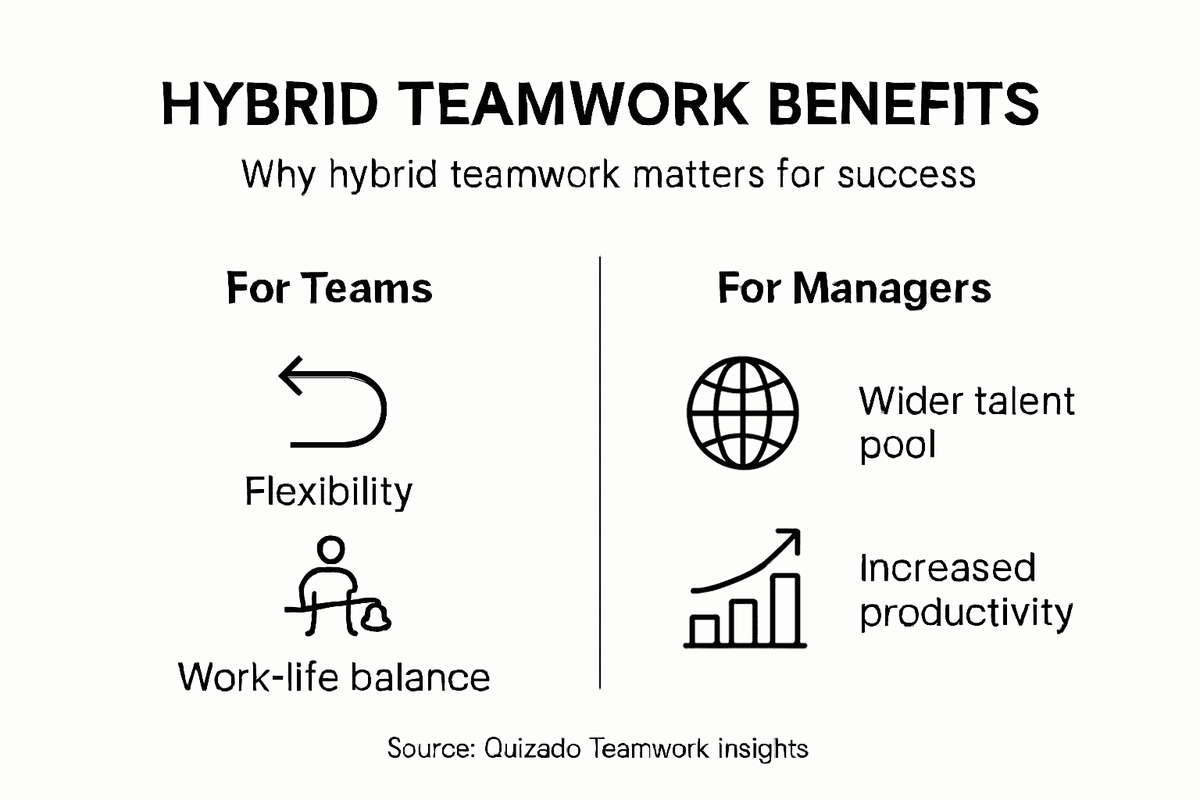
Managers gain strategic advantages through hybrid team structures, including expanded talent recruitment capabilities, reduced overhead costs, and improved employee retention. By offering flexible work models, organizations can attract top-tier professionals who value workplace adaptability. These approaches simultaneously support diverse employee needs while maintaining organizational performance, creating a win-win scenario that balances individual preferences with collective productivity goals.
Pro Tip: Develop a comprehensive hybrid work policy that clearly defines expectations, communication protocols, and performance metrics to ensure transparent and equitable implementation.
Overcoming Challenges in Hybrid Environments
Hybrid work environments present complex challenges that require strategic and nuanced management approaches. Communication gaps and coordination difficulties represent significant obstacles that organizations must proactively address to maintain team effectiveness and employee engagement.
The primary challenges in hybrid settings include weakened social connections, reduced spontaneous interactions, and potential disparities between remote and on-site team members. Effective strategies involve creating deliberate communication rituals, establishing clear virtual interaction protocols, and developing inclusive decision-making processes that ensure all team members feel equally valued and integrated, regardless of their physical work location.
Blended communication strategies can bridge geographical divides by leveraging technology and creating structured interaction opportunities. Organizations must invest in robust digital collaboration tools, provide comprehensive technology training, and develop explicit norms for both virtual and in-person interactions. Leadership plays a critical role in modeling transparent communication, promoting psychological safety, and creating adaptive policies that recognize hybrid work as an ongoing evolutionary process.
Pro Tip: Implement monthly cross-location team-building activities that rotate between virtual and in-person formats to maintain team cohesion and reduce geographical disconnection.
The table below highlights the main challenges of hybrid teamwork and effective solutions:
| Challenge | Impact on Teams | Practical Solution |
|---|---|---|
| Weakened social connection | Lower team morale | Regular team-building activities |
| Communication gaps | Misunderstandings, delays | Clear digital communication protocol |
| Coordination difficulties | Missed deadlines, confusion | Dedicated project management tools |
| Inclusion disparities | Remote staff marginalized | Inclusive meeting practices |
Strengthen Your Hybrid Teamwork with Engaging, Interactive Experiences
Hybrid teamwork demands clear communication, trust-building, and inclusion to overcome challenges like weakened social connection and coordination gaps. If your team struggles with maintaining cohesion across remote and in-office settings, leveraging interactive solutions can make a significant difference. Creating fun and engaging team-building activities tailored to hybrid work environments helps nurture connection, boost morale, and foster collaboration.

Discover how customizable quiz games from Quizado can energize your hybrid workforce with dynamic, inclusive team-building experiences. With flexible options for online or in-person play, smartphone remote control, and fully branded content, you can create memorable moments that break down communication barriers and strengthen team bonds. Don’t wait to turn hybrid work challenges into opportunities for greater engagement—explore Quizado today and transform how your team connects: Explore Interactive Team-Building Solutions.
Frequently Asked Questions
What is hybrid teamwork?
Hybrid teamwork is a collaborative approach where team members work flexibly across different physical locations, allowing seamless transitions between remote and on-site work environments.
What are the main benefits of hybrid teamwork?
Hybrid teamwork offers improved work-life balance, increased productivity, greater job satisfaction, and enhanced creativity by allowing employees to optimize their individual work preferences in diverse environments.
What are common challenges in hybrid teamwork?
Common challenges include weakened social connections, communication gaps, coordination difficulties, and inclusion disparities between remote and in-office team members, which can affect overall team effectiveness.
How can organizations overcome challenges in hybrid teamwork?
Organizations can overcome hybrid teamwork challenges by implementing clear digital communication protocols, investing in robust collaboration tools, facilitating regular team-building activities, and fostering inclusive meeting practices to ensure all team members feel valued and connected.
Host a quiz with your group
Find a hosting setup for your venue, company, classroom or activity group.