Team Motivation: Key to Stronger Workplace Collaboration

American companies face a striking challenge: nearly 60 percent of global employees report feeling disconnected from their teammates during daily work. When collaboration stalls, productivity and engagement suffer across continents. Understanding the psychology of team motivation gives HR managers new tools to target the roots of this issue. This guide explores proven strategies and practical concepts for igniting energy within large, diverse teams using interactive quizzes to drive collaboration and engagement.
Table of Contents
- Defining Team Motivation And Core Concepts
- Types Of Team Motivation In Organizations
- Key Drivers And Characteristics Of Motivated Teams
- Benefits For Engagement And Collaboration
- Risks Of Low Motivation And Common Pitfalls
- Implementing Effective Motivation Strategies
Key Takeaways
| Point | Details |
|---|---|
| Team Motivation is Crucial | Psychological energy drives performance and collaboration; understanding its core constructs is essential for team success. |
| Leadership Influences Motivation | Effective leaders enhance communication and align individual motivations with organizational goals to foster a motivated workforce. |
| Types of Motivation Matter | Recognizing different motivation types—extrinsic, introjected, identified, and intrinsic—helps tailor strategies for improving team dynamics. |
| Collaboration Enhances Performance | Structured collaboration strategies significantly increase engagement, knowledge sharing, and overall team effectiveness. |
Defining Team Motivation and Core Concepts
Team motivation represents the psychological energy that propels group performance and collaborative success. At its core, motivation is a complex process that energizes goal-directed behaviors within workplace teams, driving members toward shared objectives and collective achievements.
The fundamental components of team motivation encompass several critical psychological constructs. These include direction (understanding team goals), intensity (commitment level), initiation (starting collaborative actions), and persistence (maintaining effort over time). Each element plays a crucial role in transforming individual potential into coordinated team performance. Research indicates that motivated teams demonstrate superior integration, emotional intelligence, and social dynamics that transcend traditional workplace interactions.
Leadership serves as a pivotal catalyst in cultivating team motivation. Effective leaders create environments that enhance communication, reduce negative influences, and strategically align individual motivations with broader organizational goals. By understanding each team member's unique motivational drivers - whether intrinsic personal growth or extrinsic rewards - managers can design more engaging and productive workplace experiences.
Pro tip: Conduct regular one-on-one motivational interviews with team members to uncover their individual drive and align personal aspirations with team objectives.
Types of Team Motivation in Organizations
Motivation in organizational settings is far more nuanced than traditional binary perspectives, encompassing a sophisticated spectrum of psychological drivers. Contemporary research reveals four distinct motivation forms that shape team dynamics and performance, each representing a unique approach to inspiring collective action.
These motivational types range from external incentives to deeply personal engagement. Extrinsic motivation relies on tangible rewards like bonuses, promotions, or recognition, directly linking performance to concrete outcomes. Introjected motivation involves internal psychological pressures, where team members feel compelled to perform to maintain self-esteem or avoid feelings of guilt. Identified motivation emerges when individuals recognize a task's inherent value and align it with their personal goals, creating a more meaningful connection to work. Intrinsic motivation represents the most powerful driver, where team members find genuine satisfaction and enjoyment in the work itself, transcending external rewards.
Leadership plays a critical role in navigating these motivational landscapes. Leadership motivation styles significantly influence how teams perceive and respond to different motivational approaches. Transformational leaders, for instance, excel at inspiring intrinsic motivation by creating compelling visions and fostering personal growth. Transactional leaders might focus more on extrinsic motivators, establishing clear performance expectations and reward structures. The most effective leaders understand how to blend these approaches, recognizing that individual team members may respond differently to various motivational strategies.
Pro tip: Develop personalized motivation profiles for team members to understand their unique motivational triggers and design targeted engagement strategies.
Here is a comparison of the four main types of team motivation and their implications for organizations:
| Motivation Type | Key Driver | Typical Outcome | Best Leadership Approach |
|---|---|---|---|
| Extrinsic | External rewards | Increased short-term performance | Transactional leadership |
| Introjected | Internal pressure | Compliance, possible stress | Supportive, empathetic style |
| Identified | Value alignment | Long-term commitment | Purpose-driven leadership |
| Intrinsic | Personal enjoyment | Innovation, high engagement | Transformational leadership |
Key Drivers and Characteristics of Motivated Teams
Motivated teams represent a complex ecosystem of psychological and organizational dynamics that transcend traditional performance metrics. High-performing teams demonstrate unique characteristics that enable them to navigate challenges, innovate consistently, and maintain exceptional collaborative potential.
The fundamental characteristics of motivated teams include several critical dimensions. Trust emerges as the foundational element, creating an environment where team members feel psychologically safe to share ideas, take calculated risks, and offer constructive feedback. Strong communication serves as the critical infrastructure, ensuring transparent information exchange and mutual understanding. Shared purpose acts as the strategic glue, aligning individual efforts toward collective goals and creating a sense of meaningful contribution. These teams also exhibit remarkable adaptability, quickly recalibrating strategies in response to changing organizational landscapes.

Organizational leaders play a pivotal role in cultivating these team characteristics. By establishing clear performance expectations, providing autonomy, recognizing individual contributions, and creating supportive learning environments, they can systematically enhance team motivation. The most successful approaches integrate both intrinsic motivators like personal growth opportunities and extrinsic motivators such as performance recognition, creating a holistic motivation strategy that resonates with diverse team members.
Pro tip: Implement quarterly team reflection workshops where members collaboratively assess team dynamics, celebrate achievements, and identify areas for collective improvement.
Benefits for Engagement and Collaboration
Multi-sectoral collaboration strategies represent a transformative approach to organizational performance, fundamentally reshaping how teams interact, innovate, and achieve collective goals. By integrating diverse perspectives and creating interconnected knowledge networks, organizations can unlock unprecedented levels of engagement and productivity.
The benefits of robust collaboration extend far beyond traditional performance metrics. Knowledge sharing becomes a dynamic, two-way process where team members actively exchange insights, challenge assumptions, and co-create innovative solutions. Mutual support emerges as a critical psychological mechanism, enabling individuals to build resilience, enhance self-efficacy, and maintain motivation during complex challenges. Cross-functional learning breaks down organizational silos, allowing teams to develop adaptive skills, understand broader organizational contexts, and create more holistic problem-solving approaches.
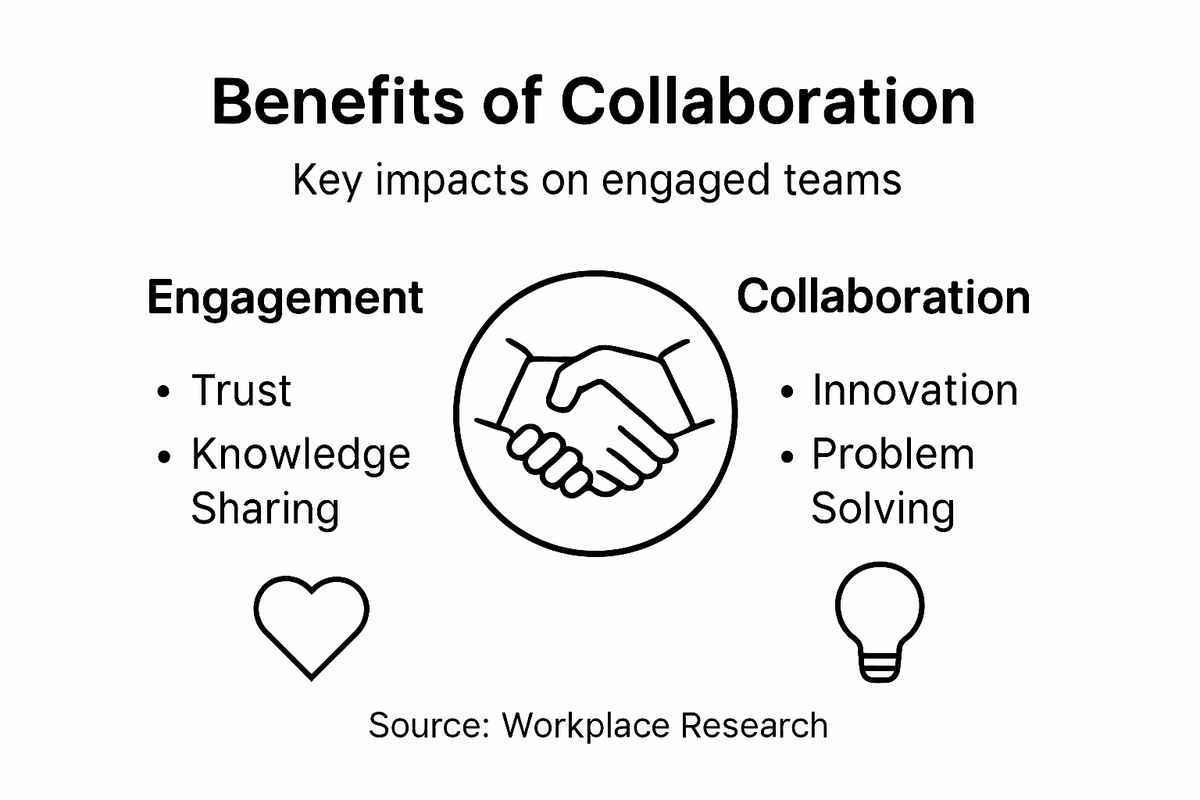
Engagement thrives when organizations intentionally design collaborative environments that recognize individual contributions while emphasizing collective achievement. This requires creating psychological safety, establishing clear communication channels, and developing reward systems that celebrate both individual excellence and team synergy. The most successful approaches integrate structured peer support mechanisms, provide opportunities for skill development, and maintain transparent performance feedback loops that motivate continuous improvement.
Pro tip: Design quarterly cross-team innovation workshops where members from different departments collaborate on solving organization-wide challenges, fostering engagement and breaking down traditional departmental barriers.
The following table summarizes leading benefits of highly motivated and collaborative teams:
| Benefit | Impact on Teams | Organizational Value |
|---|---|---|
| Knowledge sharing | Faster idea exchange | Stronger innovation culture |
| Mutual support | Enhanced team resilience | Reduced turnover and stress |
| Cross-functional learning | Broader skillsets developed | Greater flexibility and adaptability |
| Engagement | Higher ongoing participation | Sustainable team performance |
Risks of Low Motivation and Common Pitfalls
Low motivation represents a critical organizational challenge that can silently erode team performance and individual potential. Diminished performance risks emerge through complex psychological mechanisms that progressively undermine workplace effectiveness and employee well-being.
Disengagement serves as the primary warning signal of declining motivation, manifesting through decreased productivity, reduced creativity, and emotional withdrawal. Team members experiencing low motivation often exhibit subtle but destructive behavioral patterns: increased absenteeism, minimal effort, resistance to collaboration, and a pervasive sense of indifference toward organizational goals. These symptoms can spread rapidly, creating a toxic cycle that undermines team cohesion and organizational resilience. The most insidious aspect of motivational decline is its contagious nature - one disengaged team member can potentially trigger a cascading effect of reduced performance across entire departments.
Organizational leaders must recognize the nuanced origins of motivational challenges. Typical pitfalls include overreliance on extrinsic rewards, inadequate recognition of individual contributions, unclear career progression pathways, and leadership approaches that fail to address underlying psychological needs. Effective intervention requires a holistic understanding of motivation as a complex interplay between personal expectations, organizational culture, and individual psychological drivers. Successfully navigating these challenges demands proactive strategies that go beyond superficial motivational techniques and instead create genuinely supportive, growth-oriented work environments.
Pro tip: Implement anonymous quarterly motivation assessments to identify early warning signs of team disengagement and develop targeted intervention strategies.
Implementing Effective Motivation Strategies
Motivation strategies require a nuanced, multifaceted approach that addresses both individual psychological needs and organizational objectives. Self-regulation techniques provide a sophisticated framework for understanding and enhancing team engagement through targeted interventions.
Successful motivation strategies encompass several critical dimensions. Goal setting emerges as a fundamental mechanism, transforming abstract aspirations into concrete, actionable targets. Intrinsic motivation techniques focus on creating meaningful work experiences that transcend external rewards, connecting individual passions with organizational missions. Performance feedback becomes a dynamic tool for continuous improvement, providing real-time insights that help team members understand their progress and potential. These strategies must be personalized, recognizing that motivation is not a one-size-fits-all construct but a complex interplay of individual psychological drivers, professional aspirations, and organizational context.
Leadership plays a pivotal role in implementing motivation strategies. Effective leaders create environments that balance autonomy with supportive guidance, offering resources, recognition, and opportunities for professional growth. This involves developing transparent career progression pathways, implementing innovative reward systems that go beyond monetary compensation, and fostering a culture of continuous learning and development. The most successful organizations view motivation not as a periodic intervention but as an ongoing, integrated approach to workplace culture.
Pro tip: Create personalized motivation roadmaps for each team member that align individual career goals with organizational objectives, reassessed quarterly.
Unlock Lasting Team Motivation with Interactive Collaboration
Struggling to maintain intrinsic motivation and foster meaningful collaboration within your team? As highlighted in "Team Motivation: Key to Stronger Workplace Collaboration," factors like shared purpose, trust, and engaging communication are essential to overcoming common pitfalls such as disengagement and low commitment. At Quizado, we understand that transforming these psychological drivers into real-world team dynamics requires more than traditional approaches.

Boost your team’s engagement, adaptability, and motivation with customizable quiz games designed for both online and in-person settings. Our platform helps managers create interactive experiences that build trust and facilitate knowledge sharing with features like team configuration, branded quizzes, and remote control via smartphones. Explore how you can align personal satisfaction and collective goals by visiting Quizado and discover why professional teams turn to us to solve motivation challenges in memorable ways. Take the first step now to transform team dynamics with fun, strategic team-building games at Quizado’s homepage and start building high-performing teams today.
Frequently Asked Questions
What is team motivation and why is it important?
Team motivation refers to the psychological energy that drives group performance and collaborative success. It is important because it enhances goal-directed behaviors, leading to improved team dynamics and overall productivity in the workplace.
What are the different types of team motivation?
There are four main types of team motivation: extrinsic motivation, which relies on external rewards; introjected motivation, which is driven by internal pressures; identified motivation, where individuals align tasks with personal goals; and intrinsic motivation, where satisfaction comes from the work itself.
How can leaders foster team motivation?
Leaders can foster team motivation by creating a supportive environment, aligning individual motivations with organizational goals, and recognizing contributions. Techniques such as regular one-on-one motivational interviews and offering personalized goal-setting can help in enhancing motivation levels within teams.
What are the risks associated with low team motivation?
Low team motivation can lead to disengagement, decreased productivity, increased absenteeism, and a toxic work culture. It can affect not just individual performance, but can create a contagious effect that drains the morale and effectiveness of the entire team.
Host a quiz with your group
Find a hosting setup for your venue, company, classroom or activity group.

Bring your group together for a game
Try a free starter game, then choose the format and plan for your group.
Trusted by 5,000+ hosts