In this post+
Corporate events can sometimes leave teams feeling disconnected or struggling to break the ice. Finding activities that energize your group while building genuine connections can be a challenge, especially with hybrid and remote teams in the mix. You want more than just surface-level interaction—you need practical solutions that encourage engagement, strengthen collaboration, and reduce stress throughout your event.
The right games and activities can spark meaningful conversations, establish trust, and transform your event into a memorable experience. Effective team-building activities not only bring people together but also foster communication and knowledge sharing across departments and locations.
Get ready to discover creative, actionable ideas that will help you drive participation, boost morale, and build lasting bonds among your colleagues. Each approach in this list offers a clear path to turning your next corporate event into a true team success.
Table of Contents
- 1. Classic Team Trivia for Corporate Events
- 2. Interactive Game Show Experiences with Quizado
- 3. Icebreaker Bingo to Energize Attendees
- 4. Creative Problem-Solving Challenges
- 5. Name That Tune—Music-Based Team Game
- 6. Collaborative Scavenger Hunts for Teams
Quick Summary
| Takeaway | Explanation |
|---|---|
| 1. Trivia strengthens team bonding | Classic team trivia builds cross-department relationships through shared knowledge and friendly competition among employees. |
| 2. Game shows enhance engagement | Interactive game shows provide a polished experience that encourages collaboration and participation, optimizing both productivity and morale. |
| 3. Icebreaker Bingo energizes networking | Icebreaker Bingo transforms introductions into engaging conversations, helping colleagues connect with one another through structured interaction. |
| 4. Problem-solving challenges improve skills | Creative problem-solving activities mimic workplace dynamics, fostering critical thinking and teamwork while contributing to personal development. |
| 5. Scavenger hunts promote collaboration | Collaborative scavenger hunts require team members to work together, enhancing communication and problem-solving abilities while fostering a positive culture. |
1. Classic Team Trivia for Corporate Events
Classic team trivia stands as one of the most effective and accessible team-building activities for any corporate setting. It combines competition, knowledge sharing, and pure fun into an experience that energizes your workforce.
Why does trivia work so well in corporate environments? The answer lies in its ability to create multiple benefits simultaneously. Team trivia enhances employee engagement while strengthening cross-department relationships through shared knowledge and friendly competition. Employees get a mental break from their regular workload, reducing stress while building trust with colleagues they might not interact with daily.
Trivia games also serve as powerful icebreakers, particularly useful when your team includes newer employees or spans multiple locations. The format naturally encourages participation across all experience levels and departments. Whether you're running a hybrid team or a fully in-person event, trivia adapts easily to your audience.
What Makes Classic Trivia Effective
The strength of traditional trivia lies in its simplicity combined with strategic design. Team-based games that incorporate varied categories and difficulty levels cater to diverse audiences while keeping everyone engaged. When you mix easy questions with challenging ones, you prevent frustration while maintaining excitement.
Key benefits of classic trivia include:
- Breaks down departmental silos by encouraging teams to work across divisions
- Creates a low-stress environment that promotes genuine interaction
- Builds team cohesion through shared goals and friendly competition
- Allows knowledge sharing across different expertise areas within your organization
- Provides a mental break that reduces workplace stress and energizes participants
The competition element matters more than you might think. Healthy competition motivates teams to engage thoughtfully with questions and celebrate their victories together. This creates positive memories associated with your corporate event.
Classic trivia works because it combines mental stimulation with social bonding, making it an effective strategic team-building activity that feels effortless to participants.
Implementing Trivia at Your Event
Successful trivia requires thoughtful planning. Start by selecting your question categories based on your audience's interests. Include some company-specific knowledge to make the event feel personalized. Mix in pop culture, history, and general knowledge to appeal to diverse backgrounds.
Consider these implementation tips:
- Vary difficulty levels to keep momentum and maintain engagement throughout
- Create balanced teams so competition stays close and exciting
- Set clear rules about phone usage and consultation before starting
- Prepare a tiebreaker question in case scores end up identical
- Announce winners with fanfare to recognize achievements and build morale
The setup also matters. You need a host who can read questions clearly and manage pacing. Separate screens for team display and host control help maintain professionalism and prevent cheating. Good audio ensures everyone hears questions equally.
Pro tip: Mix company-related trivia questions with general knowledge ones to create investment in the competition while keeping content accessible to all participants.
2. Interactive Game Show Experiences with Quizado
Interactive game shows represent the next evolution in corporate event entertainment. Unlike traditional trivia, they recreate the energy and polish of television game shows like Family Feud and Jeopardy, transforming your event into a professional production your team will remember.
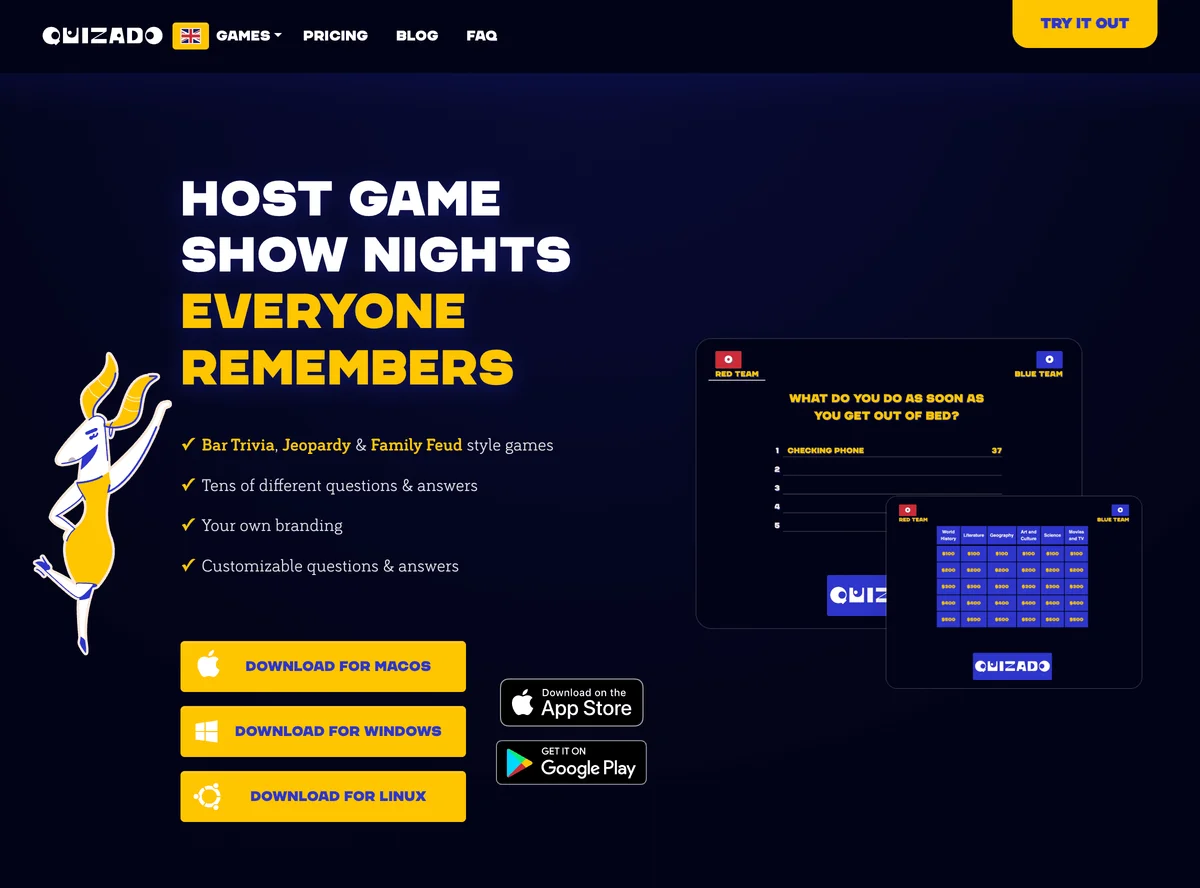
Quizado brings game show experiences directly to your corporate event through downloadable software that works on any device. The platform features authentic graphics, animations, and sound effects that replicate real TV game shows. Your team doesn't just play a game—they participate in a polished, branded entertainment experience.
What sets interactive game shows apart from basic trivia? The answer lies in the immersive production quality combined with strategic engagement. Gamification strategies with interactive game shows promote collaboration, creativity, and participation through narrative-driven challenges and real-time feedback. These elements boost productivity and morale while encouraging knowledge sharing across your organization.
Why Game Show Formats Outperform Traditional Games
Game show formats tap into something primal about competition and entertainment. The familiar structure makes participation feel natural, even for employees who might hesitate during standard team activities. Everyone recognizes the format, so minimal explanation is needed.
Key advantages of the game show approach include:
- Professional presentation that reflects positively on your company brand
- Multi-format flexibility allowing you to switch between Family Feud style, Jeopardy style, or Wheel of Fortune gameplay
- Server-run games that survive a reload or a device switch, plus offline Family Feud and Jeopardy in the desktop and mobile apps
- Smartphone-based controls where teams use their phones as remote buzzers and answer devices
- Customizable branding to incorporate your company logo and visual identity
- Ready-made content libraries with over 500 hours of pre-loaded questions, plus the ability to create custom questions
The technical setup matters less than the experience it creates. Quizado handles the complexity behind the scenes, leaving your host free to focus on energy and engagement rather than technical troubleshooting.
Interactive game show experiences transform corporate events from standard activities into memorable entertainment that strengthens team bonds while maintaining professional polish.
Implementation for Maximum Impact
Successful game show events require thoughtful planning around format selection and content curation. Choose between Family Feud's team debate format, Jeopardy's knowledge challenge structure, or other formats based on your team's preferences and event goals.
Consider these setup elements:
- Select your game show format based on participant preferences and event duration
- Customize questions to reflect company culture, industry knowledge, or team interests
- Configure team sizes to ensure balanced competition and full participation
- Set up separate display screens so the host controls the game while teams view questions clearly
- Conduct a brief practice round to familiarize teams with the buzzer system
- Prepare prizes or recognition for winning teams to elevate stakes
At hotels or conference centers where internet reliability fluctuates, it helps that Quizado runs every game on its servers and that Family Feud and Jeopardy can continue offline in the desktop and mobile apps. Your event runs smoothly regardless of connection issues.
Pro tip: Customize your questions to include company-specific trivia and inside jokes that make the experience feel personal while still maintaining the professional game show atmosphere.
3. Icebreaker Bingo to Energize Attendees
Icebreaker Bingo transforms the awkward first moments of corporate events into energized networking sessions. This game turns introductions into fun conversations by encouraging attendees to discover colleagues' unique traits and experiences through structured interaction.
Unlike passive icebreakers where people sit and listen, Bingo forces movement and genuine connection. Participants receive customized bingo cards with prompts encouraging one-on-one conversations. Instead of matching numbers, they match characteristics like "Has traveled to five continents" or "Speaks three languages." Finding matches requires actual interaction, not luck.
Why does this approach work so effectively? The game structure removes social anxiety by giving people a legitimate reason to approach strangers. Icebreaker Bingo boosts engagement by turning introductions into interactive activity that energizes the room and stimulates conversations. Attendees build connections quickly while the activity fosters organic interaction and reduces social awkwardness.
How Icebreaker Bingo Creates Connection
The genius of Bingo lies in its simplicity combined with psychological effectiveness. People naturally want to win, and winning requires them to mingle. This transforms networking from optional socializing into a game with stakes.
Key benefits of the format include:
- Forced movement that energizes attendees and combats sitting fatigue
- Natural conversation starters eliminating the "what do I talk about?" paralysis
- Democratic participation where introverts and extroverts engage equally
- Memory building through meaningful one-on-one exchanges rather than surface small talk
- Inclusive atmosphere that welcomes new employees and remote participants
- Flexible format working for both in-person and hybrid events
The prompts on your cards determine success. Generic prompts like "Has brown eyes" create shallow interactions. Thoughtful prompts about experiences, skills, and backgrounds spark real conversations people remember.
Icebreaker Bingo works because it combines the fun of a game with the genuine benefit of building real workplace connections through structured mingling.
Implementation Strategy
Designing effective Bingo cards requires thoughtful prompt selection. Customize prompts to reflect your company culture, team interests, and event goals. Mix professional experiences with personal interests to create well-rounded conversation opportunities.
Consider these implementation steps:
- Create bingo cards with 5x5 grids containing 24 unique prompts plus one free center square
- Include prompts ranging from professional to personal to appeal to diverse interests
- Ensure prompts encourage meaningful conversation, not just yes-or-no answers
- Print or digitally distribute cards before attendees arrive
- Announce clear rules about finding people who match each prompt
- Offer a prize for the first person reaching five in a row
- Continue playing until several winners emerge to maintain momentum
Timing matters significantly. Launch Bingo in the first 15 to 20 minutes of your event when attendees most need help connecting. This energizes the room before sitting for presentations or meals.
Pro tip: Include a "Free" square in the center and populate your cards with prompts specific to your company's departments, recent company achievements, or team members' hidden talents to create inside-joke moments that deepen bonding.
4. Creative Problem-Solving Challenges
Creative problem-solving challenges inject real intellectual engagement into corporate events. Unlike games purely focused on entertainment, these activities require teams to think critically, collaborate under pressure, and develop innovative solutions to complex puzzles.
These challenges work because they mirror actual workplace dynamics. Teams face ambiguous problems without obvious answers, forcing them to communicate, debate, and synthesize diverse perspectives. The structured process develops skills that transfer directly to your organization's daily operations.
What makes problem-solving challenges valuable for events? Gamified problem-solving can boost productivity and engagement, making it one of the most impactful team-building activities available. Beyond the event itself, participants develop better critical thinking and communication patterns they carry back to their regular work.
How Problem-Solving Challenges Work
Effective challenges present narrative-driven puzzles that teams must decode within time limits. The best formats combine multiple challenge types to maintain interest and accommodate different thinking styles. Some teams excel at logic puzzles while others shine with creative lateral thinking challenges.
Key characteristics of engaging problem-solving activities include:
- Real-time feedback that keeps teams motivated and informed of progress
- Escalating difficulty that challenges advanced teams while remaining achievable for others
- Collaborative requirement forcing team members to contribute their unique strengths
- Time pressure that simulates workplace urgency without causing stress
- Tangible outcomes like solving a mystery or cracking a code rather than abstract wins
- Debrief opportunities where teams reflect on how they approached the challenge
The debrief separates memorable problem-solving events from forgettable games. When teams discuss their process, they internalize lessons about collaboration and communication that stick long after the event ends.
Creative problem-solving challenges transform corporate events into learning experiences that build stronger teams while developing the critical thinking skills your organization needs.
Implementation for Your Event
Successful implementation requires balancing difficulty with achievability. Teams should feel challenged but not defeated. Design multiple parallel challenges so groups work simultaneously, creating friendly competition.
Consider these setup elements:
- Create challenges that require diverse skills so every team member contributes meaningfully
- Establish clear rules and success criteria before teams begin solving
- Set realistic time limits that create urgency without inducing panic
- Provide hints or escalating clues if teams hit dead ends to maintain momentum
- Track completion times to determine winners and create leaderboard drama
- Prepare a thorough debrief session discussing strategy and lessons learned
- Celebrate creative approaches alongside correct answers to reward innovation
Virtual and hybrid teams benefit tremendously from problem-solving challenges. The format adapts easily to remote collaboration tools while maintaining engagement across distributed locations.
Pro tip: Design your challenges to require solving multiple smaller puzzles sequentially rather than one giant problem, as this creates momentum checkpoints that keep energy high throughout the activity.
5. Name That Tune—Music-Based Team Game
Name That Tune transforms corporate events into high-energy musical competitions where teams race to identify songs from brief audio clips. This game works across all age groups and musical preferences, making it universally engaging at any corporate gathering.
Unlike games requiring specialized knowledge, Name That Tune taps into something everyone experiences daily. Music is deeply familiar to most people, creating a level playing field regardless of department or seniority. Teams compete using instinct and quick thinking rather than memorized facts.
Why does this game shine at corporate events? The Name That Tune game enhances non-verbal communication and quick decision-making while creating high-energy moments that foster shared joy. Music serves as a universal connector, reducing workplace stress and breaking down communication barriers across departments and generations.
What Makes Music-Based Games Effective
Music triggers emotional responses that other games simply cannot replicate. The moment a song plays, teams immediately feel energized. Recognition creates dopamine releases that feel genuinely rewarding, more so than traditional trivia victory.
Key advantages of the music game format include:
- Universal appeal across age groups and musical preferences
- Instant feedback where results are immediate and undeniable
- Emotional engagement through music's natural connection to human psychology
- Cross-generational bonding as older and younger employees share musical knowledge
- Low complexity requiring no special equipment beyond audio and a scoring system
- Natural conversation starters about favorite songs and musical memories
- Inclusive participation where quiet team members can contribute equally
The beauty lies in simplicity. Teams don't need to understand complex rules or strategies. They simply listen, identify, and answer. This removes barriers that prevent shy team members from participating.
Name That Tune works because music creates immediate emotional connection and joy, making it one of the most universally engaging corporate event games available.
Implementation Strategy
Successful Name That Tune events require thoughtful song selection. Include a mix of eras and genres so teams with different musical backgrounds can excel. Popular classics give broad recognition while newer hits engage younger employees.
Consider these implementation details:
- Curate a diverse song list spanning multiple decades and genres
- Use short audio clips, typically 5 to 10 seconds, for identifying difficulty
- Divide the group into balanced teams with mixed experience levels
- Display song titles and artists after teams submit answers for learning
- Award points for speed and accuracy, rewarding both quick thinking and correctness
- Build leaderboards to create friendly competition momentum
- Include bonus rounds with theme-based songs for heightened engagement
Quizado's Name That Tune game platform handles the technical complexity, managing audio playback, scoring, and display screens so you focus on hosting energy.
Pro tip: Mix well-known songs everyone recognizes with deeper cuts from those same artists, allowing teams to build momentum with correct answers before hitting challenging questions that separate top performers.
6. Collaborative Scavenger Hunts for Teams
Collaborative scavenger hunts transform corporate events into dynamic activities where teams solve puzzles, complete challenges, and coordinate efforts toward shared goals. Unlike simple treasure hunts focused on finding objects, modern scavenger hunts emphasize problem-solving and teamwork.
Scavenger hunts work because they require every team member to contribute. Someone finds a clue, another decodes it, a third locates the next challenge. This division of labor ensures participation from quiet and outgoing team members alike.
Why are scavenger hunts so effective for corporate teams? Scavenger hunts develop communication, creative problem-solving, and teamwork skills transferable directly to workplace environments. These interactive challenges require teams to work together within time limits, fostering collaboration while promoting a positive corporate culture that values diverse skills and perspectives.
What Makes Scavenger Hunts Uniquely Powerful
Scavenger hunts combine physical movement with mental engagement. Teams get energized by moving around the venue while staying mentally sharp solving riddles and puzzles. This combination of physical and mental stimulation keeps energy levels high throughout your event.
Key benefits of the scavenger hunt format include:
- Inclusivity by engaging team members with diverse skills and strengths
- Natural role division where different personality types excel at different tasks
- Active participation requiring physical movement that combats sitting fatigue
- Problem-solving development through riddles, puzzles, and creative challenges
- Communication requirement forcing teams to discuss strategy and coordinate
- Flexibility that works for small teams or large groups across multiple venues
- Memory creation through shared experiences and challenges overcome together
The physical movement aspect matters significantly. Hunts get people off chairs and mingling across the venue. This creates natural networking opportunities that wouldn't occur during seated activities.
Scavenger hunts succeed because they require collaboration while keeping teams energized through physical movement and mental challenge, creating memorable bonding experiences.
Implementation Strategy
Successful hunts require careful challenge design. Mix different challenge types so various team members shine. Include riddles for creative thinkers, physical challenges for active participants, and trivia for knowledge-based contributors.
Consider these setup elements:
- Create a hunt map showing boundaries and permitted areas for exploration
- Design riddles and clues requiring team discussion to solve
- Establish checkpoint stations where teams verify completion and collect next clues
- Include photo challenges requiring teams to capture specific images as proof
- Set a reasonable time limit allowing completion without rushing
- Assign one team member as roaming judge to verify challenge completion
- Prepare multiple difficulty levels or parallel hunts for different team skill levels
- Build celebration moments at the finish where winning teams are recognized
Virtual and hybrid teams benefit from adapted scavenger hunts too. Digital hunts can include finding items around home offices or completing online tasks that still require coordination and communication.
Pro tip: Design your hunt with multiple clue paths so teams can progress even if stuck on one puzzle, maintaining momentum while allowing flexible problem-solving approaches that accommodate different thinking styles.
Below is a comprehensive table summarizing the various team-building activities and strategies discussed throughout the article and their associated benefits, implementation guidelines, and outcomes.
| Activity | Benefits | Implementation Guidelines |
|---|---|---|
| Classic Team Trivia | Enhances engagement, builds cross-department relationships, reduces stress. | Use varied difficulty levels and themes to cater to diverse teams and excite participation. |
| Interactive Game Show Experiences | Encourages collaboration and includes immersive production quality. | Customize formats to match team preferences and reinforce branding with visual identity integration. |
| Icebreaker Bingo | Energizes networking and promotes connections through shared activities. | Develop thoughtful bingo prompts that spark meaningful conversations and encourage mingling. |
| Creative Problem-Solving Challenges | Stimulates intellectual engagement and promotes innovative skills. | Create narrative-driven puzzles requiring diverse team strategies and ensure post-activity debriefs. |
| Name That Tune | Facilitates quick decision-making and energizes participants universally. | Choose diverse songs encompassing various genres and eras for broad accessibility and appeal. |
| Collaborative Scavenger Hunts | Develops teamwork and communication through engaging activities. | Design multiple activity paths with varied tasks ensuring participation from all team members. |
Elevate Your Corporate Event with Interactive Game Show Experiences
Engaging your team with the right games can transform corporate events from ordinary to unforgettable. The challenge is finding activities that promote teamwork, reduce stress, and stimulate creativity while being easy to set up and enjoy. Whether you want to break the ice with icebreaker bingo or energize the room with classic trivia, embracing game formats that foster collaboration and friendly competition is key.
Quizado offers an exceptional solution tailored to these needs through its dynamic workplace trivia games. With seamless smartphone-based controls, customizable branding, and server-run games you can elevate your corporate event with polished, TV-style game shows like Family Feud or Name That Tune.
Ready to make your next corporate event a standout moment that builds trust and connection across teams? Explore Quizado to access professional-grade quiz software designed specifically for engaging teams in memorable, interactive experiences. Start with our free version or dive into extensive customization and question libraries perfect for any audience. Discover how you can bring the fun and strategic benefits of game show formats directly to your venue now.
Frequently Asked Questions
What types of corporate event games can help improve team bonding?
Engaging activities like Classic Team Trivia, Interactive Game Show Experiences, and Icebreaker Bingo significantly enhance team bonding. Consider mixing different formats to appeal to various interests and skill levels within your team.
How do I implement an effective trivia game at my corporate event?
To implement a successful trivia game, select diverse question categories and create balanced teams to foster friendly competition. Set clear rules about participation and prepare a tiebreaker question to keep the game lively.
What are the main benefits of conducting scavenger hunts during corporate events?
Scavenger hunts encourage teamwork and communication while providing a fun way for participants to engage with one another actively. Plan challenges that require collaboration and diverse skills to maximize participation.
How can I ensure participation from all team members in games?
To ensure full participation, create diverse teams that blend different personalities and skill sets. Implement formats like Icebreaker Bingo or Name That Tune, where interaction is central to the game.
What steps should I take to organize a collaborative problem-solving challenge?
Organize a problem-solving challenge by defining clear rules and creating diverse challenges that require different skills. Allow time for teams to discuss their strategies and reflect on their experiences during a debrief session after the activity.
Recommended
Turn these ideas into a team event
Prepare an office quiz or remote game with a shared screen, phone participation and a host on your team.