Understanding Defining Team Building Success Clearly
Building a team that actually works together is tougher than you think. Most companies run icebreakers and call it a win, but the real impact goes way deeper. Teams that invest in structured team building see measurable drops in workplace stress and big jumps in performance, according to the National Institutes of Health. Surprised? The real secret is not about playing games or bonding over lunch. It is about transforming how people trust, interact, and solve problems as a unit.
Table of Contents
- What Is Team Building Success And Its Importance?
- Key Elements That Define Team Building Success
- The Role Of Communication In Team Building Efforts
- Measuring The Impact Of Team Building Success
- Real-World Examples Of Successful Team Building
Quick Summary
| Takeaway | Explanation |
|---|---|
| Team dynamics drive performance. | Successful teams outperform individuals by fostering collaboration and communication. |
| Invest in psychological safety. | Creating environments where team members feel safe improves trust and effectiveness. |
| Establish clear communication channels. | Open communication promotes transparency, resolving conflicts and enhancing collaboration. |
| Utilize both quantitative and qualitative measures. | Assessing team success requires both numerical data and personal experiences for a comprehensive view. |
| Continuous improvement is essential. | Team building is an ongoing process, requiring regular adaptations and updates to strategies for success. |
What is Team Building Success and Its Importance?
Team building success represents a strategic approach to creating high-performing, collaborative workplace environments where individuals transform from independent workers into cohesive, mutually supportive units. Understanding this concept goes beyond simple group activities and requires comprehensive insight into organizational dynamics and human interaction.
Defining Organizational Team Success
At its core, team building success means developing a workplace ecosystem where collective performance exceeds individual capabilities. This involves creating an environment where communication flows seamlessly, mutual trust develops naturally, and team members understand their interconnected roles. Research from the National Institutes of Health confirms that effective team building significantly reduces workplace stress and improves interpersonal relationships.
Key characteristics of successful team building include:
- Clear and transparent communication channels
- Shared understanding of team goals
- Mutual respect and psychological safety
- Complementary skill sets among team members
Why Team Building Success Matters
Successful team building is not just a corporate nicety but a fundamental requirement for modern organizational effectiveness. When teams function harmoniously, they generate exponential value compared to individual contributions. Organizations that prioritize team dynamics often experience higher productivity, improved innovation, and reduced employee turnover.
Companies seeking to enhance their team performance can explore our comprehensive team building strategies to create more engaged and collaborative workplace environments. By investing in deliberate team development approaches, organizations can transform their workforce into adaptive, resilient, and high-performing units capable of navigating complex professional challenges.
Key Elements That Define Team Building Success
Defining team building success requires a nuanced understanding of the critical components that transform individual efforts into collective excellence. These elements are not just theoretical constructs but practical frameworks that organizations can systematically implement to enhance team performance and cohesion.
Essential Psychological Foundations
Successful team building fundamentally relies on understanding human psychological dynamics. Research from organizational psychology demonstrates that psychological safety is a primary determinant of team effectiveness. Teams that create environments where members feel secure expressing ideas, taking risks, and admitting vulnerabilities consistently outperform more traditional hierarchical structures.
Key psychological elements include:
- Emotional intelligence and empathy
- Mutual trust and vulnerability
- Constructive conflict resolution skills
- Shared emotional commitment to team goals
Structural Components of High Performance
Beyond psychological foundations, team building success demands deliberate structural design. This involves creating clear communication pathways, establishing transparent accountability mechanisms, and developing complementary skill sets within the team. Learn more about our team building strategies to understand how organizations can systematically enhance team dynamics.
Competent teams are characterized by:
- Well-defined roles and responsibilities
- Flexible leadership approaches
- Continuous learning and adaptation mechanisms
- Performance measurement and feedback systems
Successful team building is not a one time event but an ongoing process of cultivation, understanding, and strategic development.
Here is a table summarizing the key psychological and structural elements that define team building success, providing a clear comparison of both foundational areas.
| Element Type | Key Components | Description |
|---|---|---|
| Psychological Foundations | Emotional intelligence, Trust, Empathy, Conflict skills | Focuses on building mutual understanding, safety, and trust |
| Structural Components | Roles, Leadership, Adaptation, Accountability | Relies on defined structure, learning, and feedback systems |
| Psychological Commitment | Shared emotional buy-in, Vulnerability | Encourages openness, belonging, and creative risk-taking |
| Structural Clarity | Transparent communication, Responsibility distribution | Ensures everyone understands their duties and communication |
Organizations that recognize this paradigm invest in creating environments where collective potential can be consistently unlocked and transformed into exceptional performance.

The Role of Communication in Team Building Efforts
Communication stands as the foundational pillar of effective team building, serving as the critical mechanism through which collective understanding, alignment, and collaborative potential are realized. Successful teams recognize communication not merely as an information exchange process but as a sophisticated ecosystem of interpersonal interactions that drive organizational performance.
Communication Dynamics and Team Effectiveness
Research from the National Institutes of Health reveals that open communication directly correlates with enhanced team trust, transparency, and conflict resolution capabilities. Teams that cultivate robust communication infrastructures consistently demonstrate superior problem solving skills and adaptive capacity.
Key communication characteristics include:
- Active and empathetic listening
- Transparent and consistent information sharing
- Constructive feedback mechanisms
- Respectful dialogue across hierarchical levels
Barriers and Strategic Communication Approaches
Effective team communication requires deliberate strategies to overcome inherent organizational barriers. Communication challenges often emerge from hierarchical structures, diverse personality types, and technological limitations. Explore our comprehensive team building technology solutions to understand how modern tools can bridge communication gaps.
Strategic communication approaches focus on:
- Creating psychologically safe dialogue environments
- Implementing multi channel communication platforms
- Developing cross functional communication protocols
- Encouraging regular informal interaction opportunities
Ultimately, communication in team building transcends mere verbal or written exchanges. It represents a complex, dynamic process of mutual understanding, collective learning, and shared organizational vision that transforms individual contributions into synchronized team performance.
Measuring the Impact of Team Building Success
Measuring team building success transcends simplistic quantitative assessments, requiring a sophisticated, multidimensional approach that captures both tangible performance metrics and intangible organizational dynamics. Organizations must develop comprehensive evaluation frameworks that provide holistic insights into team transformation and collective effectiveness.
Quantitative Performance Indicators
Research from organizational psychology demonstrates that objective metrics play a crucial role in understanding team building outcomes. Quantitative measurements offer concrete evidence of team development and organizational improvement.
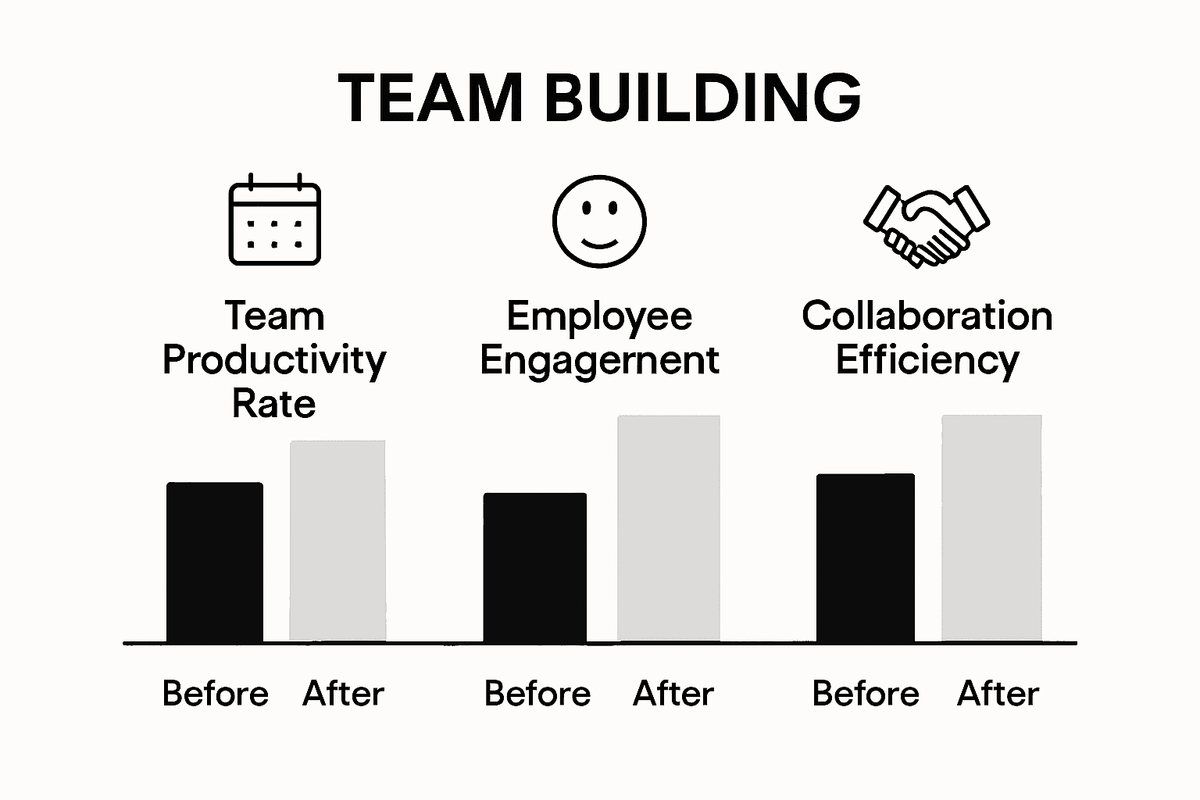
Key performance indicators include:
- Team productivity rates
- Employee engagement scores
- Collaboration efficiency metrics
- Project completion timelines
- Reduction in interpersonal conflict incidents
Qualitative Assessment Strategies
Beyond numerical data, successful team building evaluation requires nuanced qualitative insights that capture the human experience of organizational transformation. Explore our customized team assessment approaches to understand comprehensive evaluation techniques.
Qualitative assessment methods encompass:
- Structured team feedback surveys
- Individual and group interviews
- Behavioral observation protocols
- Psychological safety assessments
- Narrative and experiential reporting
Effective team building impact measurement is an ongoing, dynamic process that requires continuous refinement, adaptability, and a commitment to understanding the complex interplay between individual potential and collective performance.
The following table organizes quantitative and qualitative methods for measuring team building success, making it easier to compare their main features and advantages at a glance.
| Measurement Method | Example Metrics/Tools | Focus | Type |
|---|---|---|---|
| Quantitative | Productivity rates, Engagement scores | Concrete team outcomes | Numerical |
| Quantitative | Collaboration efficiency, Timelines | Project delivery and output speed | Numerical |
| Quantitative | Conflict reduction data | Workplace climate improvements | Numerical |
| Qualitative | Team feedback surveys | Perceptions and satisfaction | Experiential |
| Qualitative | Observational protocols, Interviews | Behavioral and psychological view | Experiential |
| Qualitative | Psychological safety assessments | Emotional and social climate | Experiential |
Real-World Examples of Successful Team Building
Real world team building success transcends theoretical frameworks, manifesting through concrete organizational transformations that demonstrate the profound impact of strategic collaborative approaches. These practical examples illuminate how intentional team development can revolutionize workplace dynamics and organizational performance.
High Stakes Team Performance Environments
Research from healthcare settings reveals that team building interventions can dramatically improve collective performance in high pressure environments. Surgical teams utilizing simulation based training demonstrate remarkable improvements in communication, coordination, and patient outcomes.
Compelling team building scenarios include:
- Medical teams developing synchronized emergency response protocols
- NASA mission control groups enhancing collaborative decision making
- Military special operations units building trust through shared challenges
- Advanced technology companies creating cross functional innovation teams
Transformative Organizational Strategies
Successful team building requires more than isolated interventions. Sustainable transformation demands holistic approaches that integrate continuous learning, psychological safety, and adaptive communication strategies. Discover innovative team building techniques that can fundamentally reshape organizational culture.
Key organizational transformation characteristics include:
- Implementing regular team reflection sessions
- Creating mentorship and knowledge sharing programs
- Developing flexible leadership development frameworks
- Encouraging horizontal and vertical communication channels
These real world examples demonstrate that exceptional team building is not a destination but an ongoing journey of collective growth, mutual understanding, and continuous organizational adaptation.
Unlock Team Building Success with Customized Game Experiences
The article highlights common challenges for organizations striving to create genuine team building success. Many teams struggle with communication barriers, a lack of psychological safety, and limited engagement strategies that fail to bring out the best in every individual. If you are looking for practical solutions to transform your team's dynamic and measure real impact, Quizado.com is your answer. Our platform takes the core concepts discussed, such as clear communication and mutual trust, and translates them into engaging, interactive quiz game experiences customized for your team's needs.

Experience how our customizable team games foster collaboration, spark healthy competition, and elevate morale through fun and meaningful interaction. With offline and online flexibility, personalized branding, and question banks designed for every team, Quizado helps you build the kind of team success described in the article. Start now and empower your workforce to work better together. Visit Quizado.com to discover how you can make team building both effective and truly enjoyable.
Frequently Asked Questions
What is team building success?
Team building success refers to the process of creating a cohesive and high-performing team where individual contributions are unified to exceed the sum of their parts. It involves fostering communication, trust, and a shared understanding of goals among team members.
Why is successful team building important for organizations?
Successful team building enhances productivity, boosts innovation, and reduces employee turnover. When teams work harmoniously, they can generate greater value and navigate challenges more effectively than individuals working in isolation.
What are the key elements of effective team building?
Key elements include clear communication channels, mutual trust, well-defined roles, complementary skill sets, a shared understanding of goals, and an environment that supports psychological safety and constructive feedback.
How can organizations measure team building success?
Organizations can measure team building success through quantitative performance indicators like productivity rates and engagement scores, as well as qualitative assessments utilizing team feedback surveys and behavioral observation. Together, these methods provide a comprehensive understanding of team dynamics.
Recommended
Run this night with Quizado
Quizado is bar trivia software. Build the rounds, let players join by QR code on their phones, and show live scores on the TV.

Start Hosting Bar Trivia Tonight
Download Quizado free and host your first trivia night tonight!
Trusted by 5,000+ hosts