Why host trivia nights to boost weekday bar traffic
Weekday revenue can increase when bars and restaurants implement strategic trivia nights. Empty tables on Tuesday and Wednesday evenings represent lost revenue that many venue owners struggle to recover. Professional trivia game show software transforms slow weekday nights into packed, profit-driving events that keep customers engaged and spending. This guide explains why interactive trivia works, how to implement it effectively, and which technology features maximize results.
Table of Contents
- Understanding The Challenge: Weekday Traffic Slumps In Bars And Restaurants
- How Trivia Nights Drive Increased Weekday Traffic And Revenue
- Engagement Mechanics: Why Interactive Trivia Keeps Customers Returning
- Technology Advantages: The Edge Of Professional Trivia Game Software
- What Most People Get Wrong: Misconceptions About Trivia Nights
- Comparing Formats: Traditional Paper Trivia Vs. Digital Game Show Software
- Implementing Trivia Nights: A Step-By-Step Venue Owner's Guide
- Discover Trivia Game Show Software Built For Bars And Restaurants
- Frequently Asked Questions
Key takeaways
| Point | Details |
|---|---|
| Revenue impact | Trivia nights can boost weekday bar revenue while increasing customer spending. |
| Engagement advantage | Interactive trivia creates social bonding and team competition that drives repeat visits and longer stays. |
| Technology edge | Professional software eliminates manual errors, keeps each game on its servers, and enhances perceived event quality. |
| Format choice | Digital trivia cuts hosting delays and errors compared to traditional paper formats. |
| Implementation keys | Success requires proper promotion, staff training, and reliable software with branding options. |
Understanding the challenge: weekday traffic slumps in bars and restaurants
Most bars and restaurants face a predictable pattern. Weekend crowds generate strong revenue while weekday traffic drops dramatically. Typical weekday revenue is 20-30% lower than weekends for many venues. This gap creates serious operational strain.
Fixed costs like rent, utilities, and minimum staff requirements remain constant regardless of customer volume. Empty seats on Tuesday evenings cost just as much to maintain as full houses on Saturday nights. The math becomes painful when overhead stays high while revenue drops.
Interactive event formats offer a proven solution to these weekday revenue challenges. Trivia nights specifically attract customers who might otherwise stay home during the week. The key factors driving weekday slumps include:
- Customers perceive weeknights as low-energy times not worth leaving home
- Work schedules and early morning commitments limit midweek socializing
- Competing entertainment options like streaming services keep people at home
- Lack of compelling reasons to choose your venue over others on slow nights
Understanding these dynamics helps venue owners target trivia nights strategically. The goal is creating an event compelling enough to overcome the natural inertia keeping customers home on weekdays. When done right, trivia transforms a liability into a competitive advantage.
How trivia nights drive increased weekday traffic and revenue
Trivia nights solve the weekday traffic problem through multiple revenue mechanisms. Venues that implement trivia nights can see weekday revenue rise. More importantly, engaged patrons tend to spend more on food and drinks during these events compared to typical visits.
The spending increase comes from extended dwell time. Trivia nights typically run 90 to 120 minutes, keeping customers in seats much longer than casual drop-ins. Longer stays translate directly to additional rounds of drinks, appetizer orders, and dessert sales. The math works beautifully for venue profitability.
Team competition creates natural spending triggers. Groups ordering together tend to purchase more items than individuals. The social atmosphere encourages celebratory rounds after correct answers and consolation drinks after tough questions. This dynamic keeps tabs growing throughout the event.
Teams competing in trivia nights create social pressure to order more items, as group participation naturally encourages collective spending on food and beverages throughout the extended event.
The impact of trivia nights on revenue extends beyond the event itself. Regular trivia creates habitual visits. Customers block out the same night each week, building predictable traffic patterns that help with inventory planning and staff scheduling. This reliability makes weekday operations more efficient and profitable.
Repeat attendance compounds these benefits. Teams return week after week, developing loyalty to your venue specifically. They bring new members, expanding your customer base organically. The social proof of seeing packed tables on formerly slow nights attracts walk-in traffic from curious passersby.
Engagement mechanics: why interactive trivia keeps customers returning
The psychological drivers behind trivia night success run deeper than simple entertainment. Team competition fosters social bonding that creates emotional connections to your venue. Group interaction and smartphone buzzer systems increase participation speed and excitement levels significantly.
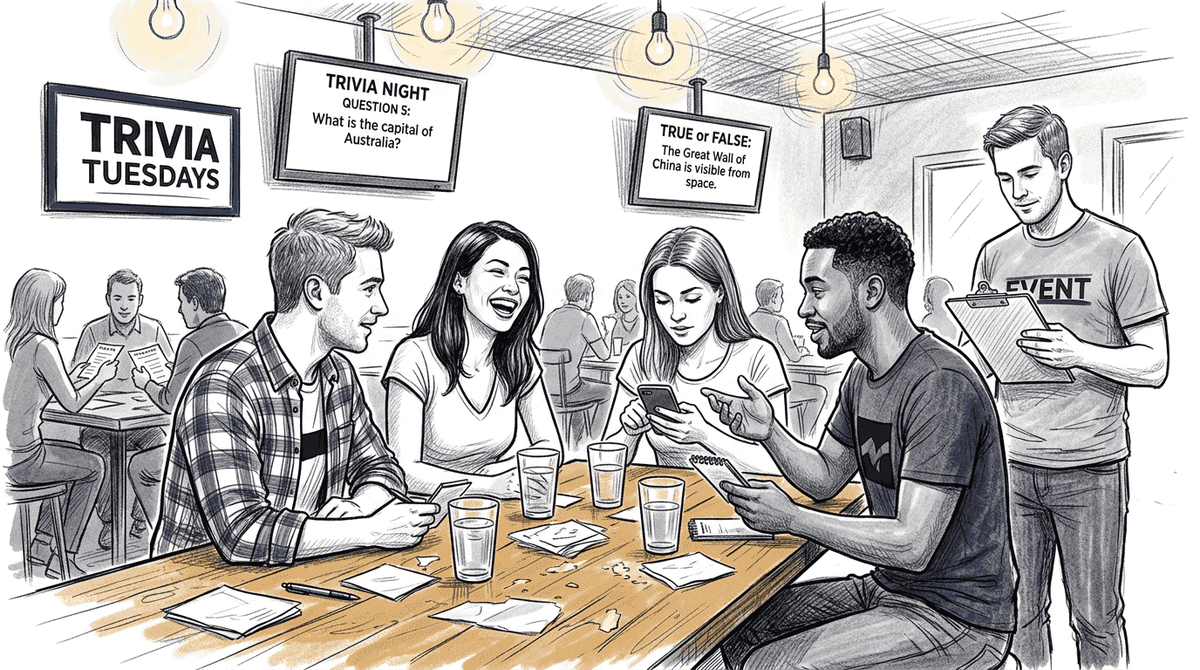
Smartphone-based buzzer systems eliminate the lag time inherent in raising hands or shouting answers. Instant digital response creates gameshow-style tension that keeps energy high throughout the event. This technological advantage makes every question feel urgent and exciting rather than passive and slow.
Customization and branding strengthen venue identity in ways generic trivia cannot match. When questions reference local landmarks, inside jokes about regular customers, or neighborhood history, participants feel personally connected. This localization transforms trivia from generic entertainment into a community event that belongs specifically to your venue.
The mechanics of successful hosting interactive trivia nights include several key elements:
- Clear, visible scoreboards that maintain competitive tension throughout the event
- Varied trivia scoring methods that reward different types of knowledge
- Multimedia questions incorporating audio, images, and video for sensory variety
- Balanced difficulty that challenges experienced players while welcoming newcomers
Pro Tip: Rotate question categories each week to keep content fresh and attract different demographic segments. One week might focus on music trivia, the next on sports, then pop culture, ensuring various customer interests get featured regularly.
These guest engagement psychology principles create events that feel personalized and dynamic rather than repetitive. The combination of social bonding, technological excitement, and customized content builds strong emotional associations between customers and your venue. That emotional connection drives the repeat visits that make trivia nights profitable long-term investments.
Technology advantages: the edge of professional trivia game software
Professional trivia game show software delivers advantages that traditional paper-based formats cannot match. Digital game show software raises perceived event quality while reducing hosting errors. These improvements directly impact customer satisfaction and return rates.
Reliability is critical in bar and restaurant environments. WiFi networks often struggle under the load of 50-plus smartphones connecting simultaneously. Trivia software that runs the game on its servers keeps the board and scores through a reload or a device switch, and a mobile hotspot keeps players online. Your event picks up where it left off after a connectivity hiccup.
Digital formats eliminate manual scoring errors that plague paper trivia. Automatic calculation removes disputes about point totals and speeds up result announcements. This automation lets hosts focus on entertainment and engagement rather than arithmetic and record keeping.
Professional software transforms ordinary trivia into polished game show experiences with animations, sound effects, and visual themes that replicate television production quality, elevating perceived value in customers' minds.
The comparison between traditional and digital approaches reveals stark operational differences:
| Feature | Traditional Paper Trivia | Digital Game Show Software |
|---|---|---|
| Setup time | 45-60 minutes per event | 10-15 minutes per event |
| Scoring accuracy | Prone to manual errors | Automated, error-free |
| Multimedia support | Limited to printed images | Full audio, video, image integration |
| Branding options | Generic printed sheets | Custom logos, colors, themes |
| WiFi dependency | Not required | Needed for players' phones; a backup hotspot helps |
| Participant inclusion | Slower, hand-raising | Instant, smartphone-based |
These technological advantages directly support the engagement mechanics discussed earlier. Faster question delivery maintains energy levels. Multimedia integration creates variety that holds attention. Branded experiences strengthen venue identity and customer loyalty.
Pro Tip: Test your trivia software with a small staff group before the first public event. Familiarity with features like buzzer timing, score adjustments, and multimedia playback prevents awkward pauses during live hosting.
The process of creating trivia events becomes significantly easier with professional trivia software benefits that include ready-made question libraries, customizable templates, and automated workflows. This efficiency lets venue owners focus on promotion and customer service rather than technical logistics.
What most people get wrong: misconceptions about trivia nights
Several persistent myths prevent venue owners from implementing profitable trivia nights. The most common misconception assumes trivia only attracts hardcore knowledge enthusiasts who intimidate casual customers. Reality shows completely different patterns. Successful trivia nights draw diverse demographics including young professionals, date night couples, family groups, and retirees.
Another widespread belief suggests technology alienates less tech-savvy participants. Smartphone-based buzzers actually enhance inclusion by eliminating the physical advantage loud, aggressive players have in shouting-based formats. Quieter team members contribute equally when responses happen digitally. This leveling effect improves group dynamics and retention.
Many venue owners underestimate the importance of customization, assuming generic trivia questions work just as well as localized content. Data proves otherwise. Events incorporating neighborhood references, local sports teams, and venue-specific inside jokes generate significantly higher repeat attendance than generic question sets. Personalization matters enormously.
Key misconceptions about common trivia night myths include:
- Believing trivia requires extensive preparation time when software automates most logistics
- Assuming small venues cannot compete with large establishments, when intimacy often advantages smaller spaces
- Thinking trivia nights cannibalize existing revenue instead of creating entirely new customer visits
- Fearing technology costs exceed benefits, when affordable software delivers immediate ROI
The complexity barrier also gets exaggerated. Modern trivia software handles scoring, timing, and multimedia automatically. Hosts need minimal training to run smooth events. The technical burden is far lighter than most venue owners expect.
Competition concerns also prove unfounded. Multiple venues in the same area can successfully host trivia on different nights, creating a circuit of trivia enthusiasts who visit each location weekly. The market expands rather than fragments when multiple venues participate. Cooperation through varied scheduling benefits everyone.
Comparing formats: traditional paper trivia vs. digital game show software
Choosing between traditional and digital trivia formats significantly impacts operational efficiency and customer experience. The performance gap between approaches continues widening as software capabilities advance. Digital platforms now deliver measurably superior results across virtually every metric venue owners care about.
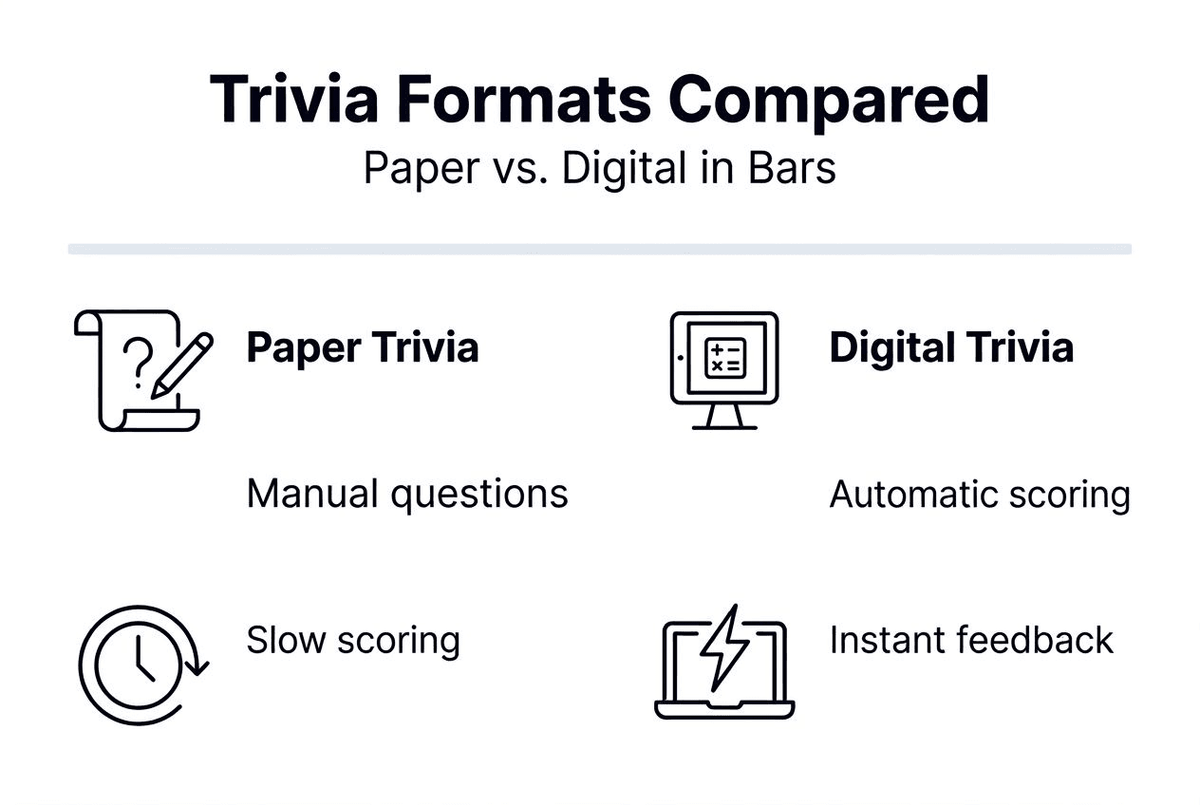
Paper-based trivia requires hosts to manually read questions, track responses, calculate scores, and resolve disputes. These manual processes introduce delays and errors that disrupt event flow. Even experienced hosts struggle to maintain consistent pacing throughout multi-hour events.
Digital software automates these pain points while adding features impossible with paper formats. Instant scoring updates keep competitive tension high. Multimedia questions create sensory variety that text alone cannot match. Customizable branding reinforces venue identity with every displayed question.
The operational differences become especially clear in side-by-side comparison:
| Aspect | Paper Format | Digital Software |
|---|---|---|
| Question delivery speed | Slow, reading-dependent | Instant, visual display |
| Answer collection | Manual, error-prone | Automated, accurate |
| Score disputes | Common, time-consuming | Rare, system-verified |
| Host workload | High, constant attention | Low, software-managed |
| Customer perception | Amateur, informal | Professional, polished |
| Scalability | Limited by manual capacity | Unlimited, software-handled |
The participant experience differs just as dramatically. Paper formats force teams to wait while hosts manually process responses and update scores. Digital systems provide real-time feedback that maintains momentum. This responsiveness keeps energy levels high and prevents the dead air that kills engagement.
Venue owners evaluating trivia formats comparison should consider long-term scalability. Paper trivia hits hard limits on team numbers and question complexity. Software scales effortlessly to accommodate growth, additional locations, or format experimentation. This flexibility protects your investment as your trivia program expands.
Implementing trivia nights: a step-by-step venue owner's guide
Successful trivia night implementation follows a clear sequence that minimizes risk while maximizing impact. Starting with proper planning prevents the common pitfalls that cause many first-time events to underperform. The process breaks down into manageable phases that even busy venue owners can execute effectively.
-
Analyze your weekday traffic patterns to identify which nights need the most help. Tuesday and Wednesday typically see the lowest volume, making them prime candidates for trivia interventions.
-
Select trivia software that runs the game on its servers and offers branding customization. Test the platform thoroughly before committing to ensure it meets your technical requirements and aesthetic preferences.
-
Train your hosting staff on both the software mechanics and entertainment aspects of running engaging events. Technical proficiency matters less than personality and crowd management skills.
-
Develop a multi-channel promotion strategy starting three weeks before your first event. Use social media, email lists, in-venue signage, and partnerships with local businesses to build awareness.
-
Schedule your first event and gather detailed feedback from both participants and staff. Track attendance numbers, revenue per customer, and specific operational challenges.
-
Refine your format based on feedback, adjusting question difficulty, timing, prize structures, and promotional messaging. Continuous improvement drives long-term success.
The starting trivia nights guide emphasizes consistency in scheduling. Customers need predictable event times to build habitual attendance. Changing nights or skipping weeks destroys momentum that takes months to rebuild.
Pro Tip: Create a dedicated trivia night menu with slightly higher margins on popular items. The captive audience during events provides an opportunity to promote profitable food and drink options without seeming pushy.
Common failure points to avoid include underpromotion, inadequate staff training, and relying on venue WiFi without a backup hotspot. Many venues also fail by making questions either too difficult or too easy, alienating large portions of their potential audience. Balance proves essential.
The trivia night workflow should become as routine as opening and closing procedures. Standardized processes ensure consistent quality even when different staff members host. This reliability builds customer trust and simplifies training for new team members.
Discover trivia game show software built for bars and restaurants
Professional trivia game software streamlines hosting while dramatically improving event quality. The right platform eliminates technical headaches that distract from customer engagement. Professional trivia game software runs every game on its servers, so a reload or a device switch does not derail your events.
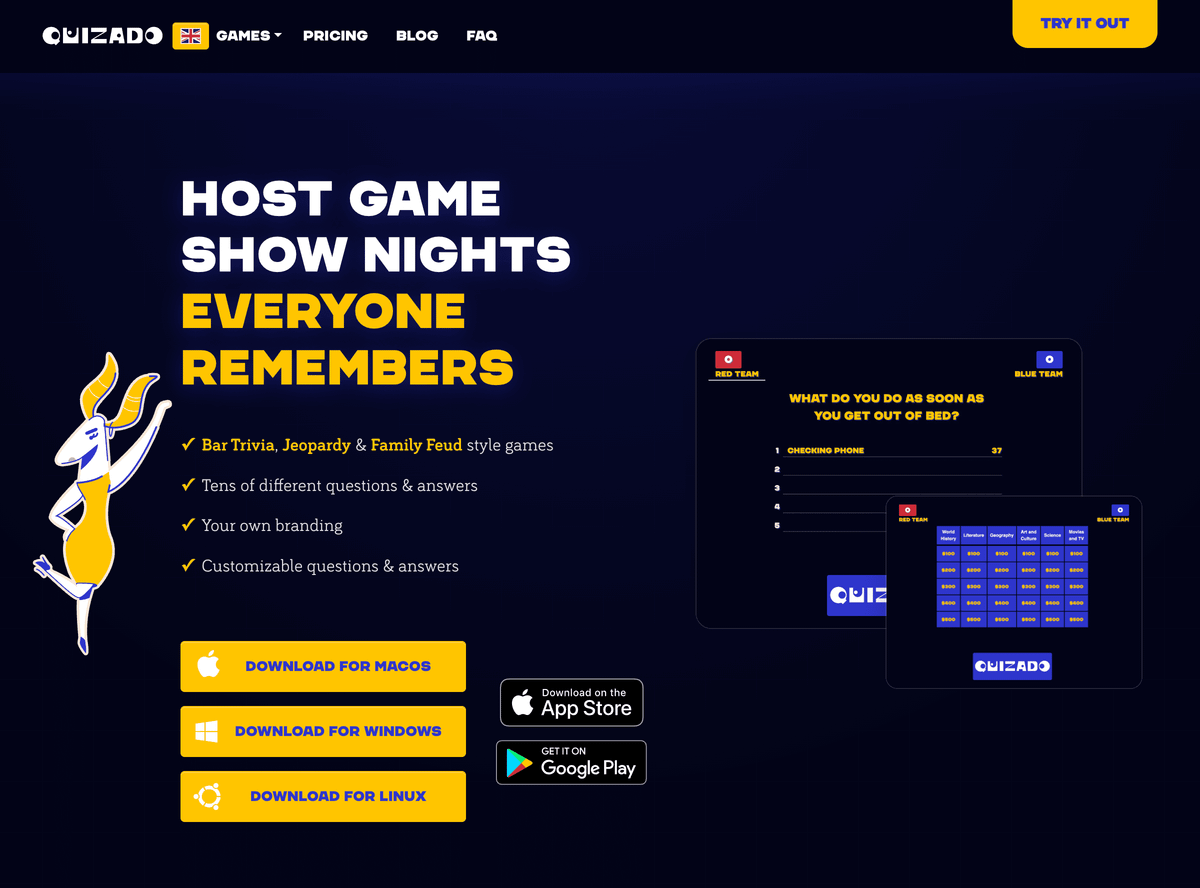
Customization options let you brand every aspect of the trivia experience with your venue's colors, logos, and personality. This branding transforms generic entertainment into signature events that customers associate specifically with your establishment. Ready-made question libraries save hours of preparation time while custom question tools let you add local flavor.
Quizado offers bar and restaurant owners the tools needed to create immersive trivia experiences that engage customers and grow weekday revenue. The platform handles technical complexity automatically, letting you focus on hospitality and entertainment. Try the software to discover how professional game show features can transform your slowest nights into your most profitable.
Frequently asked questions
How much can trivia nights increase my bar's weekday revenue?
Trivia nights can boost weekday revenue, depending on venue size, promotional effort, and execution quality. Engaged customers tend to spend more on food and drinks during trivia events compared to typical visits. These increases compound over time as regular attendance builds.
Do I need reliable WiFi to host digital trivia nights effectively?
Reliable WiFi helps, and players need internet on their phones, so keep a mobile hotspot as backup. Software that runs the game on its servers keeps the board and scores through a reload or a device switch when network quality degrades under heavy smartphone load. This reliability is critical in bar environments where WiFi often struggles.
How can I promote trivia nights to ensure good attendance?
Promote trivia nights at least two weeks in advance using social media posts, email marketing to existing customers, and prominent in-venue signage. Consistent weekly scheduling helps build a loyal audience who blocks out your trivia night as a standing commitment. Word of mouth from satisfied participants becomes your most powerful promotional tool over time.
Run your next trivia night with Quizado
Prepare the rounds, invite players by QR code and show live scores on your venue’s screen.

Bring your group together for a game
Try a free starter game, then choose the format and plan for your group.
Trusted by 5,000+ hosts