15 Effective Team Games for Work Meetings That Build Real Engagement Without Leaving the Office

Key takeaway: The best games for meetings are simple, research-backed activities that boost team engagement, trust, and creativity without feeling forced. Options like trivia with Quizado, emoji guessing, and one-word check-ins are proven to improve communication and collaboration, even in hybrid teams.
Let’s be honest: most “fun” games in meetings aren’t really fun. They’re often forced, awkward, or so irrelevant they make people wish they had just stayed on mute.
But here’s the truth: when done right, a well-placed game can change the energy of a room. It can turn a meeting into a moment that builds trust, sparks creativity, and reminds your team that collaboration doesn’t always have to be serious.
Below are 15 meeting-friendly games your team will actually enjoy, each rooted in real team psychology, simple to run, and surprisingly effective at strengthening engagement. No leaving the office. No downloading awkward PDFs. Just playful, purposeful interaction.
1. Name That Emoji
This clever little game uses emojis to represent phrases your team has to decode, like “📉☕🧟” for “Monday morning zombie.” It’s fast, visual, and encourages lateral thinking in a way that naturally gets people laughing. You can use the emojis to describe a specific person in a team to make it even more engaging and funny.
But it’s more than just fun. A Frontiers in Psychology systematic review found that emojis significantly enhance emotional expression and clarity in digital communication, helping teams connect faster with less ambiguity.
2. Quizado Trivia: Team Edition
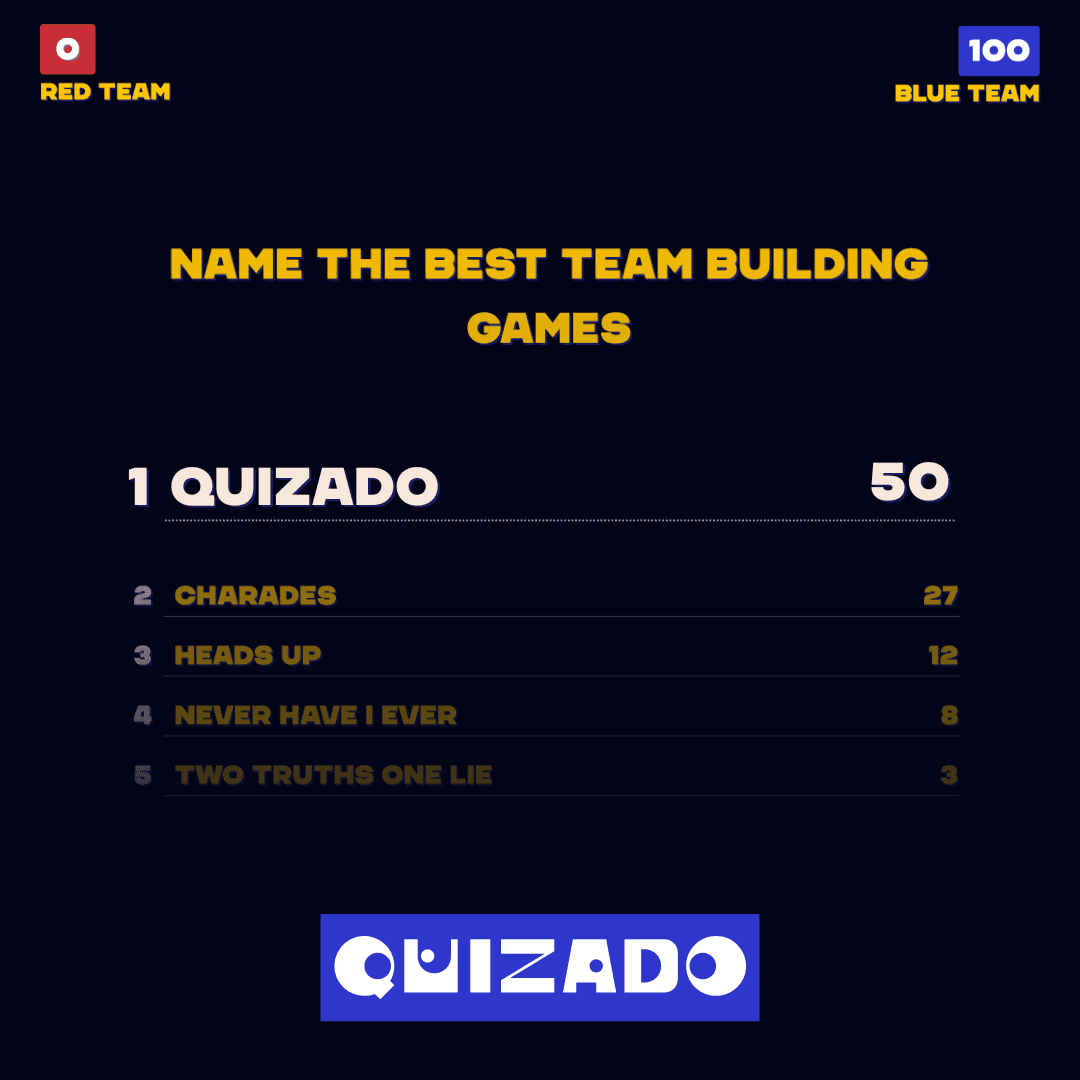
Trivia works because it strikes the perfect balance between competition and collaboration. With Quizado, you can launch custom or ready-made trivia rounds in seconds, covering categories like food, pop culture, or logic puzzles. It’s the ideal break from routine and short enough to keep momentum, yet energizing enough to make everyone sit up straighter.
And science backs it up. A University of Michigan study found that low-stakes group competition increases dopamine and motivation which means your team not only retains more information, but connects more deeply in the process.
3. Guess Who? (Workplace Edition)
Before your meeting, we recommend collecting anonymous “fun facts” from each team member. Then, during the session, reveal each fact one by one and have the group guess who it belongs to. The more surprising or silly, the better.
This exercise encourages curiosity and empathy, two underrated elements of effective teamwork. In a world of Slack handles and job titles, personal stories humanize colleagues and open space for real conversation, especially for teams who haven’t worked together closely yet.
4. Office Scavenger Hunt
With this game, the goal is simple: give your team 60 seconds to find an item on their desk that fits a weird or fun category. Think: “Something older than your manager,” or “An item you’ve never used but won’t throw away.”
It adds motion and humor to meetings, breaking up the monotony without dragging down productivity. Even hybrid teams can join in by sharing photos or describing what they found, making this a low-barrier, high-energy boost for team cohesion.
5. Silent Strategy Game
This activity requires teams to solve a problem. Sort images, build a structure, or sequence steps without speaking. That means no talking, no writing, just reading each other’s body language and intuition.
And there’s a reason it works: research from the MIT Human Dynamics Lab showed that high-performing teams rely more on non-verbal cues and evenly distributed communication than on dominant voices. A game like this reveals those unspoken dynamics and gives quieter team members a space to shine.
6. “Build the Future” LEGO Challenge
Each team is given a pile of LEGO or building blocks and asked to create a structure that represents something abstract, for instance “what teamwork looks like,” or “our company in five years.” Then, they explain their build.
What may seem like play is actually a proven strategic tool. Research published in the Journal of Work-Applied Management found LEGO Serious Play enhances team cohesion, creativity, and even psychological safety in group setting.
7. Debate Club: Hot Takes Edition
Create a list of workplace “hot takes” and ask two volunteers to debate each one in under a minute. Examples include: “All meetings should be emails” or “Dogs in the office are a distraction.”
HBR coverage of Amy Edmondson’s research highlights that high-performing teams share a sense of psychological safety, a belief needed to speak up, take risks, and foster creativity. The brilliance of this activity lies in its mix of lightheartedness and structure. It gives people a space to practice quick thinking and respectful disagreement, which is considered as a key component of psychological safety. And when done right, it often reveals how diverse perspectives can coexist and even enrich a conversation.
8. Quizado Custom Trivia: Company Edition
Want to reinforce your internal culture while having fun? Create a trivia round about your company. Think: past projects, team nicknames, internal memes, or “who said this in Slack?”
It’s a brilliant way to preserve culture, especially in hybrid teams. Quizado’s custom template builder lets you easily design quizzes that reflect your team’s personality. When people see themselves in the content, they engage more deeply and retain more too.
9. Escape Room Lite
You don’t need a budget for a corporate escape room. Just a few printed clues and a narrative will get you started. Tools like Escape Team let you download ready-to-use scenarios that take place in your own meeting room or desk area.
These games simulate real workplace tension: time pressure, cross-functional cooperation, and shared goals. That’s why escape-style puzzles are used by companies like Google and SAP during team development. They test how people think under stress, without real-world consequences.
10. One-Word Check-In or Wrap-Up
At the start or end of a meeting, ask everyone to describe their mood or state of mind in one word. No explanations, just a pulse check.
This might sound simple, but it opens a powerful window into your team’s emotional rhythm. According to a review in the Journal of Occupational Health Psychology highlights that micro-reflection techniques, like one-word check-ins, help reduce stress and improve emotional regulation in teams.
11. Reverse Brainstorm
Flip your next problem-solving session by asking: “How could we make our meetings worse?” You’ll get a chorus of fun revealing the answers. Once the laughs are out, flip the ideas back into positive solutions.
This technique is rooted in lateral thinking, a strategy made popular by Edward de Bono. By exploring the absurd or undesirable, your brain becomes more flexible and more likely to land on creative, viable improvements.
12. Digital Build-Off (City-Builder Games)
Pair up teammates and have them build a fictional city using tools like Townscaper, Cities: Skylines, or Minecraft. Assign themes like “our team culture” or “the perfect workplace,” then share your digital creations.
Far from just play, this approach taps into a type of cooperative learning that’s proven to strengthen connection. A 2021 trial in JMIR Serious Games showed that teams playing cooperative video games scored 20% higher in cohesion and subsequent task productivity compared to non-gaming control groups.
13. “This or That?” Lightning Polls
Create a quick series of binary choices, like “coffee or tea?”, “hybrid or remote?”, “early bird or night owl?,” and run them live through chat or hands-up. These light moments reveal personality, encourage participation, and foster a sense of belonging, especially for introverts or newer hires who may not jump into more intense group discussions.
14. Mood Board: Meme Edition
Ask everyone to bring or submit a meme that represents their current mood. Compile them into a slide deck or share them live and let the GIFs do the talking.
Humor, especially when self-directed, boosts connection and psychological safety. Neuroscience shows that laughter increases oxytocin, a hormone linked to social bonding, meaning meme sharing isn’t just entertaining, it’s neurologically good for teamwork.
15. The “What If” Game
Ask bold, imaginative questions like:
- “What if we only had 2-hour workdays?”
- “What if we ran our team like a restaurant?”
- “What if we were banned from using email for a week?”
These hypotheticals loosen creative muscles and encourage divergent thinking, which is a hallmark of innovative cultures. It’s a favorite tool of design-led companies like IDEO, who use it to open up space for breakthrough thinking without real-world risk.

Final Thoughts: Build Culture, Not Just Agendas
Team meetings don’t have to be dry, silent, or predictable. With the right activity delivered at the right moment, they become something much more powerful: a way to build connection, trust, and momentum.
Whether you use Quizado to run a trivia showdown, challenge your team to build a metaphor in LEGO, or simply invite a one-word check-in, you’re reminding your team that collaboration can be both productive and playful.
Ready to bring this energy into your next meeting? Try Quizado for free and see how easy it is to transform team dynamics.
Run this night with Quizado
Quizado is bar trivia software. Build the rounds, let players join by QR code on their phones, and show live scores on the TV.

Start Hosting Bar Trivia Tonight
Download Quizado free and host your first trivia night tonight!
Trusted by 5,000+ hosts