Corporate Trivia Events: Reliable Play for Team Engagement
Most event planners underestimate trivia, assuming it's just casual fun for happy hours. Research proves otherwise. Trivia stimulates dopamine release through friendly competition, driving measurable improvements in collaboration skills and employee engagement. Corporate trivia events now rank among the most effective team-building activities, particularly when reliable platforms keep the game running. This guide reveals how strategic trivia implementation transforms workplace culture and delivers quantifiable results for corporate teams.
Table of Contents
- Introduction To Trivia In Corporate Events
- Psychological And Social Mechanisms Behind Trivia's Effectiveness
- Benefits Of Trivia For Team Building And Corporate Culture
- Common Misconceptions About Trivia In Corporate Settings
- Comparison Of Trivia And Other Team-Building Activities
- Technology And Software Features Supporting Trivia In Corporate Events
- Practical Implementation Tips For Corporate Trivia Events
- Conclusion: Leveraging Trivia To Enhance Corporate Team Building
- Discover Quizado: Your Partner For Engaging Corporate Trivia
- FAQ
Key Takeaways
| Point | Details |
|---|---|
| Collaboration Boost | Trivia events build collaboration skills through interactive problem-solving. |
| Technology Preference | Planners favor trivia software that keeps the game running through a reload or a device switch. |
| Participation Impact | Customized trivia content encourages more people to take part. |
| Strategic Value | Trivia offers scalable, engaging alternatives to traditional trust exercises. |
| Success Factors | Proper planning and facilitation maximize trivia's team-building effectiveness. |
Introduction to Trivia in Corporate Events
Corporate trivia events engage employees through interactive competition and collaboration, creating structured opportunities for team members to work together outside daily responsibilities. Unlike traditional training sessions, trivia combines entertainment with cognitive challenges that naturally encourage communication and joint problem-solving.
The demand for innovative team-building solutions has accelerated trivia's adoption across industries. Companies seeking alternatives to generic trust falls and ropes courses now turn to trivia because it accommodates diverse team sizes, remote participants, and varying physical abilities. This inclusivity makes trivia particularly valuable for modern workforces spanning multiple locations and demographics.
Trivia's effectiveness stems from fundamental psychological triggers. Competitive elements stimulate dopamine release, heightening focus and motivation. Simultaneously, the cooperative format required for team-based trivia builds social bonds as colleagues collaborate toward shared goals. These dual mechanisms of competition and cooperation create memorable experiences that strengthen workplace relationships.
Successful corporate trivia events require more than random questions. Strategic content selection aligned with company values, appropriate difficulty calibration, and technology that handles varying venue conditions determine whether trivia becomes a forgettable activity or a culture-building cornerstone. Understanding why team activities matter helps planners design events that deliver lasting engagement beyond the event itself.
Psychological and Social Mechanisms Behind Trivia's Effectiveness
The neuroscience behind trivia reveals why it outperforms passive team-building approaches. When participants answer questions correctly or compete for points, their brains release dopamine, a neurotransmitter associated with reward and motivation. This biological response creates positive associations with teamwork and learning, making trivia inherently more engaging than lecture-style activities.
Active cognitive participation distinguishes trivia from spectator experiences. Consider these engagement mechanisms:
- Information Retrieval: Recalling facts activates multiple brain regions, strengthening memory pathways
- Pattern Recognition: Identifying question themes develops analytical thinking
- Time Pressure: Rapid decision-making builds confidence in collaborative problem-solving
- Immediate Feedback: Instant scoring provides clear success metrics that motivate continued participation
Real-time social interaction amplifies these cognitive benefits. When teams huddle to discuss answers, they practice communication skills, negotiate differing opinions, and build trust through shared victories and losses. These micro-interactions accumulate into stronger interpersonal connections that persist after the event concludes.
"Trivia creates psychological safety by framing knowledge gaps as learning opportunities rather than failures. This reframing encourages employees to take intellectual risks in a supportive environment."
The combination of neurological rewards and positive social experiences explains why employees remember trivia events months later while forgetting most conventional training sessions. This memorability translates into sustained improvements in team dynamics, making trivia a strategic investment rather than superficial entertainment. Exploring real team benefits of quiz games provides deeper insights into these lasting impacts.
Benefits of Trivia for Team Building and Corporate Culture
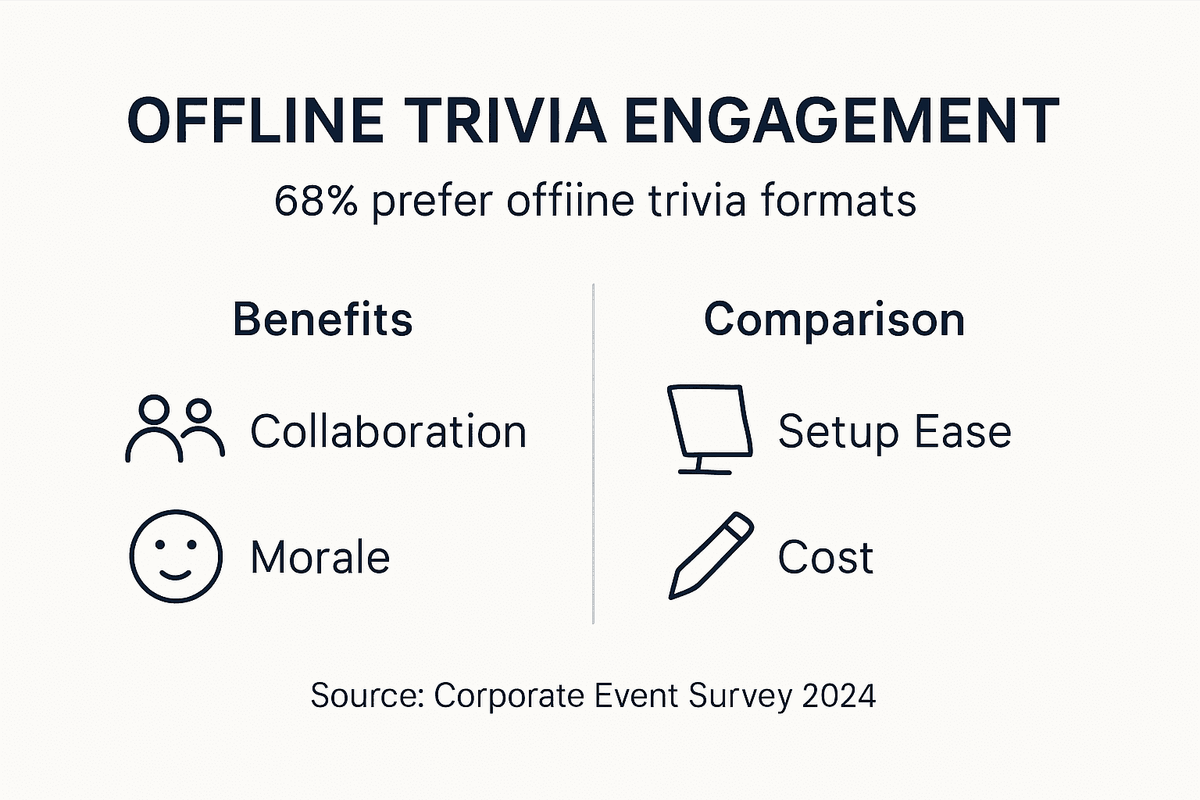
Quantifiable improvements distinguish effective team-building investments from feel-good activities that lack measurable outcomes. Trivia events help build collaboration skills, as teams develop systematic approaches to dividing tasks and leveraging individual expertise during gameplay. These collaboration patterns transfer directly to workplace projects requiring coordinated effort.
Employee engagement and morale receive significant lifts from well-executed trivia programs. Fun, inclusive competitions break monotony and create anticipation for recurring events. Organizations reporting the highest satisfaction scores typically customize trivia content to reflect company milestones, industry-specific knowledge, and employee interests, transforming generic questions into culture-reinforcing experiences.
Customization capabilities separate amateur trivia from strategic corporate tools. Branded question sets that incorporate company history, product knowledge, or values-aligned themes demonstrate organizational investment in employees while reinforcing key messages. This alignment between entertainment and education strengthens corporate culture more effectively than traditional communication methods.
Additional benefits include:
- Cross-Department Connections: Mixed teams from different departments build networks that improve interdepartmental collaboration
- Communication Skills Development: Articulating answers under time pressure enhances clarity and conciseness
- Inclusive Participation: Varied question categories ensure all employees contribute regardless of role or tenure
- Scalable Implementation: Trivia formats adapt equally well to 20-person teams or 200-person gatherings
- Recurring Event Success: Regular trivia nights create tradition and sustained engagement versus one-off activities
Understanding benefits of team-based games in the workplace and why team games matter for corporate settings helps planners maximize these advantages through intentional design choices.
Common Misconceptions About Trivia in Corporate Settings
Skepticism about trivia's professional value persists despite mounting evidence. Addressing these misconceptions directly helps planners build confidence in trivia as a strategic tool.
Misconception 1: Trivia is Just Entertainment Reality reveals trivia's dual function as both engaging and educational. Strategic question design incorporates professional development topics, industry knowledge, and problem-solving scenarios that reinforce workplace competencies. The entertainment wrapper simply makes learning more palatable and memorable than traditional training formats.
Misconception 2: Trivia is Too Simple for Sophisticated Teams This assumption overlooks customization potential. Advanced teams benefit from challenging, research-based questions requiring critical thinking and debate. Difficulty calibration ensures appropriate cognitive engagement for any audience, from entry-level employees to executive leadership teams.
Misconception 3: Technology Requirements are Complicated Modern platforms eliminate technical barriers through intuitive interfaces and games that run on the server. Cross-platform compatibility means participants use familiar smartphones rather than learning specialized equipment.
Pro Tip: Test your chosen trivia platform in the actual venue one week before the event. This advance run identifies potential technical issues and allows time for adjustments, preventing day-of scrambles that undermine participant experience.
Recognizing the purpose of team events clarifies how trivia fulfills strategic objectives rather than serving as mere distraction from work.
Comparison of Trivia and Other Team-Building Activities
Selecting optimal team-building approaches requires understanding relative strengths and limitations across options. This comparison illuminates trivia's competitive advantages.
| Activity Type | Engagement Level | Setup Complexity | Scalability | Customization | Cost Efficiency |
|---|---|---|---|---|---|
| Corporate Trivia | High | Low | Excellent | Extensive | High |
| Trust Falls/Ropes | Medium | High | Poor | Minimal | Medium |
| Virtual Escape Rooms | High | Medium | Good | Moderate | Medium |
| Team Workshops | Low-Medium | Medium | Good | Moderate | Low |
| Sports Events | Medium | High | Poor | Minimal | Low |
Resource and time efficiency favor trivia significantly. Traditional activities like ropes courses require specialized facilities, trained facilitators, and extensive setup time. Trivia runs in standard conference rooms, hotels, or restaurants with minimal advance preparation once content is prepared.
Engagement metrics consistently show trivia outperforming passive activities. While workshops deliver information, trivia's interactive format maintains attention and encourages active participation throughout the event. Virtual escape rooms provide comparable engagement but lack trivia's flexibility for in-person, hybrid, or fully remote implementations.
Trivia's unique advantages include:
- Universal Accessibility: No physical requirements exclude participants
- Instant Adaptability: Question sets swap easily to match audience needs
- Reliability: Games run on the server and survive a reload or a device switch
- Measurable Outcomes: Scoring provides clear performance data
Best use scenarios position trivia ideally for diverse, geographically distributed teams requiring inclusive activities. Organizations with unreliable venue connectivity should test the WiFi and keep a mobile hotspot ready. Learning about team building concepts provides framework for matching activities to organizational goals.
Technology and Software Features Supporting Trivia in Corporate Events
Selecting appropriate technology determines whether trivia events succeed or collapse under technical difficulties. Essential features separate professional platforms from inadequate alternatives.
Reliability tops the priority list. Conference centers, hotels, and retreat venues frequently suffer from overloaded WiFi networks incapable of supporting dozens of simultaneous connections. Software that runs the game on its servers, plus a mobile hotspot as backup, keeps gameplay going when the venue network struggles. This reliability prevents the embarrassing delays and frustrated participants that plague internet-dependent platforms.
Critical platform features include:
- Customizable Branding: Upload company logos and select visual themes matching corporate identity
- Flexible Content Libraries: Access pre-made question sets plus tools for creating custom content
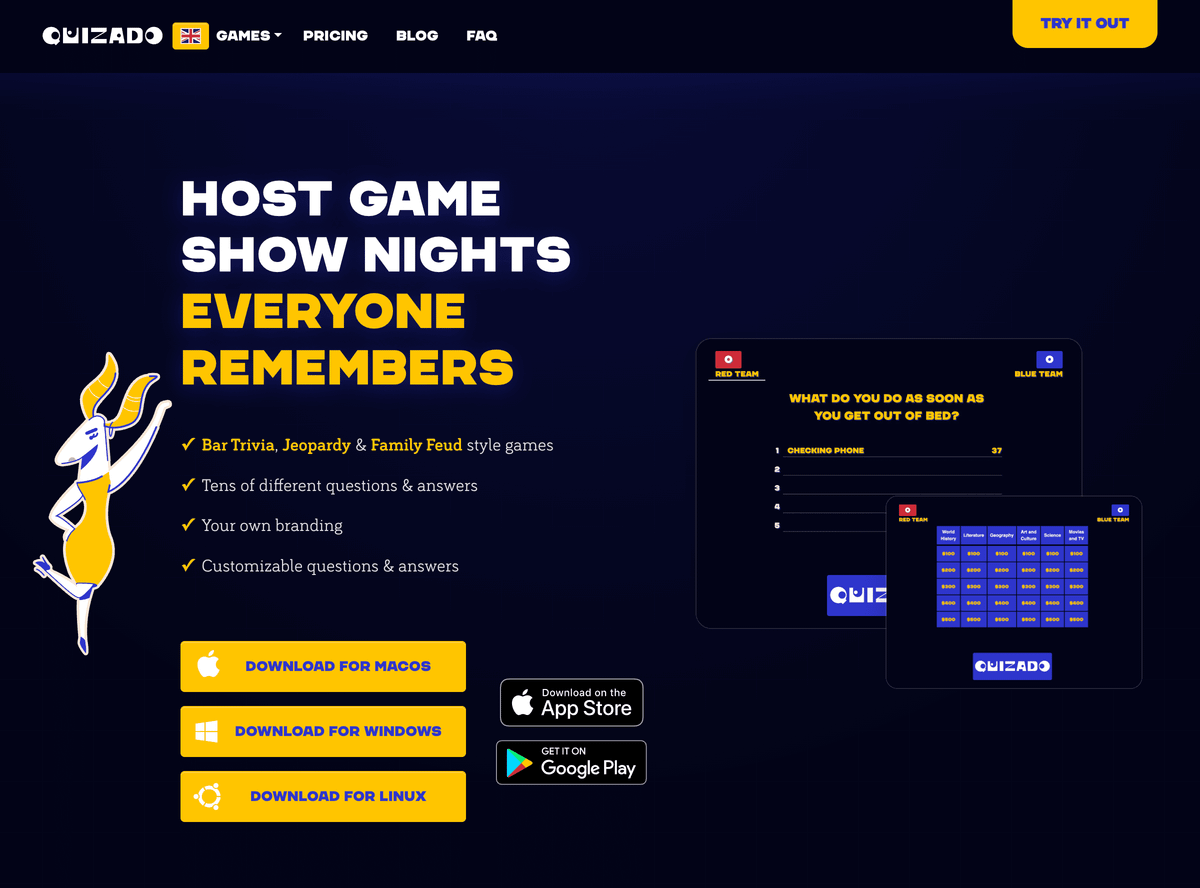
- Multi-Platform Support: Run on macOS, Windows, Linux, Android, and iOS without compatibility issues
- Smartphone Integration: Participants use personal devices as buzzers and controllers
- Scalable Team Configuration: Adjust team sizes and quantities to match event scope
- Separate Host Controls: Dedicated interface for facilitators independent from participant displays
User-friendly interfaces benefit both hosts and participants. Hosts need intuitive controls for managing game flow, adjusting scores, and handling technical questions. Participants require clear displays and responsive input methods that work reliably under time pressure.
Pro Tip: Schedule a full rehearsal with volunteer participants three days before your event. This practice run reveals interface confusion points and allows time to create supplementary instructions or adjust settings for smoother actual gameplay.
Exploring how to run team quizzes effectively and embracing emerging technologies helps planners leverage these features strategically.
Practical Implementation Tips for Corporate Trivia Events
Successful trivia execution follows systematic planning that addresses content, logistics, and facilitation.
-
Assess Objectives: Define specific goals such as improving cross-department relationships or reinforcing product knowledge. Clear objectives guide content selection and success measurement.
-
Customize Content: Develop questions reflecting company culture, industry context, and employee interests. Mix difficulty levels to maintain engagement across knowledge ranges. Include 30% company-specific questions, 40% industry topics, and 30% general knowledge for balanced appeal.
-
Form Balanced Teams: Create mixed groups combining departments, seniority levels, and tenure. This diversity promotes network building and prevents dominant players from overwhelming quieter participants.
-
Establish Clear Rules: Communicate scoring systems, time limits, and collaboration guidelines before starting. Ambiguity breeds frustration and disputes that undermine engagement.
-
Facilitate Dynamically: Maintain energy through enthusiastic hosting, timely pacing, and celebratory recognition of both correct answers and creative attempts. Insert brief breaks between rounds to prevent fatigue.
-
Gather Feedback: Distribute post-event surveys measuring enjoyment, perceived value, and suggestions for improvement. This data informs future iterations and demonstrates responsiveness to employee input.
-
Measure Collaboration Impact: Assess team interaction quality through observation or follow-up assessments examining whether improved communication patterns persist in workplace settings.
Pro Tip: Incorporate a "lightning round" featuring rapid-fire questions in the final segment. This format change energizes participants and creates memorable closing excitement that leaves positive lasting impressions.
Reviewing corporate event game examples provides additional implementation insights and format variations.
Conclusion: Leveraging Trivia to Enhance Corporate Team Building
Trivia transforms from casual entertainment into strategic team-building when implemented with clear objectives, appropriate technology, and thoughtful facilitation. The measurable collaboration improvements, enhanced engagement, and culture-reinforcing customization capabilities position trivia as a superior alternative to traditional activities that fail to capture employee attention or deliver quantifiable results.
Specialized platforms offering reliable server-run games, extensive customization, and user-friendly interfaces eliminate technical barriers that previously limited trivia's corporate applications. Organizations prioritizing consistent, scalable, and inclusive team-building programs find trivia uniquely suited to meeting diverse workforce needs across various settings and formats.
Event planners seeking memorable, effective team-building experiences should embrace trivia's proven benefits. The combination of neurological engagement, social connection, and strategic content alignment creates lasting impacts that extend well beyond the event itself, strengthening workplace relationships and organizational culture through structured, enjoyable collaboration.
Discover Quizado: Your Partner for Engaging Corporate Trivia
Quizado delivers the professional trivia platform corporate event planners need for seamless, impactful team-building experiences. Our software runs every game on its servers, so a reload or a device switch keeps the event going, while extensive customization options align perfectly with your brand identity and cultural objectives.
Explore comprehensive resources on running team quizzes effectively and discover why team games matter for corporate success. Compare platforms through our detailed interactive game show platforms comparison to see how Quizado's features exceed alternatives. Visit Quizado today to transform your corporate events into engagement-driving experiences that teams remember and value.
FAQ
What are the key advantages of using trivia for corporate team building?
Trivia builds collaboration skills through interactive problem-solving that requires team members to pool knowledge and coordinate responses. The activity enhances employee engagement and morale by providing fun, inclusive competition that accommodates diverse skill sets and creates positive shared experiences.
How can trivia be customized to fit different corporate cultures?
Trivia questions adapt easily to reflect company-specific themes, industry knowledge, historical milestones, and values-aligned content. Customization can increase participation because employees find personalized content more relevant and engaging than generic questions.
What technology features are most important for smooth trivia events?
Quizado runs every game on its servers, so a reload or a device switch does not stop the event, and Family Feud and Jeopardy can continue offline in the desktop and mobile apps if the connection drops. User-friendly interfaces simplify hosting and participant experience, while branding options support visual alignment with corporate identity.
How can I measure the success of a trivia-based corporate event?
Use pre and post-event surveys to gauge employee engagement, satisfaction, and perceived value of the experience. Assess improvements in team collaboration through direct observation of workplace interactions or structured feedback sessions. Track participation rates and employee requests for recurring trivia events as indicators of program success and cultural impact.
Why do teams prefer trivia over traditional team-building activities?
Trivia offers inclusive participation requiring no special physical abilities or outdoor conditions that exclude employees. The scalable format adapts easily from small teams to large gatherings while maintaining consistent engagement quality. Immediate scoring and competitive elements create excitement that passive workshops and trust exercises fail to generate.
Recommended
Turn these ideas into a team event
Prepare an office quiz or remote game with a shared screen, phone participation and a host on your team.

Bring your group together for a game
Try a free starter game, then choose the format and plan for your group.
Trusted by 5,000+ hosts